
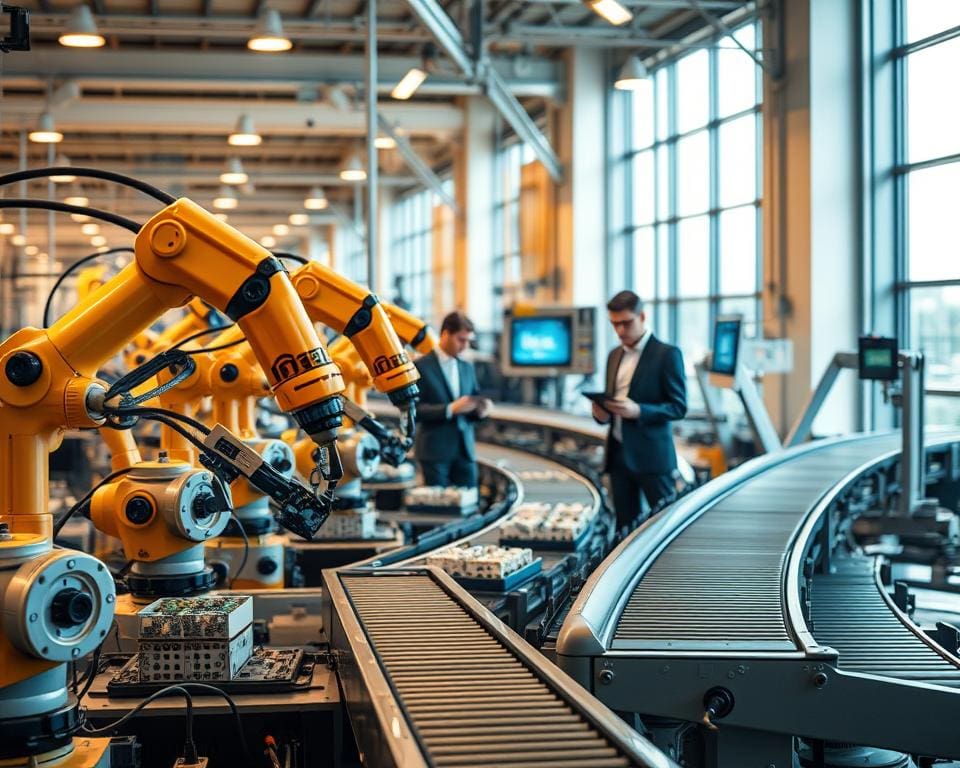
Across the United Kingdom, manufacturers are turning to technology to streamline production lines and lift competitiveness. Integrating hardware, software and connectivity reduces cycle times, cuts defects and improves production efficiency on the shopfloor.
Real-world adopters report measurable industrial automation benefits. Systems from Siemens, ABB, Rockwell Automation and Schneider Electric, alongside UK specialists such as Renishaw and Fanuc, have helped firms achieve 20–50% reductions in manual handling and single-digit percentage gains in yield in pilot projects.
Typical deployments begin with a pilot or proof of concept, move to scaled roll-out and include operator training and continuous improvement. Assessments in this product-review style piece weigh production line automation not just by throughput but by ease of integration, vendor support, total cost of ownership and realistic ROI timelines for smart manufacturing UK.
This article will show how smart systems support field work and streamline production lines, using practical examples and vendor comparisons to guide British manufacturers toward faster, cleaner and more resilient operations.
How do smart systems support field work?
Smart systems bring clarity to operations on the shop floor, in maintenance bays and across logistics routes. They feed teams with timely intelligence, cut travel time and let engineers act with confidence from any location. These gains answer the practical question: How do smart systems support field work?
Real-time data collection and remote monitoring
Sensors for vibration, temperature, current and acoustic signatures form the front line of visibility. Data from PLCs and SCADA systems flows via secure protocols such as MQTT and OPC UA into platforms like Microsoft Azure IoT, Siemens MindSphere and PTC ThingWorx.
Engineers view live KPIs on dashboards, spot anomalies and triage faults without travelling to site. This level of real-time monitoring manufacturing reduces response time and supports continuous oversight around the clock.
Predictive maintenance to reduce downtime
Machine-learning models, vibration signature analysis and trend-based thresholds estimate remaining useful life. Tools from IBM Maximo and GE Predix help forecast failures before they occur. Rolling predictive programmes have a track record of cutting unplanned outages and lowering repair costs.
These systems integrate with maintenance workflows and safety rules to meet regulatory duties such as PUWER in the UK. That alignment keeps assets productive and compliant while extending service life.
Mobile interfaces and worker empowerment
Mobile maintenance apps and field worker IoT tools put instructions, checklists and AR overlays into technicians’ hands. Tablets, intrinsically safe PDAs and apps from PTC Vuforia and Honeywell connect work orders, photos and signatures to the maintenance record.
Faster fault resolution, fewer skill barriers and better audit trails follow. Where connectivity is patchy, private LTE, mesh networks and edge caching keep mobile apps responsive and data reliable.
Automation technologies that increase throughput and quality
Manufacturers in the United Kingdom are adopting automation technologies UK to lift output while keeping a close eye on production quality control. This section reviews core solutions from a product-review stance: capability, flexibility, safety and ease of deployment. Short, practical comparisons help procurement teams and engineers choose the right path for their floor.
Robotics and collaborative robots
Traditional industrial robots from Fanuc, ABB and KUKA excel in high‑speed welding, palletising and machine tending where payload and reach matter. These systems deliver tight repeatability for long production runs.
Collaborative robots from Universal Robots and Doosan Robotics lower the barrier to entry for smaller firms. Cobots for SMEs offer simpler programming, quick redeployment and built‑in safety features that reduce guarding needs. For operations with mixed tasks, cobots enable flexible cell layouts and faster changeovers without sacrificing consistency in robotics in manufacturing.
- Payload and reach: choose industrial arms for heavy, long‑reach jobs.
- Programming model: pick cobots when ease of use and redeployment matter.
- Safety: assess collaborative features to cut downtime from guarding.
Automated guided vehicles and material handling
AGV systems and AMRs from MiR, KION and Seegrid speed internal logistics and reduce manual lifts that cause injuries. Navigation methods vary: SLAM, lidar or QR codes each suit different layouts and change rates.
Fleet management software controls routes, prioritises jobs and links to warehouse management systems. This reduces idle time between workstations and shortens cycle times for busy lines.
- Navigation: SLAM and lidar for flexible factories, QR for stable routes.
- Scalability: choose platforms that grow with production demands.
- Integration: ensure WMS and MES links for smooth material flow.
Machine vision for inspection and quality assurance
High‑resolution cameras, multispectral imaging and deep‑learning classifiers outpace manual checks for surface defects, measurement drift and assembly faults. Vendors such as Cognex and Keyence supply turnkey units, while open‑source frameworks let teams prototype bespoke solutions.
Successful machine vision inspection hinges on lighting, camera placement and training datasets. Address false positives early and connect vision systems to rejection or repair mechanisms for instant remediation. This tight loop boosts overall production quality control and reduces downstream scrap.
For crop and land management parallels, modern automation blends robotics with remote sensing and IoT. Practical examples and smart tools are summarised in this article on precision tools for weeding: smart weeding technologies.
Industrial Internet of Things (IIoT) and connectivity
The fabric that links machines, people and data defines modern factories. In the IIoT UK landscape, clear choices about sensors, gateways and processing shape safety, uptime and competitive edge. A careful mix of local and cloud resources gives teams the tools they need for fast action and long-term insight.
Sensors, gateways and secure data transmission
Condition-monitoring, flow, pressure and proximity sensors collect the signals that drive decision-making. Industrial sensors gateways bridge operational technology and IT, supporting Modbus, PROFINET and OPC UA interoperability to move data reliably into higher-level systems.
Secure IIoT protocols are essential when telemetry crosses networks. Use VPNs, TLS and private APNs for cellular links. Adopt the National Cyber Security Centre guidance on network segmentation, asset inventories and regular patching to reduce exposure and protect intellectual property.
Field teams can read more about how smart sensors improve machine safety and efficiency at smart sensor case studies.
Edge computing versus cloud processing
Edge computing manufacturing deployments handle low-latency tasks near the equipment. Devices from HPE Edgeline, Dell EMC or Siemens Industrial Edge can host real-time control, safety interlocks and fast anomaly detection on site.
Cloud platforms such as AWS, Azure and Google Cloud scale heavy analytics, long-term storage and model training. A PLC plus edge node keeps motion control local while the cloud holds historical datasets for predictive models.
Hybrid architectures balance latency, resilience and data sovereignty. In the UK, sensitive data can remain on-premises while aggregated insights move to cloud services for advanced analytics.
Interoperability standards and factory integration
Standards such as OPC UA, MQTT and ISA-95 enable systems to exchange context-rich data. Open APIs and middleware help connect MES, ERP and PLM suites without brittle point-to-point links.
Legacy machines pose integration challenges through bespoke protocols and varied data schemas. Practical approaches include protocol converters, edge adapters and phased refits to avoid disruptive rip-and-replace projects.
Adopting common formats and incremental integration lets manufacturers unlock automation, reduce downtime and improve maintenance planning while retaining existing asset value.
Software solutions that transform production management
Software now sits at the heart of modern factories. It links machines, people and planning to raise output and quality. The right stack brings together MES UK capabilities, seamless ERP integration manufacturing and live visual tools to help teams act fast.
Manufacturing Execution Systems coordinate work orders, traceability, quality checks and resource allocation on the shopfloor. Leading platforms such as Siemens Opcenter and Rockwell FactoryTalk support industry workflows and compliance for regulated sectors like food and pharmaceuticals. When paired with ERP suites such as SAP, Oracle NetSuite or Microsoft Dynamics, MES modules keep demand planning, inventory and finance synchronised for smoother production.
Selection should favour configurability, vendor support and clear audit trails. These criteria help UK manufacturers get the most from MES UK investments and ensure traceability across complex supply chains.
Digital twins create live replicas of assets or whole processes. Tools from ANSYS, Siemens Xcelerator and Dassault Systèmes enable what-if studies, capacity planning and predictive testing. A robust digital twin simulation speeds commissioning, shortens line changeovers and reveals bottlenecks before they affect output.
Engineers use scenario playbooks to test throughput under different demand profiles. That approach reduces risk and shortens time to optimal performance.
Analytics and dashboards turn raw data into actionable insight. Production analytics dashboards tailored for operators, supervisors and directors surface KPIs such as Overall Equipment Effectiveness, first-pass yield, cycle time and root causes of downtime. Embedded analytics in MES and IIoT suites pair with BI tools like Power BI and Tableau to deliver role-specific views.
Good dashboard design uses real-time alerts, drill-down paths, mobile access and contextual recommendations for corrective action. Clear KPI visualisation manufacturing helps teams focus on the few measures that move performance, not a flood of numbers.
- Link MES functions to ERP integration manufacturing for accurate planning.
- Use digital twin simulation to reduce commissioning and test scenarios safely.
- Design production analytics dashboards with role-based KPIs and mobile access.
Workforce adaptation, safety and sustainability benefits
Adopting smart systems reshapes roles rather than erases them. UK manufacturers should prioritise workforce adaptation automation through targeted reskilling manufacturing workforce programmes. Practical routes include apprenticeships, Institute for Apprenticeships & Technical Education-aligned training, supplier-led workshops and accessible online courses. Technicians can move into system supervision, quality engineers can focus on analytics, and operators can take on higher-value tasks that require judgment and adaptability.
Automation also strengthens manufacturing safety UK by removing people from hazardous tasks and improving lockout/tagout procedures. Modern equipment incorporates automation safety standards such as safety-rated sensors, light curtains and safety PLCs, and aligns with PUWER and ISO 45001 guidance. Real-time alarms and smart monitoring make incident prevention more reliable and give safety teams clearer, auditable records.
Sustainable production technologies deliver measurable environmental gains. Energy monitoring, variable-speed drives and better process control reduce energy per unit, while improved inspection cuts scrap rates and optimises packaging. Internal logistics that use automated guided vehicles lower transport emissions across sites. These improvements support corporate sustainability targets and ease regulatory reporting in the UK.
For procurement and product review, evaluate solutions on technical merit, vendor ecosystem, ROI, workforce impact and sustainability outcomes. Start with pilot projects that use clear success metrics, adopt phased roll-outs and secure supplier service agreements to protect long-term value. This balanced approach helps manufacturers achieve safety, sustainability and productive workforce adaptation automation at scale.