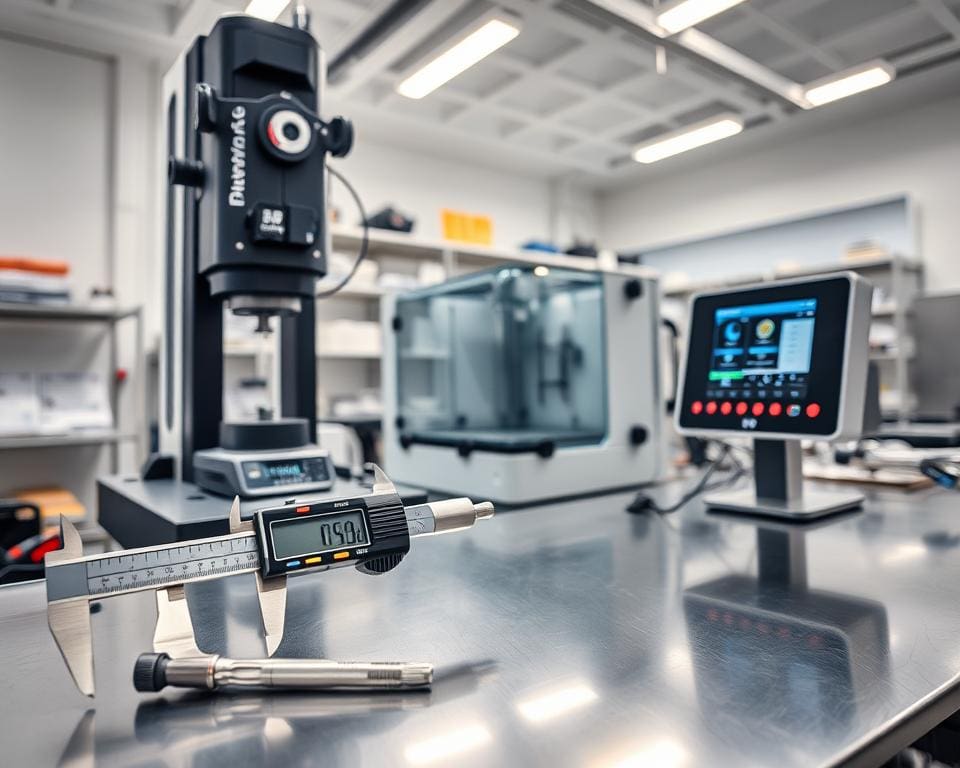
Quality control devices sit at the heart of reliable manufacturing. This short guide frames a product‑review style look at QA instruments, inspection equipment and QC tools used across UK industries such as automotive, aerospace, medical devices, electronics and precision engineering.
We cover handheld tools, benchtop instruments, laboratory‑grade systems, inline automated inspection and non‑destructive testing (NDT), plus the digital inspection ecosystems that tie them together. Readers will see how manufacturing inspection devices and quality assurance instruments support repeatable measurements and faster decision making on the factory floor.
The article has a dual focus: the technical devices that enable quality control and the careers that design and specify them. It will help hiring managers, design engineers, quality engineers, test engineers and graduates compare metrology equipment UK options and understand what to ask for when specifying new systems.
Expect comparative evaluations of device types and typical manufacturers such as Mitutoyo, Hexagon, ZEISS, Nikon Metrology, Olympus, Keysight Technologies, Fluke, GE and Teledyne. Decision factors include accuracy, repeatability, throughput, cost of ownership and integration capability with CAD and lab software.
Readers will also find a practical methodology: device categories mapped to use cases, typical specifications to watch (resolution, repeatability, throughput) and notes on connectivity and data systems that boost the value of QC tools. For further context on how technicians ensure consistent results in large installations, see this practical overview at how technicians ensure quality in large.
The tone is inspirational: the right device and the right technical design career can transform product reliability, safety and competitiveness. This introduction sets the scene for deeper reviews of metrology equipment UK and manufacturing inspection devices that follow.
Overview of quality control devices and their role in manufacturing
Quality control devices shape how manufacturers meet standards and build trust. Clear definitions help teams set inspection objectives and choose the right tools for each stage of production.
Defining quality control and inspection objectives
Quality control (QC) targets defect detection and ensures products meet specifications. Quality assurance (QA) focuses on systems and processes to prevent defects. Inspection sits between these functions, verifying parts, assemblies and final products against set criteria.
Common inspection objectives include dimensional conformity, material verification, surface finish, assembly checks and functional testing for safety compliance with CE, UKCA and ISO 9001. Typical KPIs are first-pass yield, defect per million opportunities (DPMO), Cp/Cpk and measurement system analysis such as gauge R&R.
How devices integrate into production lines and testing labs
Integration models vary by need. Handheld tools suit spot-checking while benchtop equipment supports first-article inspection and failure analysis. Inline and at-line systems enable production line inspection at 100% throughput. End-of-line testers confirm function before shipment.
Physical integration can include mounting on conveyors, robot cells, safety enclosures and connection to industrial PCs or PLCs. Common communication standards are Ethernet/IP, PROFINET, Modbus and OPC UA. Examples show the point:
- Automotive panel checks using 3D laser scanners.
- Electronics PCB inspection with automated optical inspection (AOI) machines.
- Medical device dimensional verification using coordinate measuring machines (CMMs).
Benefits of automating inspection: accuracy, speed and traceability
Automated inspection benefits include consistent measurements, greater throughput and reduced operator variability. Systems can reveal features that manual checks miss and speed time-to-market.
Traceability in manufacturing improves when automated systems log data to central databases and link results to batch or serial numbers. This capability supports audits, regulatory reporting and robust manufacturing QA UK practices.
Cost-benefit analysis must weigh capital outlay against fewer recalls, lower scrap and faster delivery. Real-world gains include AOI reducing solder defects and inline vision catching paint flaws. Limitations exist: maintenance needs, skilled staff and the risk of over-reliance without regular validation and calibration.
What careers focus on technical design?
Technical design roles sit where creativity meets measurable performance. Professionals in these jobs shape products so they can be made, tested and inspected with confidence. This blend of design and quality control opens varied pathways across UK industry.
Roles that bridge product design and quality assurance
Design engineers take concept sketches through CAD models to production-ready drawings. They add tolerances, choose materials and make decisions that ease assembly and testing. Quality engineers define inspection plans, run measurement system analysis and work with suppliers to keep standards high. Test engineers write validation protocols, build automated rigs and verify that products meet specification.
Other titles include process engineers, production engineers, inspection technicians, metrology engineers and NDT specialists. These roles collaborate with procurement, manufacturing and compliance teams to meet sector needs. In aerospace, systems engineers and quality assurance engineers coordinate to satisfy regulatory traceability. In medical devices, design verification and validation engineers align with QA for MHRA and ISO 13485 compliance.
Skills employers seek: CAD, metrology, and systems thinking
Employers value hands-on CAD experience with SolidWorks, Siemens NX or Creo and a firm grasp of GD&T. Competence with metrology tools, CMM programming and inspection software such as PC-DMIS strengthens a candidate’s profile.
Test and measurement skills matter too. Familiarity with sensors, oscilloscopes, data acquisition systems and environmental chambers helps when defining test engineer responsibilities. Digital skills like PLCs, Python scripting, MATLAB and SPC boost analytical capability and reporting.
Soft skills are crucial. Systems thinking, root-cause analysis methods such as 5 Whys and Ishikawa, project management and clear communication enable teams to translate design intent into measurable checks. These quality engineer skills make the difference between a good design and a producible one.
Typical career paths: design engineer, quality engineer, and test engineer
Design engineer jobs start with product conception and detailed modelling, then progress to senior designer, lead engineer or engineering manager roles. Quality engineers focus on inspection plans, MSA and SPC before moving to quality manager or head of quality positions. Test engineers develop and automate tests, then advance to principal test engineer, test manager or systems verification lead.
Entry routes include degrees in mechanical, electronic, aerospace or manufacturing engineering, apprenticeships and HNDs. Professional registration via the Engineering Council and industry certificates from CQI/IRCA, ASQ or BINDT add credibility. The Midlands, North West and South West offer advanced manufacturing and aerospace opportunities, while electronics work clusters in the South East.
For those exploring pathways into tech design, resources on how to get started can guide early steps and career decisions. what careers focus on technical design remains a practical query for anyone mapping long-term growth.
Common handheld and portable quality control instruments
Portable metrology empowers inspectors and engineers to take reliable measurements outside the lab. Handheld QC instruments cover basic dimensional checks through to alloy verification. Choose tools that match the task, the environment and your traceability needs.
Calipers, micrometres and portable thickness gauges
Vernier and digital calipers handle external, internal and step measurements with ease. Outside and inside micrometres, in both mechanical and digital forms, give higher resolution for critical features. Depth gauges and small bench stands extend capability for repeatable depth readings.
Ultrasonic thickness gauges measure wall or coating thickness on pipes and welds where access is limited. Coating thickness gauges use magnetic induction or eddy current principles to check paint or plating. Key specs to weigh include resolution (0.01mm or 0.001mm), measurement range, IP rating for shop-floor use, battery life and calibration traceability.
Trusted brands such as Mitutoyo, Starrett, TESA and Brown & Sharpe offer instruments designed for rugged field use and documented accuracy, which helps with compliance and audit trails.
Hardness testers and portable spectrometers
Portable hardness testers include Leeb rebound units, portable Rockwell rigs and Shore durometers for polymers. These devices help verify heat treatment, surface hardening and wear resistance with minimal set-up.
Portable spectrometers for material analysis range from handheld X-ray fluorescence (XRF) analysers to optical emission spectrometers (OES). XRF units such as the Olympus Vanta and Bruker S1 TITAN enable rapid positive material identification. OES instruments, including Thermo Scientific Niton models, provide finer alloy quantification when required.
When selecting a portable spectrometer consider safety and licensing for XRF use, detection limits, sample preparation and certification for regulated industries. These factors determine suitability for inspection and compliance tasks.
When to choose handheld tools versus benchtop systems
Handheld instruments excel for spot checks, field service and in-situ inspections of large assemblies or installed equipment. They suit lower capital budgets and situations that demand quick, mobile measurements.
Benchtop or laboratory systems are preferable when you need the highest accuracy, fixture-based repeatability or extensive statistical reporting. Systems such as laboratory CMMs and optical comparators integrate with metrology software for detailed analysis and traceable results.
The trade-off is clear: handheld tools offer flexibility and speed at lower cost but bring greater variability and reduced resolution. Benchtop solutions deliver consistent, high-accuracy data and stronger integration for quality programmes. Use an inspection tool comparison UK approach to map device capability to inspection objectives and budget, ensuring the right balance between mobility and precision.
Advanced laboratory and inline inspection equipment
Modern factories and test labs rely on advanced inspection equipment to ensure parts meet specification and performance goals. These systems bridge the gap between design intent and finished product, offering fast, repeatable checks that support quality culture across production lines in the UK.
Coordinate measuring machines (CMM) and optical comparators
CMMs deliver micron-level dimensional measurement using touch probes or scanning sensors. Bridge, gantry and portable arm models from Hexagon, Zeiss and Mitutoyo cover shopfloor and metrology-lab needs. Software such as PC-DMIS and Verisurf streamlines programming for first article inspection, reverse engineering and part validation.
Optical comparators and digital profile projectors offer non-contact measurement for delicate or transparent parts. Nikon Metrology and Keyence provide tailored systems that reduce risk of damage while measuring form and feature relationships.
Accuracy depends on fixturing and environmental control. Stable temperature, vibration isolation and proper workholding are essential to extract the promise of these instruments.
X-ray, CT scanning and non-destructive testing (NDT) devices
Industrial X-ray radiography reveals internal features with 2D clarity. CT scanning NDT builds three-dimensional views to expose porosity, voids and assembly faults. Suppliers such as Nikon Metrology, Yxlon (Comet) and GE Inspection Technologies equip labs for castings, electronics and complex assemblies.
Other NDT methods include phased array ultrasonic testing for layered structures, eddy current for surface and subsurface cracks, and dye penetrant or magnetic particle checks for surface defects. Each technique addresses a specific failure mode without harming the part.
Regulatory compliance matters when using ionising sources. Shielding, licensing and operator certification align practice with BS and ISO standards while protecting staff and environment.
Vision systems and automated optical inspection (AOI) for electronics
Machine vision combines cameras, optics and lighting with image-processing software to detect dimensional, surface and assembly faults. AOI systems are critical in PCB fabrication to inspect solder joints, component placement and polarity after reflow.
High-resolution cameras, telecentric lenses and structured light projectors raise detection capability for complex geometries. Vendors such as Cognex, Keyence, Mirtec and Omron supply hardware and algorithms tuned to production speeds.
Inline inspection UK installations often position AOI systems immediately after soldering to catch defects early. Performance hinges on resolution, field of view and lighting control, plus skilled vision engineers who tune algorithms to reduce false positives.
Data, software and connectivity that enhance device capability
Metrology software and QC software turn raw measurements into insight. Tools such as PC-DMIS, Verisurf, Mitutoyo MeasLink and Zeiss CALYPSO are common in UK factories, while proprietary AOI vision packages add specialised routines. These systems automate reporting, feed inspection data management platforms and reduce manual transcription errors.
Statistical process control and SPC software link measurement trends to action. Solutions like Minitab and InfinityQS, or QMS modules inside ERP and MES, trigger alerts for drifting processes and record non-conformances. Test automation using LabVIEW, Python scripts and vendor APIs keeps cycles repeatable and integrates instrument control with inspection workflows.
Connectivity standards are the backbone of Industry 4.0 inspection connectivity. OPC UA provides secure interoperability across equipment, while MQTT and field buses such as EtherNet/IP and PROFINET carry telemetry. Edge computing pre-processes scans on the shop floor; cloud platforms preserve audit trails and enable digital twins for predictive maintenance and virtual inspection.
Data integrity, interoperability with CAD and people skills determine success. Role-based access, audit trails and UK data‑protection best practice protect records. Automatic CAD transfer of GD&T into inspection programmes saves programming time. Finally, evaluate licensing, validation and support through pilots and UK case studies before full deployment to manage total cost of ownership.