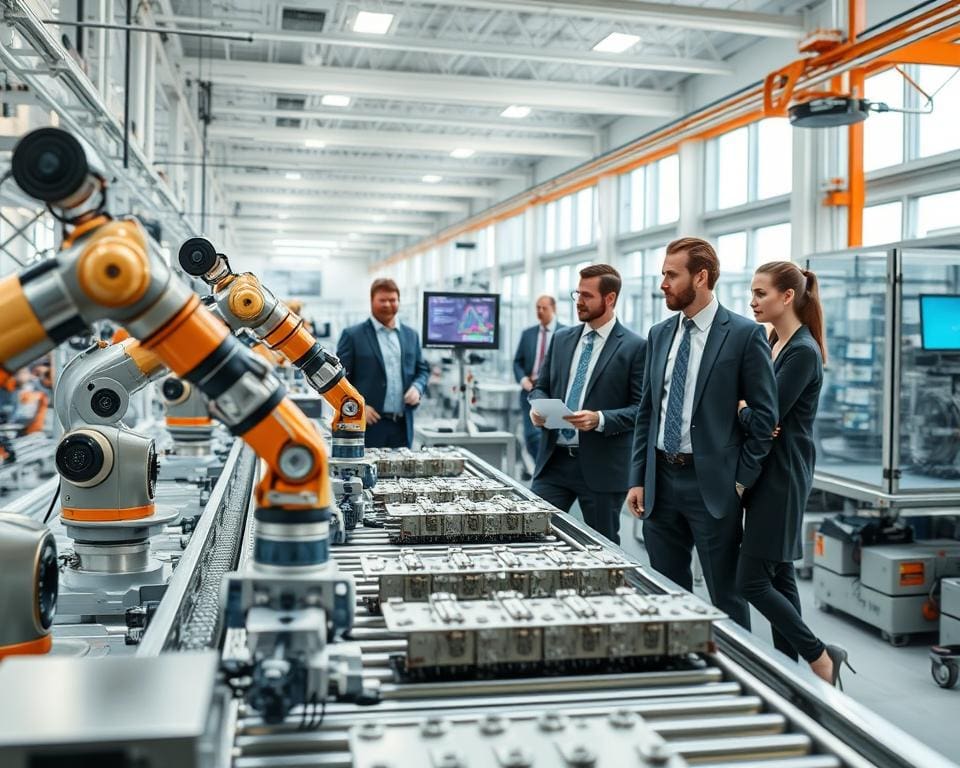
This article opens with a clear question for UK manufacturers and maintenance professionals: how is automation integrated into factories to deliver measurable gains? We examine an automation strategy that brings together hardware, software, processes and services to enable automated manufacturing across British plants.
The scope covers industrial automation integration in practical terms. You will read about robotics and PLCs, cloud platforms such as Microsoft Azure IoT and AWS IoT, and solutions from Siemens, Rockwell Automation, Schneider Electric, ABB, Honeywell and PTC. We explain how these suppliers fit into maintenance workflows and predictive programmes that reduce downtime and raise asset reliability.
The piece is written for the current factory automation UK landscape. It connects integration choices to national priorities: levelling‑up, productivity drives and Net Zero ambitions. That context explains why timely industrial automation integration matters for competitiveness and sustainability.
Expect practical insights, technology comparisons and retrofit tactics. Later sections present maintenance technologies, core system components, phased retrofit plans, software ecosystems, human factors, KPIs and future trends. Case evidence from British industry and measurable outcomes will guide an achievable path to automated manufacturing.
Overview of factory automation and its benefits for UK manufacturing
The shift to automated production reshapes British industry. This factory automation overview explains the tools and systems that power modern sites, from robotic arms and cobots to PLCs, SCADA, MES and industrial IoT. It sets out why manufacturers in the UK are investing in automation to lift output and meet tighter quality and sustainability goals.
Defining automation in the factory context
Industrial automation definition covers hardware, software and networks that run production with minimal human intervention. Typical elements include automated production lines, machine vision, autonomous guided vehicles, collaborative robots and integrated control systems. Distinctions matter: factory automation focuses on discrete operations and assembly, while process automation applies to continuous chemical or power processes.
Key benefits: productivity, quality and safety
-
Manufacturing productivity rises through consistent cycle times and 24/7 capability. OEMs and systems integrators report higher throughput after line automation with fewer bottlenecks.
-
Quality improves via vision inspection and closed-loop control that reduce variability. Repeatable robotic tasks mean fewer defects and lower recall risk.
-
Safety advances when machines remove people from hazardous tasks. Safety systems from Pilz and SICK help lower accident rates and improve ergonomics for shopfloor teams.
Economic and sustainability impacts for British industry
Benefits of automation UK range from short-term output gains to long-term cost efficiency. Capital investment can be recouped through lower lifetime costs, reduced waste and fewer reworks. That supports competitiveness against lower-cost locations.
Automation drives job evolution rather than wholesale replacement. Roles shift towards maintenance, systems programming and data analysis, creating higher-skilled opportunities in factories across the UK.
Automation and sustainability link through energy-efficient drives, variable speed control and real-time process monitoring. Better quality control cuts scrap, aligning with Net Zero targets and corporate ESG reporting. Circular economy principles gain traction when automation reduces resource use and enables selective remanufacture.
Public support exists for adoption. UK Research and Innovation, Catapult centres and government productivity programmes offer funding and expertise to help manufacturers implement automation and scale benefits.
How is technology applied in maintenance roles?
Maintenance teams in UK industry are shifting from reactive fixes to agile, data-driven care. Sensors, gateways and analytics create a continuous stream of equipment health data. That stream lets engineers anticipate faults, plan interventions and keep production moving with less disruption.
Predictive maintenance: sensors, IoT and data analytics
Vibration, temperature, acoustic and electrical sensors are fitted to motors, gearboxes and pumps to capture condition signals. IIoT gateways send telemetry to platforms such as Siemens MindSphere, PTC ThingWorx or Microsoft Azure IoT for processing. Analytic techniques include trend analysis, anomaly detection and machine learning models that estimate remaining useful life. Real-world studies and vendor reports show measurable drops in unplanned stoppages when predictive programmes are tuned and validated.
Condition-based maintenance workflows and software
Condition-based maintenance relies on clear workflows: data collection, thresholding, alarm generation and automatic work-order creation. Integration with enterprise EAM/CMMS platforms like IBM Maximo or Infor EAM ensures parts provisioning and scheduling happen without delay. Mobile maintenance apps allow technicians to follow digital checklists, upload photos and close jobs in the field.
- Typical steps: baseline audit, sensor selection, threshold tuning and rule validation.
- Software touchpoints: dashboard visualisation, automated work orders and parts management.
- Architectural choice: edge processing for latency-sensitive checks, cloud for historical modelling.
Augmented reality and remote assistance for engineers
AR systems such as PTC Vuforia and Microsoft HoloLens overlay schematics and step-by-step instructions on live equipment views. Remote experts can join a live feed, draw annotations and guide repairs without travel. This AR remote assistance maintenance approach reduces mean time to repair, spreads knowledge quickly and improves safety during complex fixes.
Case study: reduced downtime through technology in a UK plant
A UK food-processing plant combined SKF vibration sensors with an Azure IoT analytics stack and IBM Maximo for automated work orders. The programme began with a baseline audit, followed by phased sensor deployment and analytics tuning. Staff received hands-on training to use the mobile CMMS and AR tools for complex diagnostics.
Outcomes reported were a 40% reduction in unplanned downtime and a 25% cut in maintenance spend, with faster response times and improved availability. The project highlights the importance of model validation, data retention policies and iterative tuning of alerts to avoid false positives.
For teams selecting hardware and architecture, choose sensors rated for the environment, plan for secure IIoT gateways and decide which analytics run at the edge versus the cloud. Validate models with historical failures and maintain clear data governance. Read a practical overview of future industrial maintenance practices here to guide your next steps.
Core components of automated factory systems
A modern automated plant is a tapestry of purpose-built hardware and software. Understanding the core components automated factory managers must choose helps shape investment, maintenance and staff plans. Each element must work with the others to deliver reliable throughput and predictable yields.
Robotics span a wide performance range. Collaborative robots such as Universal Robots and the FANUC CR series are built for safe human interaction, quick programming and flexible cell layouts. Heavy industrial arms from ABB, KUKA and Yaskawa serve tasks that demand high speed, long reach and tight repeatability.
End-effectors matter as much as the arm. Grippers, tool-changing systems and specialised end tools determine cycle time and part quality. Return-on-investment cases should include capital cost, tooling, and uptime gains from reduced manual handling.
Programmable logic controllers and supervisory systems form the control backbone. PLCs like the Siemens S7 family or Rockwell ControlLogix execute deterministic, real-time logic for machines and safety interlocks. SCADA packages and HMIs from AVEVA/Wonderware or Inductive Automation provide supervisory control, visualisation and historian capabilities.
Integration with MES and enterprise systems is common. Safety PLCs, redundancy schemes and adherence to IEC 61508 and IEC 62061 ensure functional safety and minimise single-point failures.
Sensors, actuators and network infrastructure convert the physical world into data and action. Factories deploy proximity, photoelectric, strain, temperature, vibration sensors and rotary encoders to monitor condition and position. Actuators include servos, pneumatic cylinders and hydraulic drives for motion and force.
Industrial networking choices affect determinism and interoperability. EtherNet/IP, PROFINET and OPC UA are widely used. Time-Sensitive Networking (TSN) is emerging for converged, low-latency links. Edge devices and protocol gateways handle local processing and translation while keeping control loops deterministic.
Maintainability underpins long-term value. A spares strategy based on mean time between failures from manufacturers, plus planned critical spares, reduces downtime. Thoughtful factory network infrastructure design, paired with robust sensors and actuators, keeps machines running and maintenance predictable.
Integrating automation with existing production lines
Upgrading a live factory requires careful planning and a clear roadmap. Start with a site audit that maps asset criticality, failure modes, spare parts, control architecture and legacy systems. Use the audit to scope pilot projects that prove value before larger rollouts.
Assessment and retrofit strategies for brownfield sites
Begin retrofit automation brownfield projects by sensorising existing equipment for condition monitoring. Fit motor drives with energy meters and add modular cobots for repetitive tasks where safety and access permit. Carry out cost‑benefit analyses to prioritise high‑impact areas.
Run a small pilot on a non‑critical line to validate ROI and refine integration methods. Keep pilots short and measurable, then expand in staged waves that match maintenance windows and seasonal demand.
System interoperability and communication standards
Choose open standards to reduce vendor lock‑in and improve lifetime flexibility. Prioritise interoperability OPC UA for rich, secure data exchange between PLCs, SCADA and cloud platforms. Use MQTT or REST APIs where lightweight or web integration is needed.
Bridge legacy PLCs using middleware or edge gateways that translate protocols and normalise data for IIoT platforms. Consult industry groups such as the Industrial Internet Consortium and PROFIBUS & PROFINET International for best practice and certification guidance.
Phased implementation to minimise production disruption
Adopt phased automation implementation UK plans that begin with pilot trials and progress through staged rollouts. Schedule intrusive tasks during planned shutdowns, night shifts or quiet seasons to reduce impact on output.
Document every change, apply version control to PLC code and follow thorough Factory Acceptance Test and Site Acceptance Test routines. Keep clear rollback plans and train maintenance teams so each phase closes with stable operation before the next begins.
Software platforms and data ecosystems that enable automation
The modern factory depends on software and data to turn machines into a coordinated production system. A robust manufacturing data ecosystem links shop‑floor controllers to enterprise planning, enabling real‑time decisions that raise output, quality and sustainability. Smart deployment of platforms and clear integration patterns unlock that value for British manufacturers.
Manufacturing execution systems bridge detailed production activity with enterprise systems. Solutions such as Siemens Opcenter, Rockwell FactoryTalk and AVEVA MES handle scheduling, traceability, quality control and production reporting on the shop floor. MES integration UK typically relies on OPC UA for machine telemetry, API layers for modern services and middleware for ERP connectivity to SAP or Oracle.
Integration patterns vary by use case. A layered approach uses device protocols at the edge, an MES or middleware layer for orchestration and APIs for enterprise links. That model keeps control logic close to equipment while allowing business systems to consume rolled‑up data for planning and finance.
Industrial IoT platforms collect telemetry, manage devices and host analytics at scale. Platforms such as PTC ThingWorx, Microsoft Azure IoT, AWS IoT and Siemens MindSphere ingest signals from sensors and PLCs, apply device management and feed cloud or edge analytics. IIoT platforms cloud analytics provide scalable storage and compute for machine learning, long‑term trend analysis and interactive dashboards.
Edge analytics reduces latency and bandwidth by processing time‑critical events near the equipment. That hybrid approach supports predictive models that improve uptime and optimise energy consumption across production lines.
Factory cybersecurity must be built into every layer of the stack. Defence‑in‑depth combines network segmentation to separate OT and IT, strict patching schedules, asset inventory and controlled remote access via VPNs or jump hosts. Organisations should adopt IEC 62443, follow NCSC guidance for UK industry and run regular security assessments and penetration tests.
Secure supply chain practices are vital for IIoT rollouts. Firmware integrity, secure boot and certificate management protect devices from tampering. Vendor management that enforces secure development and update processes reduces risk across the manufacturing data ecosystem.
- Key integration technologies: OPC UA, RESTful APIs, MQTT and middleware brokers.
- Cloud and edge balance: use cloud analytics for training models, edge for real‑time control.
- Security controls: segmentation, asset inventory, patching and third‑party audits.
Human factors: workforce adaptation and skills development
Adopting automation calls for a human-centred approach that prepares people as well as machines. Organisations should plan for clear training pathways, workspace changes and thoughtful change leadership to make automation sustainable and inclusive.
Reskilling and apprenticeships
UK manufacturers need technicians versed in PLC programming, robotics maintenance, data analytics and cybersecurity. National routes such as T Levels and degree apprenticeships offer recognised standards that align with industry needs. Centres like the Advanced Manufacturing Research Centre provide industry-facing courses and practical labs to bridge classroom learning and shopfloor realities.
Training should mix blended learning, vendor certificates from Siemens Sitrain or Rockwell, hands-on workshops and on-the-job mentorship. This blend helps cohorts move quickly from theory to troubleshooting. Apprenticeships automated manufacturing programmes give younger recruits accredited experience while upskilling existing staff.
Workplace design for collaboration
Design the floor so humans and machines share space safely and productively. Ergonomic layouts, clear safety zones and well-placed HMIs reduce delays and errors. Collaborative arms should assist operators with heavy or repetitive tasks, not replace skilled roles.
Digital work instructions, AR aids and assistive technologies reduce cognitive load and speed task completion. These tools reinforce best practice, help with complex procedures and support continuous learning on the line.
Change management and culture
Successful automation depends on leadership commitment and genuine dialogue with staff and unions. Start small with pilots, celebrate quick wins and scale what works. Transparent communication about job evolution builds trust and reduces fear.
Continuous professional development and clear career pathways retain talent and create internal champions for human–machine collaboration. A steady focus on skills, recognition and involvement forms the backbone of any effective automation change management strategy.
Measuring success: KPIs and continuous improvement in automated factories
Clear metrics turn ambition into action. Leaders in UK manufacturing use a focused set of indicators to judge performance, guide maintenance and track the value of automation investments. A pragmatic measurement framework ties production KPIs to maintenance results and financial models so teams can prioritise improvements with confidence.
Key performance indicators for maintenance and production
- Overall Equipment Effectiveness (OEE) to capture availability, performance and quality.
- Mean Time Between Failures (MTBF) and Mean Time To Repair (MTTR) for reliability insight.
- Planned versus unplanned maintenance ratio and asset availability to assess maintenance maturity.
- First-time fix rate and maintenance cost per unit produced to measure technician effectiveness and cost control.
- Energy consumption per unit as a sustainability and cost KPI linked to production efficiency.
Set realistic targets by benchmarking against British industry norms from trade bodies and large OEMs. Use phased targets that tighten as systems, skills and data quality improve. Include maintenance KPIs predictive maintenance in scorecards to push condition-based strategies rather than reactive fixes.
Data-driven improvement cycles and root-cause analysis
Adopt PDCA or DMAIC as the backbone of data-driven continuous improvement. Short cycles let teams test hypotheses, measure impact and scale successful changes.
Combine historian records, sensor feeds and maintenance logs to feed root-cause work. Use the 5 Whys and fishbone diagrams together with trend analysis to find durable fixes rather than temporary workarounds.
Return on investment and total cost of ownership models
Build ROI automation UK cases that list capital expenditure, installation and commissioning, training and any recurring software fees. Estimate savings from reduced downtime, lower labour and fewer quality rejects, plus energy reductions and longer asset life.
TCO models must cover maintenance, spare parts, software licences and scheduled replacement. Use payback period and net present value to compare scenarios and stress-test assumptions with sensitivity analysis.
Run small pilots to validate technical and financial assumptions. Pilots improve confidence in KPIs automated factory and refine both ROI automation UK and TCO models before wider rollout. This approach speeds learning and reduces risk while supporting data-driven continuous improvement across the plant.
Future trends in factory automation and what UK manufacturers should consider
The future of factory automation UK will be shaped by smarter, more connected systems. Expect wider use of AI maintenance for autonomous anomaly detection and adaptive control, alongside digital twins for virtual commissioning and predictive what‑if analysis. Vendors such as Siemens Digital Industries and Dassault Systèmes are already advancing tools that let teams test scenarios before physical change.
Trends industrial automation point to greater edge intelligence, TSN networking and IT/OT convergence to support real‑time decision making. Autonomous factories will increasingly run outcome‑based services and subscription models for robotics, lowering entry barriers for small and medium manufacturers. These shifts make interoperability and open standards essential to future‑proof investments.
UK manufacturers should begin with small, measurable pilots that target high‑value assets and demonstrate ROI. Invest in people and partnerships — work with local Catapult centres, OEMs and system integrators to scale capability. Keep cybersecurity and sustainability central, so data‑driven operations are both secure and energy efficient.
Seen together, these developments offer a chance to lead on quality, agility and green credentials. Embracing digital twins, AI maintenance and the move toward autonomous factories will help British industry build resilient, innovative plants that compete on value as well as cost.