
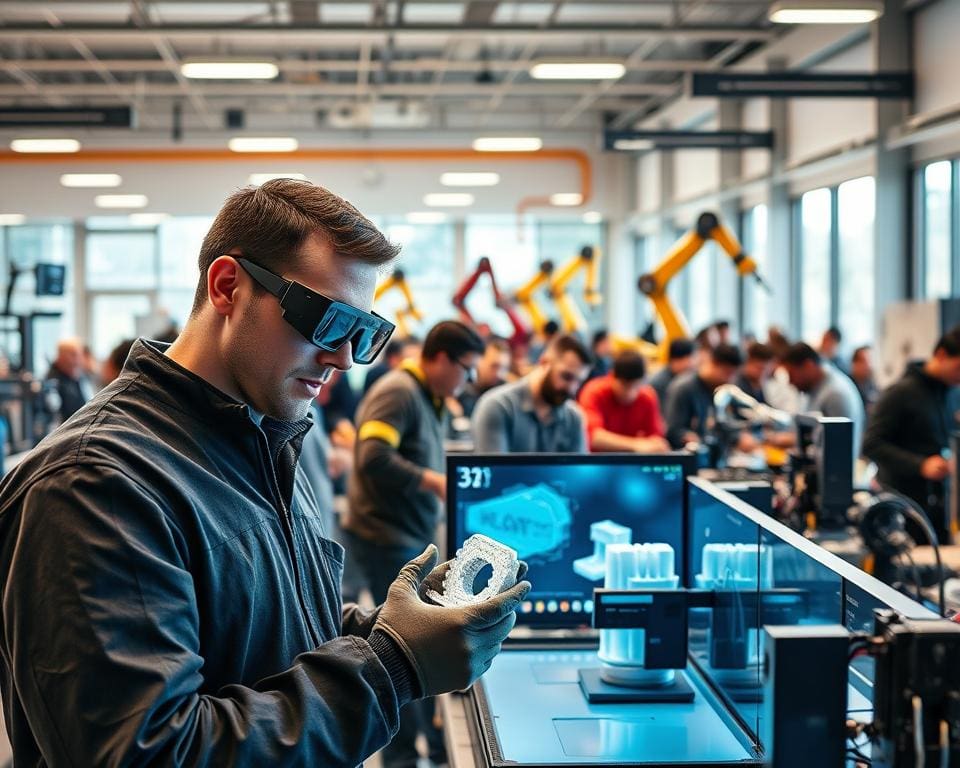
Technology is reshaping the trades across the United Kingdom. From Glasgow workshops to London construction sites, digital tools for trades and tech-enabled craftsmanship boost precision and speed without losing the craft’s core values.
The need is urgent. An ageing workforce in construction and manufacturing and a productivity gap with other advanced economies have pushed government initiatives such as the UK Industrial Strategy and Made Smarter to promote skilled labour technology UK. These programmes aim to help small firms adopt industry 4.0 for trades and bridge traditional know-how with digital skills.
The benefits are tangible. Better repeatability, less rework, safer sites and clearer client communication come from the right mix of hardware and software. For many small workshops, smart tools turn bespoke work into viable, high-value offers and make firms more competitive when bidding for contracts.
This article takes a product-review approach. It will compare classes of solutions and specific tools that support engineers, craftsmen and on-site professionals. Evaluation will hinge on usability, durability, integration, cost of ownership, training needs and clear evidence of return on investment.
Readers include engineers, tradespeople, workshop owners, procurement officers, training providers and policy-makers. The goal is practical: what to buy, how to implement and how to measure success with technology supporting skilled labour in real UK settings.
How do engineers design efficient systems?
Engineers start by defining efficiency as minimising waste of time, materials and energy while maximising throughput, reliability and ease of maintenance. Clear goals steer decisions about modularity, standardisation and simplicity. Teams embed feedback loops and resilience so systems adjust to faults and recover fast.
Principles of efficiency in system design
Core system design principles favour modular parts that are simple to replace and upgrade. Standardised components cut lead times and support interchangeability. Designers apply Occam’s razor to reduce needless complexity and boost maintainability.
Energy use and life-cycle thinking shape material choices and end-of-life plans. Engineers follow BS standards, ISO 9001 for quality and ISO 14001 for environmental management when selecting solutions for compliance and long-term performance.
Tools and methodologies engineers use
Systems engineering tools include the V-model and systems thinking to define requirements and validate performance across subsystems. Lean engineering and Six Sigma bring process mapping, value-stream analysis and DMAIC to cut waste and lift quality.
Simulation and modelling such as FEA, CFD and discrete-event simulation help predict behaviour before build. Digital twin platforms from Siemens and GE mirror assets to test scenarios and plan maintenance. Reliability-centred maintenance and lifecycle-cost analysis balance upfront investment against running costs.
Practical workflows borrow from other disciplines. For small-scale improvements, study kitchen workflow ideas to streamline tasks and reduce cross-traffic using targeted layout changes; see an example here: kitchen workflow concepts.
Case studies of efficient systems in the UK
UK engineering case studies show lean transformations paired with automation often cut lead times and raise quality. Aerospace suppliers have integrated digital inspection tools from Zeiss and Hexagon with ERP systems to speed up throughput while reducing defects.
Construction projects adopted BIM Level 2 and Level 3 to coordinate design and site teams, lowering clash rates and shortening schedules; Crossrail led much of that push. Energy firms such as Ørsted and Siemens Gamesa use predictive maintenance and condition monitoring to maximise turbine availability.
- Start small with pilots, measure KPIs like cycle time and OEE, then scale what works.
- Involve end-users early to reveal practical bottlenecks and reduce rework.
- Invest in staff training so technology delivers sustained gains rather than short-term wins.
Digital tools that enhance craftsmanship and precision
New digital tools are reshaping how makers and tradespeople work, blending traditional skill with modern tech. Workshops and site teams now choose technologies that speed design, improve accuracy and keep craftsmanship at the heart of production.
Computer-aided design and manufacturing (CAD/CAM)
CAD/CAM for crafts shortens the path from concept to finished piece by turning accurate 3D models into machine-ready toolpaths. Software such as Autodesk Fusion 360, AutoCAD, SOLIDWORKS and Siemens NX link with CAM packages like Mastercam and Autodesk PowerMill to drive CNC mills, lathes and laser cutters.
That pairing improves repeatability and reduces waste. Trades benefit from rapid iteration, clearer 3D visualisations and easier client sign-off. Post-processors and machine-specific calibration remain vital for true precision craftsmanship tools on the shop floor.
Workshops should weigh licensing models and hardware needs. Vendors and training bodies such as City & Guilds offer courses that help teams adopt CAD/CAM workflows with minimal disruption.
Augmented reality and wearable tech for on-site work
Augmented reality for trades brings digital instructions into the worker’s field of view. Headsets like Microsoft HoloLens and smart glasses from Vuzix overlay diagrams on real parts, aiding assembly, routing and diagnostics.
Wearable tech on-site, including sensors and Bluetooth tools, supports remote expert guidance and annotated live video. Pilot schemes across utilities and construction have reduced specialist travel and raised first-time-fix rates.
Reliable connectivity and ruggedised devices matter for on-site use. Thoughtful user interfaces and safety-aware design ensure AR and wearables enhance rather than distract from skilled work.
Additive manufacturing and bespoke production
Additive manufacturing bespoke UK applications now span prototypes to finished components. Processes such as FDM, SLS, SLA and metal sintering let teams produce complex geometries and small runs that were once impractical.
Airframers and heritage restorers in the UK use 3D printing for lightweight brackets and replacement parts. Small-batch jewellery makers and prosthetics firms exploit design freedom and shortened lead times for custom work.
Practices must consider material certification, surface finish and post-processing. Cost per part versus traditional machining, along with intellectual-property management, shape where additive manufacture fits a workshop’s mix of tools.
Automation, robotics and the evolving skilled workforce
The rise of robotics and smarter tooling is changing workshop floors across the UK. Small and medium enterprises find that cobots UK bring new flexibility to tasks such as machine tending, polishing and assisted assembly. These devices sit beside, not behind, operators and help reduce repetitive strain while improving consistency.
Collaborative robots in workshops
Collaborative robots contrast with older industrial arms by offering force-limited joints and safety-rated monitored stops. Brands such as Universal Robots, FANUC and ABB are common in British workshops for low-volume, varied work. Integration tends to be quicker thanks to intuitive teach pendants and hand-guiding, which lowers barriers for firms exploring automation for skilled trades.
That said, adoption needs careful planning. Teams must carry out cell-level safety assessments, fit appropriate tooling and set realistic ROI expectations. A thoughtful pilot can show how robotics for workshops lift productivity while preserving craft skills.
Reskilling and continuous professional development
New equipment brings fresh skill demands. The UK faces a shortage in trades and engineering, so reskilling skilled workforce is essential. Workers need digital literacy, basic data interpretation, hands-on robot operation and familiarity with CAD tools to thrive in modern shops.
Training pathways include apprenticeships, NVQs, T‑levels and short courses from City & Guilds or vendor certification programmes. Employers can blend on-the-job learning with micro-credentials, mentoring and partnerships with further-education colleges.
Addressing anxiety matters as much as technical training. When teams see automation for skilled trades as a route to higher-value work and career progression, engagement improves and retention rises.
Human–machine collaboration best practices
Design work cells with people in mind. Ergonomic layouts, clear role definitions and intuitive interfaces reduce errors and boost uptake. Safety must meet PUWER and HSE L124 guidance to protect staff and meet legal obligations.
Change management works best when tradespeople join pilots early and provide feedback. Define maintenance and troubleshooting duties up front so machines do not become a hidden burden.
Measure success with balanced KPIs. Track machine utilisation alongside operator productivity, first-pass quality and staff satisfaction. Use data and iterative design to refine workflows and maintain effective human–machine collaboration.
For a deeper look at how digital tools and AI shape mechanical design and manufacturing, explore how mechanical engineers drive innovation.
Data, connectivity and smarter decision-making on-site
Connected sites turn raw signals into timely choices. Small sensors on plant and handheld tools feed networks that tell teams when a machine needs attention, where assets sit and which jobs are running late. On busy UK projects this clarity lifts safety, cuts waste and keeps programmes moving.
Internet of Things for equipment monitoring
Edge sensors for vibration, temperature, load and GPS let contractors spot wear before failure. Using NB‑IoT, LTE‑M or private 4G/5G links to gateways and cloud platforms such as AWS IoT or Microsoft Azure IoT creates resilient flows. Local buffering keeps data safe when coverage drops.
Large firms including Balfour Beatty have run pilots that show measurable gains. Predictive alerts reduce unplanned downtime and improve safety by flagging unsafe conditions. Asset tracking supports theft prevention and smarter allocation across sites, so teams can rely on the right kit when they need it.
Data visualisation and mobile dashboards
Dashboards translate telemetry into simple actions. Platforms such as Power BI and specialised field tools like Procore combine IoT feeds into a single source of truth. Mobile dashboards for site put KPIs, job status and maintenance alerts in the hands of site managers and engineers.
Design must match tasks. Prioritise offline access for poor signal locations and tier alerts so crews see critical warnings first. Clear visualisation construction reduces time spent hunting answers and lowers emergency call‑outs by speeding decisions.
Cybersecurity and data governance for field operations
Field systems can be exposed by insecure devices, default passwords or weak mobile endpoints. Apply device hardening, network segmentation and multi‑factor authentication to close obvious gaps. Use VPNs or private APNs when moving sensitive operational data.
Regulatory duties under the UK Data Protection Act and GDPR matter when location or worker identifiers are recorded. Define data ownership, retention rules and approved use cases to build trust with the workforce. Vendor due diligence on cloud providers completes the governance picture.
- Use cases: predictive maintenance, theft prevention and resource scheduling.
- Tech stack: edge sensors, gateways, 4G/5G, and cloud IoT services.
- Best practice: task‑focused dashboards, offline access and tiered alerts.
Product selection and review: choosing tech that supports skilled labour
Our product review CAD CAM and hardware selection used hands-on testing, vendor specifications, third‑party certifications and feedback from UK tradespeople. We tested durability in field conditions, ease of integration with existing workflows, training availability and total cost of ownership. This methodology ensures the choices suit real workshops and sites, not just lab bench results.
Categories covered include CAD/CAM suites, AR headsets for trades and wearable devices, the best cobots UK and automation kits, additive manufacturing from desktop SLA to industrial metal, IoT equipment monitoring review platforms and secure connectivity solutions. We compared Autodesk Fusion 360, SOLIDWORKS and Siemens NX on licensing, collaboration and target users to match software to team size and project complexity.
For on-site tech we assessed Microsoft HoloLens 2 and Vuzix smart glasses for ruggedisation and battery life. Cobots from Universal Robots, ABB and FANUC were evaluated for payload, reach, programming ease and safety certification. Additive systems ranged from Formlabs desktop SLA to EOS and Renishaw metal printers, with attention to material ecosystems and post‑processing workflows.
IoT platforms such as PTC ThingWorx, Siemens MindSphere and AWS IoT were paired with field apps like Procore and Fieldwire for jobsite coordination. Cybersecurity choices include Microsoft Azure Sphere and enterprise MDM and VPN options to secure devices and data. Practical buying tips: start with a clear pain point, prefer open APIs for scalability, use trial periods or leasing and explore Made Smarter Adoption Programme grants.
Training and support weigh heavily in our scoring; vendors with UK technical teams, structured training and links to local colleges score higher. Measure success with defined KPIs — OEE, first‑time fix rate, lead time and safety incidents — collect baseline data, run pilots and scale after proven gains. This approach delivers demonstrable ROI and protects skilled craft.
Well‑chosen technology preserves craftsmanship while boosting productivity and job satisfaction. Pick one small pilot you can run within 90 days, match the tool to the specific problem, invest in training and measure outcomes. That pragmatic route turns cautious investment into lasting capability for British workshops and sites.