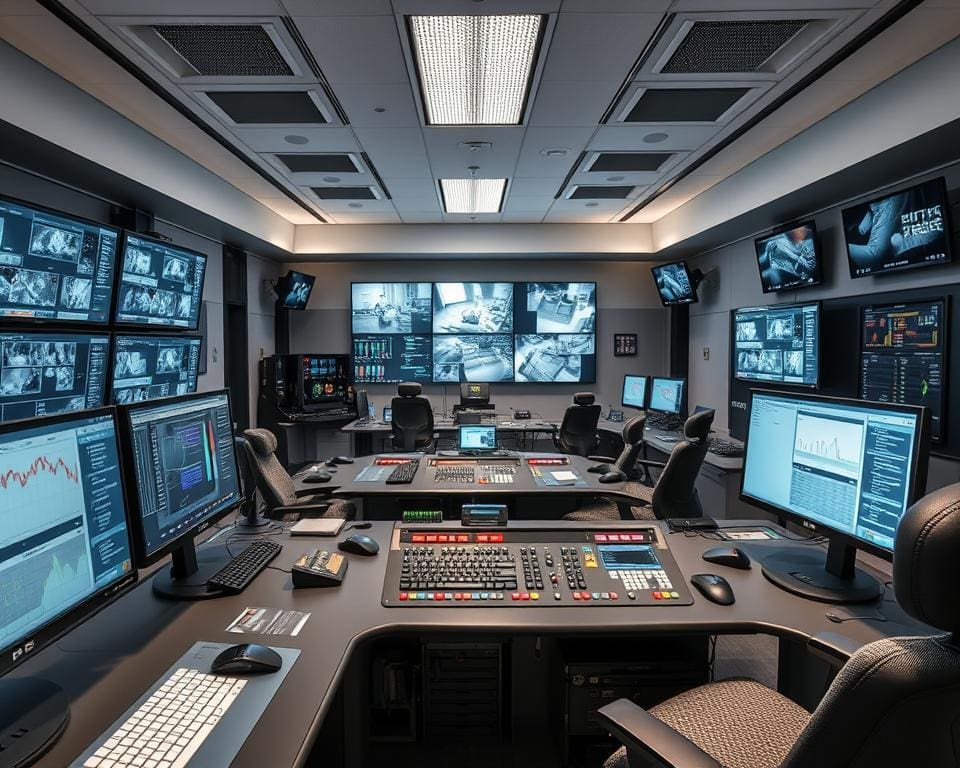
This product-review style introduction surveys the principal control room hardware that powers modern command centres in the United Kingdom and beyond. It aims to inspire buyers, integrators and operations teams by highlighting the role of control room equipment in supporting transport hubs, utilities, emergency services and security operations centres.
Control room technology must be purpose-built and resilient. Choices range from video walls and control room displays UK suppliers provide, to managed switches, UPS units and servers. These components determine system availability, scalability and the total cost of ownership.
Hardware selection is shaped by who manages it. Systems engineers, network engineers, AV specialists and operations managers each influence procurement, deployment and lifecycle care. Later sections unpack these roles and show how they map to specific command centre hardware.
Our review criteria are consistent across sections: reliability, redundancy, manageability, interoperability, ergonomics, energy efficiency and TCO. The article blends product-level detail (brands and device types), design considerations such as lighting and heat, and operational practices like monitoring, redundancy and maintenance.
Readers in the UK will find references to relevant standards and procurement considerations, including BSI guidance for control rooms, ISO/IEC for IT infrastructure and sector-specific rules for rail signalling and emergency services resilience. This context helps ensure chosen control room hardware meets regulatory and operational needs.
What roles manage technical infrastructure?
Control rooms rely on a compact team that brings systems, networks and visualisation together. Clear handoffs between IT, facilities and operations make the difference between reactive fixes and proactive resilience. These roles managing technical infrastructure aim to maximise uptime, secure connections and present reliable situational awareness for operators.
Overview of technical infrastructure roles
Typical teams include systems engineers, network engineers, AV specialists and visualisation engineers, plus operations managers who coordinate across vendors. Their shared goals are simple: ensure continuous service, enable fast incident response and maintain secure, auditable systems.
Systems engineers and their hardware responsibilities
Systems engineers handle servers, virtualisation platforms like VMware and Microsoft Hyper-V, and storage from Dell EMC or NetApp. Their systems engineer responsibilities include lifecycle planning, firmware and patch management, performance tuning and integration with monitoring tools such as Zabbix or Prometheus.
Network engineers and connectivity management
Network engineers manage switches, routers and WAN links from Cisco, Juniper and HPE. In the network engineer control room role they design resilient topologies, apply QoS for video and voice and configure redundancy for rapid failover. They also maintain firewalls from Palo Alto Networks or Fortinet and manage VPNs and segmentation to protect critical assets.
AV specialists and visualisation teams
AV specialist control room staff specify and maintain video walls from Barco or Christie, media servers and signal distribution from Crestron or Extron. They focus on calibration, bezel compensation and processor tuning to present coherent multi-source displays that aid operator decisions.
Operations managers and lifecycle oversight
Operations managers oversee procurement, vendor contracts and SLAs, ensuring maintenance and smart-hands support are in place. The operations manager lifecycle remit covers change control, staffing rosters, training and hardware refresh cycles that meet budget and performance targets.
Working together, these roles form a resilient backbone for control-room technology. Clear documentation, asset registers and auditable processes complete the picture and keep systems aligned with operational needs.
Core display hardware used in control rooms
Choosing the right display hardware shapes how teams read and react to information. A well-designed array balances clarity, durability and operator comfort. Below we explore common options and practical considerations for modern control-room environments.
Video walls and large-format displays
Direct-view LED and fine-pitch LED panels deliver crisp imagery for critical monitoring. Brands such as Barco, Samsung, LG and Planar offer panels that vary by pixel pitch, brightness and bezel width. Fine-pitch LED suits short viewing distances and high-resolution needs, while LCD video walls give a cost-effective route for broad coverage.
Video-wall controllers and processors from Datapath, Barco and ZeeVee manage inputs, windowing and mosaics. Choose controllers with redundancy and scalable I/O to avoid single-point failures. Plan for maintenance access and spare-panel strategies to keep uptime high, and consider lease or managed-service models for large-format displays that have high capital cost.
Control room monitors and multi-screen workstations
Operator desks benefit from low-ghosting monitors by Dell, HP, EIZO and ASUS. Calibration and anti-glare coatings reduce eye strain. Use multi-head graphics such as NVIDIA Quadro or AMD Radeon Pro to drive dense arrays of screens reliably.
Multi-screen workstations can be built from stacked monitors, ultrawide displays or KVM-over-IP solutions by Guntermann & Drunck and Black Box. KVM centralises control of remote systems and simplifies switching between sources. Adjustable mounts and careful sightline planning cut fatigue and improve situational awareness.
Projection systems and light conditions
Laser projectors from Epson, Panasonic and Sony produce large single images when needed. They offer high lumen output and lower servicing than lamp projectors. Projectors perform well for presentations or occasional large-format requirements in a projection systems control room.
Control room lighting is critical. Ambient light control, neutral-colour walls and adjustable shading preserve contrast and reduce reflections. Projectors need blackout capability to reach peak contrast, while LED and LCD solutions fare better under varied lighting. Match display choice to the intended use and the room’s ability to manage light.
Networking and connectivity equipment
Reliable control room networking forms the backbone of modern operations. Choose hardware that scales with demand and keeps critical feeds flowing under stress. The right mix of switches, routers and security appliances delivers resilient connectivity across display, server and peripheral layers.
Managed switches from Cisco, Juniper, HPE Aruba and Extreme Networks are common in enterprise control rooms. Look for PoE to power IP cameras and endpoints, large port counts, SFP/SFP+ slots for fibre uplinks and out-of-band management. Layer 3 switching, VXLAN for segmentation and telemetry such as sFlow or NetFlow help teams monitor performance and isolate issues.
Match uplink speeds to workload: gigabit for basic workstations, 10GbE for video aggregation and 25/40/100GbE where high-resolution video or heavy data flows are needed. Use staged firmware upgrades and configuration backups to avoid unplanned outages during updates.
Design for network redundancy through dual-homing, link aggregation (LACP) and diverse physical routes. Implement spanning-tree designs where needed and deploy dynamic routing protocols such as OSPF or BGP for automatic re-routing. SD-WAN can extend resilient connectivity across dispersed sites, while LTE or 5G provide tertiary paths for emergency access.
Run automated failover tests and keep separate physical paths for critical links. Synchronised backups and strict change-control reduce the risk of cascading failures when devices are updated or replaced.
Network security appliances must protect operational assets without hindering performance. Next-generation firewalls from Palo Alto Networks, Fortinet and Check Point offer deep packet inspection, intrusion prevention and VPN termination for remote vendors.
Segment control networks from the corporate environment and apply strict ACLs to limit lateral movement. Integrate logs into a central SIEM such as Splunk, IBM QRadar or an ELK Stack to surface anomalies quickly. Use bastion hosts, jump servers and multi-factor authentication for vendor access and schedule regular penetration testing to validate defences.
Control room servers and processing hardware
A resilient control room depends on a clear server strategy. Physical racks from Dell EMC PowerEdge, HPE ProLiant and Lenovo ThinkSystem host critical systems such as SCADA, video management systems, operational databases and analytics engines. These platforms deliver predictable performance for latency-sensitive tasks while offering enterprise support and certified firmware stacks.
Virtualisation brings flexibility to the data centre. VMware ESXi, Microsoft Hyper-V and KVM permit VM consolidation, snapshotting and rapid portability across hardware. Containerisation with Docker and Kubernetes supports microservices and cloud-native video workflows, making deployments more repeatable and easier to scale.
Right-sizing compute for real workloads is essential. Choose CPU cores, RAM and storage IOPS to match concurrent connections, analytics throughput and retention policies. NVMe SSDs work well for fast boot times, caching and database log performance in demanding environments.
Dedicated control servers
Dedicated servers remain the backbone for deterministic tasks. Use physical hosts for primary control plane duties to isolate SCADA and real-time video pipelines from noisy, general-purpose workloads. This approach keeps critical processes responsive and simplifies compliance audits.
Virtualisation for operational agility
Virtual platforms reduce hardware sprawl and speed recovery. Implement VM mobility and automated snapshot schedules for maintenance windows. Combine virtualisation control room best practice with clear resource reservations to avoid contention during peak incidents.
High-availability clustering
Design HA with both active/passive and active/active patterns based on the application. Employ synchronous and asynchronous replication where appropriate and use heartbeat monitoring and witness nodes to avoid split-brain events. Storage replication tools such as Dell EMC RecoverPoint and NetApp SnapMirror support resilient SAN/NAS topologies for sustained uptime.
Database clustering matters for transactional integrity. Microsoft SQL Always On and Oracle RAC provide failover and load sharing for critical data. Plan geographical redundancy for disaster recovery to meet RTO and RPO targets tied to operational needs.
GPU acceleration and specialised compute
GPU acceleration gives control rooms the power to decode and analyse many video streams in real time. NVIDIA Quadro, Tesla and RTX lines, plus AMD MI series cards, speed up object detection, tracking and complex visual rendering. Offloading encoding and decoding to hardware encoders from Matrox or Haivision reduces CPU load and increases density for media servers.
Thermal and power planning is non-negotiable for GPU-dense servers. Monitor temperatures, verify driver and OS compatibility with VMS and analytics suites, and size power delivery to prevent throttling during extended peaks.
- Match server class to workload: control-plane, media, storage or analytics.
- Use virtualisation control room techniques for flexibility and predictable failover.
- Implement high-availability clustering and replicated storage for continuous operations.
- Adopt GPU acceleration video processing where high-density decoding or AI inference is required.
Audio and communication hardware
Sound and voice form the lifeline of any control room. Reliable control room audio lets teams share situational awareness, reach field crews and coordinate with partner agencies. Careful selection of microphones, processors and dispatch systems creates clarity under pressure.
Microphone arrays and conference audio systems
Beamforming microphone arrays from Shure, Sennheiser and Bosch capture speech even in noisy spaces. Ceiling and desktop microphones reduce ambient noise while keeping the operator area uncluttered.
Digital signal processors from Biamp, QSC and Yamaha handle echo cancellation and noise suppression. These DSPs route and mix sound for conferencing platforms such as Microsoft Teams, Zoom and Pexip to link with external agencies.
Intercoms, dispatch consoles and headsets
Specialist dispatch consoles from Zetron, Motorola and Airbus integrate telephony, radio gateways and logging for accountable communications. These systems sit at the heart of an intercom control room, enabling fast, secure voice links.
Rugged headsets from Sennheiser and Plantronics (Poly) offer noise-cancelling microphones and all-day comfort for long shifts. KVM and soft-client integration allows operators to patch voice channels, record communications and support training and audit requirements.
Public address and paging systems
Public address systems from Bosch and TOA deliver site-wide paging, zoned announcements and emergency broadcasts. Solutions such as Bosch Praesideo offer redundant amplifiers and backup paths to protect audibility during faults.
Compliance with British standards for voice evacuation demands routine testing and close integration with alarms. Automated monitoring and regular maintenance ensure that paging hardware remains reliable when every second matters.
Environmental and infrastructure hardware
Designing the backbone of a control room demands clear priorities: resilience, thermal control and secure access. Choose scalable uninterruptible power supplies and smart power distribution units that match load profiles and growth plans.
Uninterruptible power supplies and power distribution
Use online double-conversion UPS from APC by Schneider Electric, Eaton or Riello for zero-transfer-time protection. Modular UPS models let teams add redundancy without full replacement. Pair UPS with generator integration and automatic transfer switches to cover extended outages.
Specify power distribution units with metering and remote management to monitor consumption and spot inrush events. Regular battery testing and careful earthing reduce risks from electrical noise. Plan for battery thermal management around UPS cabinets to extend service life.
Rack systems, cooling and ventilation
Adopt 19-inch racks and secure cabinets with disciplined cable management. Hot/cold aisle containment improves efficiency and protects sensitive electronics.
For dense deployments, select precision cooling from Liebert Emerson or Stulz, or consider in-row cooling and rear-door heat exchangers to localise airflow. Environmental sensors from Sensaphone and Eaton provide early alerts on temperature, humidity and leaks.
Physical security: access control and surveillance
Layered control room physical security should include biometric or proximity access control from HID or Honeywell and mantraps for high-sensitivity zones. Implement tamper detection on racks and secure storage for spares.
CCTV solutions from Axis or Hikvision, integrated with enterprise VMS, create audit trails and support incident reviews. Define controlled visitor access and escort policies to protect assets. Asset tagging and secure disposal processes help meet regulatory obligations.
Control interfaces and operator workstations
Operators rely on a blend of physical and digital tools to act quickly and accurately. An effective operator workstation brings together input devices, furniture and bespoke controls so teams can sustain high performance across long shifts. Thoughtful layout and device choice reduce fatigue and sharpen situational awareness in a human-centred design control room.
The right input devices make routine tasks faster and less tiring. Industrial keyboards and backlit low-profile models suit 24/7 use, while precision mice and trackballs from Logitech and Kensington give smooth cursor control. Flat-panel touchscreens and projected capacitive displays from Elo and Planar enable direct map and dashboard interaction. KVM-over-IP and soft-client solutions allow remote handling of systems without losing responsiveness. Emerging touchless control options such as Leap Motion and Microsoft Azure Kinect let operators execute common commands without contacting shared surfaces.
Ergonomic control room furniture supports posture and reduces strain. Height-adjustable desks and monitor arms let teams set ideal sightlines. Supportive chairs from Herman Miller or Steelcase pair with anti-fatigue flooring to cut musculoskeletal stress. Sightline studies, reach envelopes and a clear information hierarchy help designers set font sizes and group data to lower cognitive load. Shift-based lighting and circadian-aware LED fixtures help maintain alertness. Acoustic treatment reduces auditory fatigue so teams stay focused.
Custom control panels provide predictable haptic feedback for critical actions. Bespoke units from Crestron or AMX and specialist integrators include hard buttons, knobs and tactile switches that perform well under pressure. Programmable hardware control surfaces integrate with SCADA and VMS, allowing macros and one-touch sequences that speed response. Ruggedisation, IP-rated enclosures and redundant control paths keep tactile control panels reliable for continuous operation.
Monitoring, redundancy and maintenance hardware
Effective monitoring hardware control room setups start with simple sensors and grow into full observability platforms. Temperature, humidity, smoke and water detectors sit alongside rack power metres and SNMP-enabled PDUs to feed central dashboards. Integrating tools such as Nagios, Zabbix or SolarWinds gives teams a single view of hardware health, network performance and service availability for faster decision-making.
Redundancy strategies must be defined early in design and procurement. Models such as N+1, 2N or distributed failover apply to power, cooling, networking and compute, and each choice changes floor-space and spare-parts needs. Onsite kits for PSUs, fans, NICs and spare panels plus contracted rapid-replacement SLAs reduce risk, while staged failover tests and tabletop exercises validate recovery procedures and build staff confidence.
Maintenance tools control room teams rely on include power analysers, thermal cameras and cable testers, along with vendor toolkits for firmware updates and diagnostics. Remote monitoring and logged, time-synchronised events support root-cause analysis after incidents. Use predictive maintenance driven by telemetry — temperature trends, SMART SSD metrics and battery discharge curves — to plan proactive replacements and cut unplanned downtime.
Finally, a documented regime ties everything together: version-controlled firmware management, clear change-control procedures and scheduled audits. That discipline, paired with observability and redundancy, turns monitoring hardware control room investments into resilient, manageable operations that sustain service availability and protect critical infrastructure.