
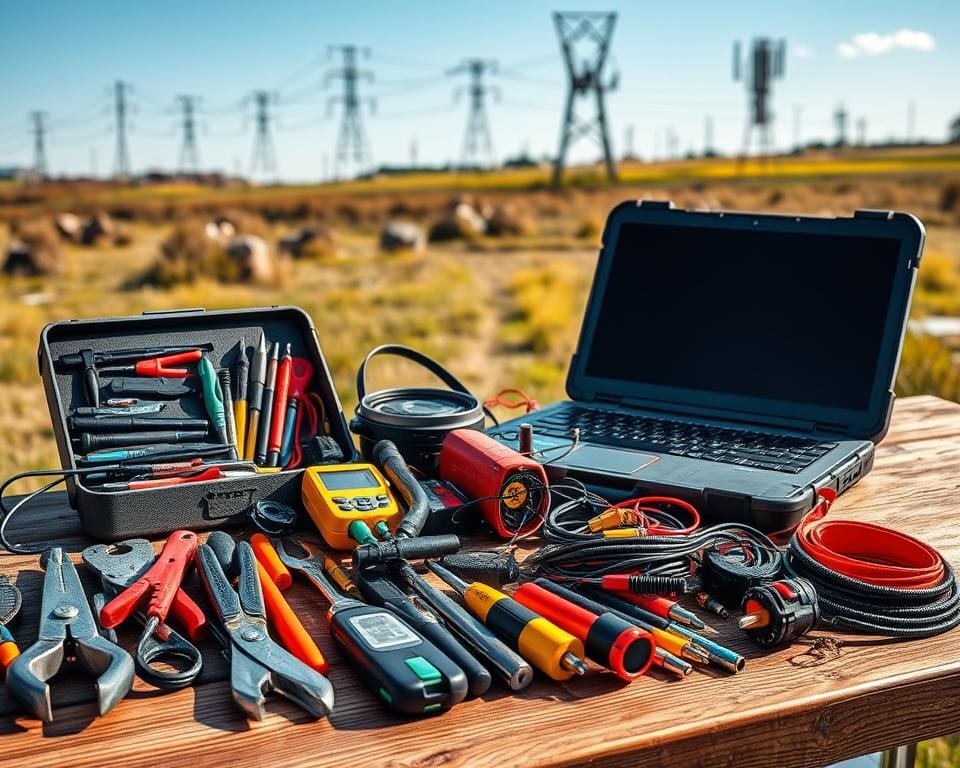
This short guide defines the scope and purpose of a product-review style reference for technicians, site engineers and service engineers across the United Kingdom. It answers what tools do field technicians carry and explains how a well-curated technician kit improves first-time fix rates, reduces downtime and helps teams meet British Standards such as BS EN requirements.
We cover the full range of field service equipment: handheld tools, measurement devices, diagnostic instruments, calibration kits, personal protective equipment, portable computing and specialist trade tools. The aim is practical and inspirational — offering recommendations from trusted brands like Fluke, Megger, Klein Tools, Bosch, DeWalt, Flir, Keysight, Testo and Trimble.
Choosing the right tools for technicians means balancing portability, accuracy, safety and serviceability. Later sections link device choice to common field tasks such as fault finding, commissioning and preventive maintenance, so readers can match their kit to real-world work.
Expect concise product insights, real-world pros and cons, and clear considerations for durability and compliance. Whether you are assembling a basic technician kit or upgrading field service equipment, this article will help you make choices that boost efficiency and keep teams safe on site.
Essential handheld tools for everyday fieldwork
Field technicians depend on a compact set of handheld tools that deliver speed, safety and reliability on site. Choose gear that balances weight and capability so you move faster without sacrificing performance. The right selection of multitools, portable tool kits, screwdrivers, pliers and wire strippers turns routine visits into confident fixes.
Multitools and portable hand tool kits
Compact multitools from Leatherman and Victorinox are ideal for quick adjustments and emergency repairs. Typical features include knife blades, pliers, wire cutters, bit drivers and small screwdrivers that fit into a pocket or pouch.
For larger jobs, modular portable tool kits from Stanley, Klein Tools and Bahco provide insulated screwdrivers, adjustable spanners and socket sets in tough, organiser cases. Pick kits with IP-rated cases and foam inserts to protect tools while stored in vans.
When working near live circuits, opt for BS EN 60900 compliant insulated tools. Expect a trade-off between carrying less weight and having a comprehensive kit for varied tasks.
Screwdrivers, pliers and wire strippers for rapid fixes
Carry a mix of screwdriver heads: Phillips, Pozidriv, slotted, Torx and Robertson. Magnetic tips and ratcheting handles speed repetitive fastening and reduce dropped fasteners.
- Use combination, long-nose and diagonal cutters for cutting and shaping wire.
- Rely on crimping pliers for secure terminations; brands such as Knipex and Klein offer proven durability.
- Select automatic or adjustable wire strippers from Ideal and Irwin to give consistent strip lengths and reduce cable damage.
Ergonomics matter. Choose non-slip grips and anti-vibration handles, with insulated grips where electrical safety is required.
Impact drivers and cordless drills for mobility
Brushless cordless drills and impact drivers from DeWalt, Makita and Bosch deliver the mobility technicians need. Compare battery platforms — 18 V/20 V max systems dominate — and assess torque control against speed to match the task.
Buy kits with two batteries and fast chargers so a depleted pack never stalls a job. Match new tools to any existing battery ecosystem to save cost over time.
- Keep magnetic bit holders, torque-limiting clutches and right-angle attachments on hand for confined spaces.
- Choose compact models for tight access and consider spare batteries and on-vehicle charging solutions to sustain a long day.
Routine maintenance — cleaning, lubrication and replacing worn bits — keeps cordless drills and impact drivers performing reliably.
For a broader look at tool choices that modern tradespeople favour, see this practical guide on essential kit for carpenters: best tools for modern carpenters.
What devices support technical measurements?
Measurement devices provide the quantitative data technicians rely on for diagnosis, commissioning and safety checks. Accuracy, input protection and ruggedness for field conditions matter as much as features. Look for clear CAT II–CAT IV ratings, traceable calibration certificates and displays that remain readable in bright daylight.
Digital multimeters for voltage, current and resistance
A digital multimeter is the backbone of electrical testing. Typical functions include AC/DC voltage, AC/DC current, resistance, continuity, diode test, capacitance and frequency. Advanced units offer true RMS, low impedance (LoZ) to kill ghost voltages and data logging for trend analysis.
Professional choices such as the Fluke 17x/18x series deliver robust input protection and precise readings. Keysight U1282A brings bench-grade features in a portable form for field use. When choosing a digital multimeter check accuracy class, input protection, CAT rating, auto-ranging and battery life.
Clamp meters for safe current measurements
A clamp meter lets technicians measure current without breaking the conductor. Jaw-style clamp meters from Fluke and Megger offer non-intrusive AC/DC current measurement and inrush detection for motor starts. They simplify fault location on three-phase systems and keep testing safer on live circuits.
Look for insulated jaws, smooth ergonomic clamp action and a matching CAT rating. Specialised units with iFlex or flexible probes suit large conductors or awkward access on industrial sites.
Insulation testers and earth loop testers for safety verification
Insulation testers apply test voltages (250 V, 500 V, 1 kV) to check insulation resistance of motors, cables and installations. Models from Megger and Fluke, such as the Megger MIT range and Fluke 1507, include selectable voltages and discharge functions to protect equipment.
Earth loop testers and soil resistance equipment from Seaward and Megger confirm protective earthing and continuity to meet BS 7671 and client acceptance criteria. Seek automatic test sequences, pass/fail indicators and scheduled calibration with traceable certificates.
Laser distance measurers for accurate site measurements
Laser distance measurers replace tapes for many tasks. They deliver millimetre accuracy over tens or hundreds of metres and allow single-operator measurement of rooms and structures. Bosch GLM, Leica DISTO and DeWalt models are proven on UK sites.
Choose devices with area and volume calculation, Pythagorean indirect measurement, Bluetooth transfer and robust IP and drop ratings. Use reflective targets for long ranges and manage batteries to avoid lost data when preparing site measurement devices for reports.
Diagnostic instruments and electronic testers
Field technicians rely on compact diagnostic instruments to speed fault-finding and confirm repairs. Portable units now combine multiple functions into one toolkit, so teams carry fewer items and work faster on live sites. Choose devices that match the task, battery life needs and environmental conditions.
Handheld oscilloscopes bring lab-grade waveform viewing into vans and plant rooms. Makers such as Rigol, Tektronix and Keysight offer rugged models with bandwidths from 100 MHz to 500 MHz and sample rates suited to digital and analogue signals. Mixed-signal, battery-powered units capture transients, decode SPI, I2C and UART and store waveforms on USB. Built-in FFT, cursor measurements and trigger options speed analysis of amplifiers, filters and sensors.
Signal generators from Keysight and Rigol serve as controlled test sources for verification and alignment. Function generators handle audio and baseband tests. RF signal sources aid communications troubleshooting and amplifier checks. Portable signal generators let technicians inject known stimuli on-site and confirm system response without returning to the workshop.
Network testers are essential for modern cabling and comms checks. Fluke Networks Versiv certifiers set standards for Cat6A and 10G certification, while handheld testers from Ideal and Klein Tools provide rapid continuity, pair mapping and length checks. LinkRunner devices verify Ethernet links, PoE delivery and basic packet behaviour to confirm network health.
Fibre testing often begins with simple optical power meters and light sources for loss checks. More advanced certifiers and OTDRs are covered under specialist tools, though basic fibre checks remain part of everyday diagnostics for many engineers.
Thermal cameras from Teledyne Flir, Fluke and Seek reveal hotspots that the eye cannot see. Consider resolution, NETD thermal sensitivity and stated accuracy when choosing a unit. IR thermometers remain valuable for quick spot checks where a full camera is unnecessary. Watch emissivity settings and take care with reflective surfaces to avoid misleading readings.
Practical uses include preventive maintenance on electrical panels, motors, bearings and HVAC systems. Use diagnostic instruments at a safe distance and wear appropriate PPE when inspecting live equipment. Regular checks with oscilloscopes, signal generators, network testers, thermal cameras and IR thermometers help prevent costly downtime and extend equipment life.
Calibration and verification equipment
Field technicians rely on reliable calibration equipment to keep systems accurate and safe. Portable options let engineers verify instruments on-site, reduce downtime and meet client expectations for traceable calibration.
The backbone of on-site work is compact calibration kits that include reference multimeters, voltage and current sources and temperature baths or thermocouples. Brands such as Fluke Calibration, Beamex and Ruska supply robust kits with UKAS-traceable certificates. Technicians must weigh uncertainty statements, calibration intervals and environmental effects when choosing in-field versus laboratory calibration.
Calibration kits and reference standards
Good calibration kits allow quick checks of electrical and temperature instruments. A reference multimeter and a stable voltage source let you verify meters without removing them from service. Temperature baths and calibrated thermocouples provide a local standard for sensors and thermostats.
Use manufacturers with strong traceability records so calibration records stand up to audits. Keep uncertainty budgets simple and clear on each certificate to show measurement confidence.
Pressure and flow calibrators for HVAC and process systems
Handheld pressure calibrators from Fluke, Druck (GE Sensing) and Beamex suit transducers, gauges and transmitters. Look for differential pressure modules, mbar/psi ranges and integrated pumps to generate test pressure safely. Fit the correct adapters and follow isolation procedures when working on pressurised systems.
Flow calibrator choices include portable devices that simulate transmitter outputs, clamp-on ultrasonic meters for non-intrusive checks and small calibration rigs for loop validation. Match the method to the process accuracy required and site constraints.
Documentation tools for traceable calibration records
Digital calibration management tools such as Beamex CMX and Fluke Connect simplify storage of UKAS-traceable certificates, calibration histories and reminders. Integrate these with your CMMS for synchronized asset data and automated alerts.
On-site practices that improve traceability include QR-coded asset tags, barcode scanning and timestamped, signed certificates. Maintain clear version control and keep calibration records audit-ready to satisfy regulatory and client demands.
Safety and personal protective equipment carried by technicians
Every technician should carry a compact set of safety equipment that matches the job and site risks. PPE for technicians is more than compliance. It reduces incidents, speeds safe restoration and builds client confidence.
Choose protective clothing that meets standards. Flame-retardant coveralls to BS EN ISO 11612 suit hot‑work and electrical tasks. High-visibility garments to BS EN 471 keep teams visible on busy sites. Safety boots to BS EN ISO 20345 with electrical hazard protection are essential for electricians. For wet or oily surfaces pick slip‑resistant soles.
Hand and eye protection must match the hazard. Insulated rubber gloves for electrical work conforming to EN 60903 protect against shock. Leather gloves work for mechanical tasks. Chemical-resistant gloves are needed when handling solvents. Safety glasses with side shields, goggles and face shields to BS EN 166 protect against impact and splash. Anti‑fog and anti‑scratch coatings help on long shifts.
Electrical isolation relies on a reliable voltage detector and strict lockout-tagout practice. Non-contact voltage detector models such as Fluke VoltAlert are useful for quick checks and prove-dead sequences. Use calibrated devices and verify them against a known live source before trust is placed in readings.
Lockout-tagout kits should contain padlocks, hasps, valve lockouts and clear tags. Brands such as Brady and Master Lock supply compatible kits that integrate with permit‑to‑work systems. Portable warning signs and barriers support LOTO and reduce risk of accidental re-energisation. Keep risk assessments and permit documents with the kit for audit readiness.
Breathing protection must fit the task. Disposable FFP2 or FFP3 masks are suitable for dust and particulates. For fumes or chemical hazards use half‑mask or full‑face respirators with P3 filters or supplied‑air systems, referencing EN 149 and EN 140. Regular fit checks and cartridge replacement are non-negotiable.
Work at height PPE is specialised and inspected frequently. Harnesses and fall‑arrest systems certified to EN 361 and EN 358 must be paired with suitable lanyards, anchor points and rescue plans. Daily pre‑use checks and periodic formal inspections keep equipment serviceable and compliant.
Training completes the safety system. Breathing protection, work at height PPE and lockout-tagout are effective only when technicians receive competent instruction, follow permit‑to‑work procedures and rehearse rescue steps. Regular refresher training keeps skills sharp and reduces on-site risk.
Portable computing and documentation devices
Field teams rely on rugged gear that keeps data flowing and work moving. Choose devices that survive drops, dust and rain while offering clear displays in bright light. Pick models with long battery life, LTE or 5G, GPS and cameras so site evidence is simple to capture and share.
Rugged tablets and smartphones suit intensive field reporting. Consider Panasonic Toughbook, Samsung XCover, Zebra and CAT for MIL‑STD and IP ratings. Look for processors that handle mapping and video, plus biometric locks for secure logins. Docking, vehicle mounts and in‑vehicle chargers extend shift time and reduce downtime.
Barcode scanners and label printers speed up asset workflows. Handheld and cordless Bluetooth scanners from Zebra, Honeywell and Datalogic make inventory checks fast. Thermal label printers from Zebra and Brother produce tough asset tags, cable wraps and calibration stickers that endure harsh conditions.
Integration matters for asset tracking. Ensure scanners and printers pair seamlessly with CMMS and asset‑management systems, support GS1 or bespoke ID schemes, and push updates to the central database for accurate records.
Mobile apps for technicians transform schematics, checklists and remote support. Use digital forms and checklist tools such as ProntoForms and GoCanvas for consistent handovers and audit trails. PDF annotation and CAD viewers keep schematics accessible on site. Remote‑support apps like Microsoft Teams, Zoom and PTC Vuforia enable live video, annotations and AR overlays for guided fixes.
Prioritise offline capability and secure synchronisation when working at remote sites. Mobile apps for technicians should cache data, then sync securely when connectivity returns. Use MDM and VPNs to protect client data and meet GDPR requirements.
- Device features: LTE/5G, GPS, sunlight‑readable screen, biometric security.
- Accessories: vehicle mounts, docking stations, power banks.
- Peripherals: barcode scanners, label printers for reliable asset tracking.
Specialist tools for particular trades
Field technicians rely on specialist trade tools to solve complex problems quickly. The right kit lifts confidence, speeds diagnosis and protects assets. Brief notes below guide choices for plumbing, electrical and telecoms work.
Plumbing
Plumbing tools should match the pipe material and access constraints. Battery-powered presses and pipe cutters from Ridgid and Milwaukee handle copper, stainless and PEX with different jaw sizes and fittings compatibility. Choose a tool that offers reliable crimp profiles and battery life for long runs.
Inspection cameras from Depstech, Ridgid and Fluke bring visuals into walls, drains and tight voids. Prioritise articulation, bright LED illumination and recording so you can show clients the issue and document repairs. For hidden leaks, ultrasonic detectors, tracer-gas kits and thermal imagers from Testo and CorDEX reveal underfloor faults without destructive digging.
Electrical
Electrical testers form the backbone of safe live work. Cable locators and pipe detectors by Radiodetection and Fluke trace buried services using a sonde or transmitter and offer depth estimation to avoid costly strikes. Look for signal separation and noise rejection when working near multiple utilities.
Phase rotation testers and sequence indicators from Fluke and Megger speed safe connections of three-phase motors and generators with instant, clear pass/fail readouts. Portable Appliance Testing devices by Seaward, Megger and Fluke provide insulation and earth continuity checks with exportable records and tablet integration for estate management.
Telecommunications
Telecommunications tools demand precision and cleanliness. A fibre optic kit should include cleavers, precision strippers and inspection scopes to ensure connectors meet return-loss standards. Fusion splicers by Fujikura and Sumitomo give repeatable low-loss joints when operators are trained and maintain strict cleaning routines.
OTDRs from EXFO, Viavi and Fluke Networks locate faults, measure splice loss and characterise links across wavelengths such as 1310 nm and 1550 nm. Consider dynamic range and selectable wavelengths for fibre length and loss profile. Keep optical power meters and small form-factor transceivers handy for quick commissioning and basic loss checks, and observe eye-safety and good housekeeping to avoid contamination.
- Choose specialist trade tools rated for the task and environment.
- Match plumbing tools to pipe type and fitting systems.
- Pick electrical testers with clear indications and data export.
- Assemble a fibre optic kit with splicing and inspection gear, plus an OTDR for deep diagnostics.
Storage, transport and maintenance of field tools
Good tool storage and tool transport start with the right van racking and service vehicle organisation. Fitments from Sortimo, Bott or Ranger Design give modular shelving, secure drawer units and heavy‑tool mounts that stop movement and cut injury risk. Use roller cases, Pelican or DeWalt backpacks and Stanley tool bags with foam inserts and weather seals to protect items on the move.
Security is part of tool care. Lockable toolboxes, vehicle immobilisers and GPS tracking deter theft and speed recovery when high‑value items are involved. Colour‑coding, shadow‑boarding and dedicated compartments make daily checks faster and help keep calibration equipment separated from consumables.
Routine tool maintenance keeps crews working and reduces cost. Clean, lubricate, sharpen blades, cycle batteries and keep inspection records to manufacturer intervals from Fluke, Bosch and Leica for critical instruments. Barcode or QR tagging, combined with regular audits and CMMS integration, ensures calibration due dates, warranties and replacement schedules are easy to manage.
Store sensitive instruments in climate‑controlled cases with silica gel and shock mounts, and keep calibration certificates and manuals both physically and digitally for traceability to UKAS‑accredited labs. Encourage end‑of‑day checklists, visual inspections and single‑point accountability to embed tool maintenance and lift uptime and reputation across the team.