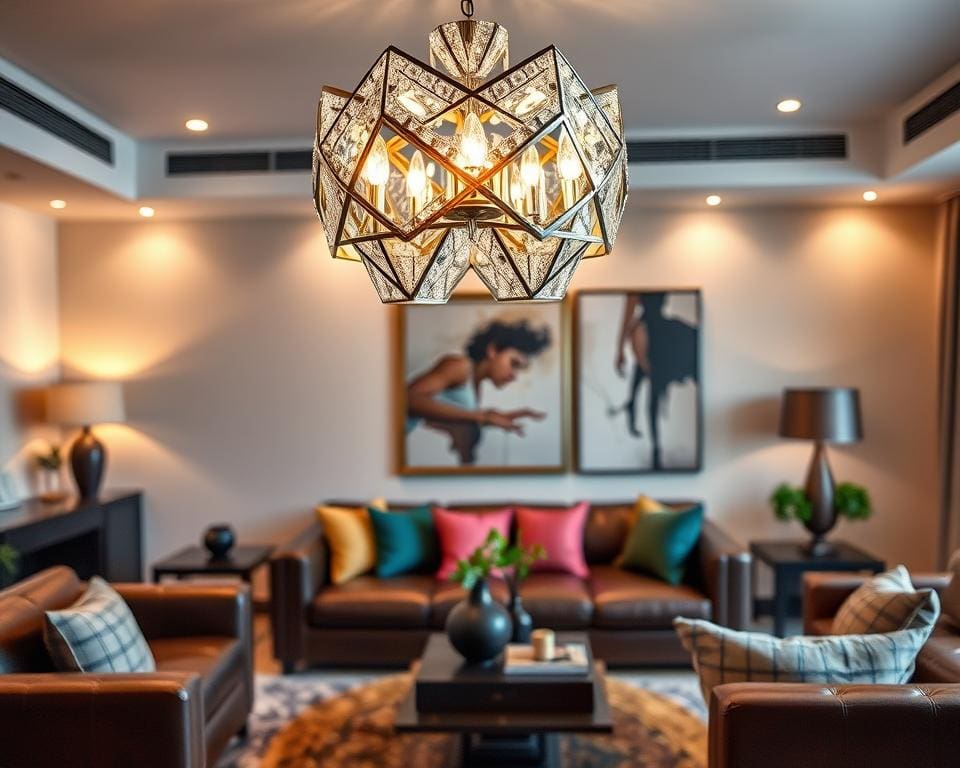
Statement lighting often defines a room at a glance. Large or distinct fittings — from statement chandeliers to oversized pendants — act as feature light fittings that command attention while providing practical illumination.
These pieces work on two levels. As focal point lighting they serve as aesthetic centrepieces, shaping the visual balance of a space. At the same time, they influence how surfaces and colours appear, guiding movement and mood through carefully considered light.
In UK homes, from Victorian bay-fronted living rooms to contemporary London apartments, statement lighting transforms character. A pendant focal point can make a low-ceiling room feel anchored, while a sculptural chandelier suits high ceilings in Georgian townhouses. Practical matters such as ceiling height, conservation area restrictions and compatibility with LED retrofit solutions from Philips, Flos and Tom Dixon will be considered later in the guide.
This article will explore why our eyes settle on certain fixtures, the design elements that create impact, the practical benefits of layered lighting, and clear advice on choosing and placing statement pieces in British homes.
Why are statement lighting fixtures a focal point?
Statement lighting becomes a natural centre of attention because it combines novelty, form and function. A bold pendant or chandelier cuts through everyday surfaces and offers a visual anchor. That anchor helps organise a room and gives people somewhere to look and gather.
Psychology of visual attention
The human eye and brain favour objects that contrast with their surroundings. Selective attention means high-contrast, novel and centrally placed items stand out. A dramatic light fitting gives exactly that contrast, making it easier for occupants to notice and remember.
Gestalt ideas such as figure–ground, focal point anchoring and the law of Prägnanz show why fixtures read as clear centres of interest. The brain simplifies complex scenes by treating a bold shape as the main element. Environmental psychology finds well-lit objects attract more attention and that movement or shimmer increases salience.
Architectural and interior design principles
Focal points operate within composition through balance, harmony and hierarchy. A single statement piece can set a visual order, guiding people towards a dining table, stairwell or seating area.
Lighting can crown architectural features or compensate where a room lacks drama. Chandeliers once gave vertical emphasis in Georgian halls. Today, oversized pendants define zones in open-plan living while creating a clear hierarchy of space.
How scale, form and contrast draw the eye
Scale matters. A pendant must relate to ceiling height and room width to feel right. Oversized pieces suit double-height spaces. Medium-scale fixtures work in typical UK rooms when placed with care.
Form creates recognition. Linear, radial and organic silhouettes read like sculptures. Suspended at eye level, these shapes behave as artwork and invite closer inspection.
Contrast in colour, material or luminance captures attention. A dark fixture against a pale ceiling, a glossy surface beside matte surrounds, or a warm lamp in a cool-lit room all increase perceptual contrast. In UK flats with lower ceilings and open-plan layouts, subtle scaling and thoughtful contrast ensure a fixture stands out without overwhelming the space.
Design elements that make lighting fixtures stand out
Statement lighting becomes unforgettable when materials, shape and surface work in concert. Selecting the right lighting materials and lighting finishes sets the scene. Careful attention to colour, texture and reflective lighting surfaces helps transform a fixture from functional into focal.
Materials and finishes that create impact
Blown glass, hand-blown Murano glass, polished chrome, aged brass, copper and smoked glass each lend a distinct mood. Natural stone such as marble and warm timbers sit well against woven rattan for a tactile contrast. Brands like Tom Dixon, Astro Lighting and Anglepoise showcase artisanal techniques and sustainable practices.
Polished metals and glass reflect and amplify light to create sparkle. Patinated metals and matte finishes absorb light, giving a sense of weight and presence. There is growing demand for recycled glass, ethically sourced woods and low‑VOC finishes that favour long life and low environmental impact.
Modern LEDs change how materials behave. Slim profiles and concealed light sources suit resin and acrylic, while micro-LED arrays and edge-lit panels let translucent materials glow evenly.
Unique shapes and sculptural silhouettes
Signature silhouettes include cascading chandeliers, orb clusters, linear bars, asymmetrical mobiles and ribboned LED forms. These shapes read as artwork from many angles and reward movement within a room.
Sculptural lighting creates depth and casts complex shadows that enrich a stairwell or hallway. Designers such as Philippe Starck, Lindsey Adelman-inspired cluster pendants and Tom Dixon’s Beat collection illustrate how three-dimensional forms capture attention.
Unique pendant designs with layered elements perform well where viewpoints shift. This dynamic quality turns transitional spaces into moments of design theatre.
Colour, texture and reflective surfaces
Bold coloured glass and enamelled metals introduce accent colour without repainting walls. Warm metallics like brass and bronze add warmth to British interiors that use cooler tones.
Ribbed glass, hammered metal, woven fibres and frosted finishes give tactile interest and change light diffusion. Mirrored or highly polished elements create bright glints while opal glass and diffusers soften output for ambient glow.
For home settings, warm white light at 2700–3000K feels inviting. Choose fittings with CRI 90+ to show artworks and finishes accurately under the light.
Practical benefits that amplify their focal role
Statement lighting does more than catch the eye. It shapes how a room works and feels through considered design and technology. Use a single fixture as the centrepiece, then build around it to gain control and flexibility.
Illumination layering gives rooms depth and purpose. Think in three simple layers: ambient for overall light, task for focused work, and accent to highlight features. A chandelier can supply ambient light in a lounge, while a pendant becomes task lighting above a kitchen island. Accent lamps bring art or textured walls to life.
Pairing a focal piece with recessed downlights, wall lights or table lamps avoids dependence on one source. This strategy reduces harsh shadows and glare. In many UK homes a pendant over a dining table works well with dimmable downlights to provide even coverage and atmosphere.
Technical choices matter for safe, reliable installation. Use dimmers and zoning to create scenes. Ensure compatible LED drivers and follow BS 7671 when wiring. Consult a qualified electrician about load, ceiling fixings and fire-safety for period ceilings.
Enhancing mood and atmosphere relies on brightness, colour temperature and light distribution. Warm, lower lux levels invite intimacy. Brighter, cooler outputs encourage focus and activity. A dramatic chandelier can make a room feel celebratory, while a soft-glow pendant produces a cosy dining nook.
Smart controls add versatility. Systems from Philips Hue and Lutron let you store scenes for entertaining, relaxing or task work. Dimmable statement fixtures extend usefulness from lively gatherings to quiet evenings.
Functionality paired with aesthetics means choosing pieces that perform as well as they look. Functional statement lights must provide adequate illumination for reading, cooking or dining. Consider glare control, beam direction and ease of cleaning when selecting a design.
Durability and certification affect lifetime value. Buy from reputable UK retailers such as John Lewis & Partners, Habitat and David Hunt Lighting to ensure quality fittings and aftercare. LED statement fixtures reduce running costs and maintenance. Retrofit LED lamps are available for vintage fittings to meet energy standards and lower lifetime expense.
- Use layered lighting to balance ambience and purpose.
- Fit dimmable statement fixtures for flexible scenes.
- Prioritise certified, energy-efficient designs for long-term value.
How to choose and place statement lighting in UK homes
Begin by assessing the room and its purpose. For dining areas, a pendant often acts as a zone-definer; hanging height of around 75–90 cm above the table works in many UK homes but adjust for ceiling height. In hallways, stairwells and living rooms the fixture may serve as sculpture or task light, so measure room dimensions and consider the pendant diameter — roughly one third the width of the dining table is a reliable rule when you choose statement lighting.
Match the style to the architecture and interior. For period properties, especially Georgian or Victorian homes, select finishes like brass or crystal to suit period proportions; for contemporary flats opt for minimalist metallics or organic forms. Think about the existing colour palette and tactile materials to ensure cohesion; this helps you place pendant UK fittings so they feel integrated rather than bolted on.
Address technical and practical placement early. Check ceiling fixings and joist support if you plan a heavy chandelier and hire a professional for reinforcement in older properties. Follow wiring standards such as BS 7671 and use IP-rated fittings in bathrooms or outdoors. Specify dimmable drivers and consider multi-circuit control to layer light and mood effectively — a practical step whenever you place pendant UK lights.
Budget with realism and plan for maintenance. Designer or bespoke pieces command higher sums, while British brands like Tom Dixon, Anglepoise, Habitat, John Lewis & Partners and Heal’s offer trustworthy alternatives and showrooms to test scale. Learn simple cleaning methods for polished metals, glass and fabrics, keep LED modules replaceable and check for aftercare warranties. Treat statement lighting as an investment: one well-chosen piece can redefine a room, whether you are fitting statement lighting for Victorian homes or a modern apartment, so use mood boards, showroom visits and specialist advice for complex installs.