
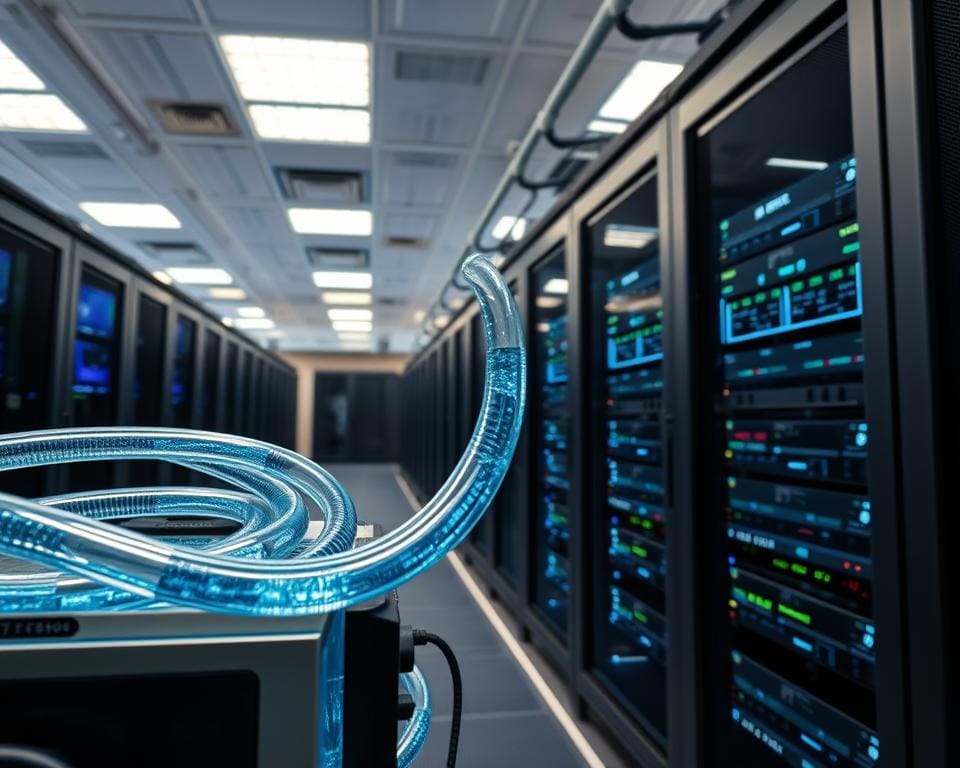
You are seeing a clear shift in data centre cooling strategies across the UK. Rising rack power densities driven by AI, machine learning and GPU clusters push air-based systems to their limits. When a single rack can draw tens of kilowatts, traditional server cooling struggles to keep chip temperatures safe and energy costs down.
Vendors such as Intel, Schneider Electric, Vertiv and Rittal report growing deployments of direct-to-chip cooling and immersion cooling at hyperscalers and colocation providers. That market momentum shows liquid cooling is no longer a niche option; it is a practical response to the demands of high-density data centres.
Regulation and corporate commitments also steer the change. Net zero targets, upcoming UK and EU efficiency rules, and tighter corporate ESG aims make reducing energy use and carbon intensity essential. Liquid cooling offers measurable gains in energy efficiency and lower PUE compared with air-only approaches.
This article will give you a concise technical primer, outline operational and economic drivers, and highlight practical steps and risks to consider before you adopt liquid cooling. You will find actionable insight on server cooling choices, whether you evaluate immersion cooling, direct-to-chip cooling, or hybrid solutions for your site.
liquid cooling: what it is and how it differs from air cooling
You will find liquid cooling technology uses fluids to carry heat away from processors and other components. It replaces the primary role of airflow with liquids that have far greater thermal capacity. That change affects system design, maintenance and energy reuse strategies.
Key approaches vary from cold plates that sit on CPUs to whole-rack solutions. Each option balances complexity, performance and compatibility with existing infrastructure.
Fundamentals of liquid cooling technology
At the core, liquid cooling transports heat with water, glycol blends or engineered dielectric fluids. You will see single-phase systems move warm fluid away, while two-phase cooling leverages boiling and condensation to extract heat more efficiently.
Common system types include direct-to-chip cold plates that attach to CPUs and GPUs. Rear-door heat exchanger units retrofit to air-cooled racks and remove heat at the rack exhaust. Immersion cooling places electronics in dielectric baths; single-phase immersion keeps the fluid liquid, while two-phase immersion uses phase change for higher heat transfer.
Vendors such as Dell Technologies, HPE, Mitsubishi Electric and Submer publish implementation guides and case studies you can consult. Typical coolants range from deionised water to 3M Novec fluids, chosen for thermal properties and electrical safety.
Performance advantages over traditional air cooling
Liquid systems deliver higher heat removal rates because liquids have greater thermal conductivity and specific heat than air. That lets you support much denser racks, with some installations reaching 30–100 kW per rack or more.
Less reliance on volumetric airflow reduces fan counts and lowers power draw from CRAC or CRAH units. You will notice tighter server inlet temperature control and reduced thermal variability, which can improve component reliability.
Higher return-water temperatures create new options for heat reuse. District heating or adsorption chillers can accept warmer water, boosting the economics of energy recovery compared with air-cooled setups.
Design considerations and integration options
You can choose retrofit paths like rear-door heat exchangers and hybrid racks, or plan greenfield deployments with built-for-liquid servers and chilled distribution systems. Each path demands different mechanical and electrical changes.
Facility upgrades often include coolant distribution units, pump stations, leak detection and separation of electrical systems. Consider raised-floor versus slab arrangements and the location of CDUs when planning layout and cable runs.
Reliability planning should cover N+1 pumps, redundant heat exchangers and isolation valves to avoid single points of failure. Follow ASHRAE thermal guidance and IEC electrical safety standards when specifying components. Schneider Electric and Vertiv offer reference architectures that illustrate these practices.
Capital costs typically rise for equipment and CDUs, but operational savings often offset the initial spend. You should evaluate interoperability between open and proprietary CDUs and choose vendors that fit your long-term maintenance and upgrade strategy.
Operational and economic drivers for adoption in data centres
You will find that operational gains sit alongside clear economic incentives when evaluating liquid cooling. The move lowers the facility cooling load, which can drive measurable PUE improvement in high-density halls. Many hyperscale and enterprise sites report step changes in PUE once heat is removed at source and chiller runs are reduced.
Moving heat into liquid cuts fan and air-handling energy. You will rely less on raised-floor plenum design and large CRAC units, which helps when free-cooling is available in UK climates. Some operators see higher return temperatures that enable efficient heat rejection or reuse for district heating.
You must weigh upfront capital against ongoing savings. Capital expenditure for CDUs, specialised racks and modified servers is higher than for legacy air systems. Models over three to ten years commonly show lower total cost of ownership (TCO) thanks to reduced energy bills and greater compute per square metre.
Operational expenditure falls through reduced chiller and fan power. You can shrink energy consumption across mechanical systems and recover rack density that cuts site footprint. Maintenance patterns change; pumps and coolant checks replace large-scale air distribution servicing, which some operators find less frequent and less disruptive.
Financing options from major vendors can spread CAPEX and speed payback. Leasing and vendor financing in the UK market make upgrades accessible for both colocation providers and enterprise IT teams. You should model scenarios that include energy price volatility to capture the full TCO effect.
New rules and corporate targets are shifting procurement. UK and EU policy on net-zero and energy efficiency increases the incentive to deploy lower-carbon solutions. Organisations face greater pressure for regulatory compliance and for demonstrable carbon reduction in their infrastructure choices.
Liquid cooling supports Scope 2 reductions by lowering electricity demand. When heat reuse is feasible, you can impact Scope 3 reporting and form partnerships with local councils or industry to sell waste heat. These steps strengthen sustainability credentials and meet stakeholder demands for greener colocation options.
Procurement teams at major cloud providers and large corporates increasingly require proof of lower-carbon cooling. That demand shapes market offerings and influences where operators invest. Your business case should include potential marketing benefits from verifiable energy metrics and carbon reduction claims.
Practical considerations for implementing liquid cooling in your data centre
Start with a clear readiness assessment. Run a heat-density audit and capacity plan to identify racks and workloads that will benefit most, such as GPU clusters and high-density compute pods. Engage your IT, facilities, procurement, legal and sustainability teams early so contractual changes, warranties and operational impacts are understood before you commit to a data centre retrofit.
Choose the right technical approach for your tolerance to downtime and budget. Retrofit options like rear-door heat exchangers and hybrid racks reduce disruption, while direct-to-chip and immersion systems deliver higher efficiency. When you design the liquid loop, specify coolant distribution units capacity, pump redundancy (N+1 or 2N), piping layouts and materials compatible with your coolant, and incorporate robust leak detection systems and containment.
Plan building integration and reuse of energy. Tie-ins to chilled water, heat exchangers for loop isolation and routes for heat reuse — for district heating, absorption chillers or on-site processes — will improve overall return on investment. Consider vendor compatibility and proven products from firms such as Fujitsu, Submer and Green Revolution Cooling to reduce risk and preserve server warranties.
Define risk management, maintenance and commissioning processes up front. Establish scheduled coolant testing, filter and pump servicing, drain-and-fill procedures, and skills training or third-party managed services. Use factory acceptance tests and phased site acceptance tests during commissioning to validate performance under load. Integrate CDU telemetry, temperature and flow sensors into your facility and IT monitoring stacks, track PUE and WUE, and start with a pilot or hybrid retrofit to de-risk wider roll-out.