
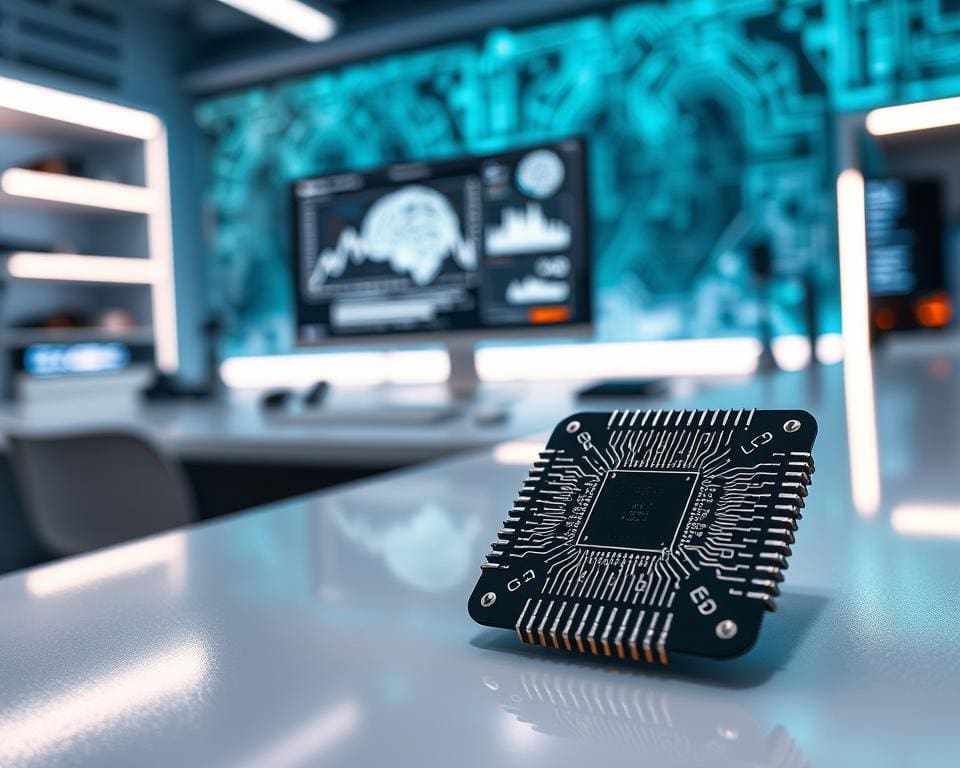
You should care about neuromorphic chips because they offer a new way to run intelligence on devices you use every day. These brain-inspired chips mimic aspects of the human brain’s structure and function, enabling neuromorphic computing that departs from traditional processor design. That matters now because AI is being deployed faster than our current hardware can handle.
Current chips struggle with power consumption, latency and scaling when you push them for continuous, on-device AI. Smartphones, autonomous vehicles, robots and IoT sensor networks increasingly need efficient, low-latency processing at the edge. The question of why neuromorphic chips matters is tied to this rising demand for real-time, energy-aware intelligence.
Industry and academia are taking notice. Intel’s Loihi, IBM’s TrueNorth and university groups such as the University of Manchester’s neuromorphic research highlight growing interest. Startups and UK research councils are also funding projects that explore neuromorphic technology UK and commercial applications.
The promise is simple: by emulating neural computation patterns, brain-inspired chips could deliver large gains in energy efficiency, faster real-time responses and improved privacy through on-device processing. This article will explain what neuromorphic chips are, how they work, why industry investment is increasing and what challenges and use cases you should expect next.
What neuromorphic chips are and how they work
You will find this section useful if you want a clear, practical grasp of what are neuromorphic chips and why they look different from ordinary processors. Read on for a compact guide to core design ideas, the role of spiking neural networks and the contrast between von Neumann vs neuromorphic systems.
Definition and core principles
At heart, neuromorphic chips are processors built to mirror how biological brains organise computation. They use many simple processing units that act like neurons, dense synaptic connections that store weights locally and asynchronous signalling that avoids a global clock. Designers choose analogue or mixed-signal circuits, memristors and other non-volatile elements to embed synaptic memory close to computation. The result targets low-power operation, fault tolerance and continual learning through local updates.
Commercial examples help you see the idea in practice. IBM TrueNorth implements a large array of neurosynaptic cores in digital form. Intel Loihi provides on-chip learning features aimed at research and prototyping. Academic teams pursue memristor-based devices to shrink energy per synaptic operation further.
Spiking neural networks and event-driven processing
Spiking neural networks form the common computational model for this hardware. Neurons signal with discrete spikes, not steady activations, so information can be carried in timing and in sparse patterns of events. This makes event-driven computing natural: chips react when spikes occur, not on every clock cycle, which cuts needless activity and saves power.
Learning on spiking networks uses local rules such as spike-timing-dependent plasticity, plus conversion methods that map trained deep nets into spiking equivalents. Some neuromorphic chips support on-chip learning, letting devices adapt in situ. Event-based vision sensors, like Dynamic Vision Sensors, pair well with this approach for low-latency perception tasks.
Comparing architectures
You should compare von Neumann vs neuromorphic to spot the trade-offs. Von Neumann systems keep CPU and memory separate and run sequential instructions, which forces frequent data movement. That data shuttling causes the von Neumann bottleneck and raises both energy use and latency for memory-heavy workloads.
Neuromorphic architecture colocates memory and computation across many tiny elements and runs massively parallel, asynchronous processes. That layout reduces data movement and excels at pattern recognition and temporal signal processing on the edge. Benchmarks and vendor claims report large gains in energy per inference and latency for specific tasks, but results vary by workload and testing method.
Keep in mind that neuromorphic chips are not drop-in substitutes for general-purpose CPUs or GPUs. Software stacks and programming models remain less mature, so you may need custom toolchains and tailored models to unlock the best results.
Why the tech industry is investing in neuromorphic chips
Interest in neuromorphic chip benefits stems from clear market needs: lower power, faster responses and stronger on-device privacy. You will see investment where those needs match product demands, such as wearables, robotics and smart sensors. UK neuromorphic research and international projects feed a steady flow of prototypes and data that draw both public and private funding.
Energy efficiency and low-power operation for edge devices
One primary attraction is energy-efficient AI. Neuromorphic designs use sparse, event-driven activity and local memory. That approach cuts energy per computation compared with constant-clock GPUs and CPUs. Demonstrations from Intel Loihi and IBM TrueNorth reported major drops in energy consumption on selected tasks, which matters when battery life and always-on sensing are essential.
You will find this advantage most useful in edge AI chips for wearables, mobile devices and environmental monitors. Those products need long operational lifetimes and tight energy budgets. UK industries in healthcare and field sensing stand to gain from lower maintenance and longer deployment cycles.
Latency reduction and real-time processing benefits
Spiking, event-driven architectures process information as events occur. That lowers latency because computation does not wait for large batched cycles. Systems such as drones, robotics and driver assistance rely on such fast reaction times to be safe and effective.
Benchmarks in vision and auditory pipelines show neuromorphic chains can produce lower end-to-end latency than conventional approaches. Real gains depend on integrating sensors and aligning tasks with the chip’s strengths, but the potential for real-time processing is clear.
Potential to improve on-device AI and privacy
On-device inference reduces the need to stream raw data to cloud servers. That supports on-device privacy and helps you meet UK and EU data protection expectations. Neuromorphic modules can run personalised models locally and adapt without sharing sensitive inputs.
This capability appeals to healthcare monitoring, smart homes and security cameras where privacy and quick responses matter. You can limit exposure of personal data while keeping latency low, a combination that attracts both consumers and regulated industries.
Commercial and research investment trends in the UK and globally
Global AI hardware investment is driven by multinational semiconductor firms, startups and academic consortia. Intel and IBM remain visible with lab systems, while venture capital and corporate partnerships back startups aiming to embed neuromorphic cores into edge AI chips for automotive and robotics markets.
UK neuromorphic research plays a clear role. Groups at the University of Manchester, University of Oxford and Imperial College London work on hardware and software, with funding from UKRI and collaborations through the Faraday Institution. Those links help translate lab results into prototypes that attract industry partners.
Investment follows market signals: energy constraints, latency needs and privacy demands. Widespread adoption still depends on stronger software tools, standard benchmarks and developer ecosystems that make the neuromorphic chip benefits practical for product teams.
Challenges, use cases and future outlook for neuromorphic chips
You should weigh several neuromorphic challenges before piloting a project. Technical barriers remain: software toolchains are immature, mainstream machine‑learning models do not map easily to spiking neural networks, and analogue device variability complicates reproducible behaviour. Manufacturing novel components such as memristors also raises questions about yield and long‑term reliability. These issues feed into neuromorphic adoption barriers that affect total cost of ownership and commercial viability.
Despite that, there are clear neuromorphic use cases where the technology already offers advantages. Edge vision for drones and autonomous robots benefits from event‑driven cameras that cut latency and power. Always‑on keyword spotting and industrial sensor monitoring suit devices that must run for months on a battery. Wearables, prosthetics and on‑body biomedical devices can use on‑chip preprocessing to protect patient privacy and extend battery life. You can also find value in research settings where neuromorphic platforms help test hypotheses about biological computation.
In the short to medium term, expect hybrid systems to dominate the future of neuromorphic computing. Neuromorphic modules will complement CPUs, GPUs and specialised AI ASICs for sensor preprocessing and low‑power inference. Incremental adoption will be driven by niche commercial wins and co‑designed sensor‑hardware solutions. For the UK, targeted funding, cross‑disciplinary training and partnerships between universities, industry and government can help build supply chains and developer communities that reduce neuromorphic adoption barriers.
When planning your strategy, prioritise pilot projects with academic partners or vendors to assess real‑world fit. Focus on energy‑constrained, low‑latency edge applications and monitor emerging toolchains and benchmarks before scaling. If software matures, manufacturing issues are resolved and robust synaptic devices appear, the long‑term future of neuromorphic computing could broaden into adaptive, personalised systems across automotive, medical and industrial domains. For now, pragmatic trials will tell you where neuromorphic chips applications make the most sense.