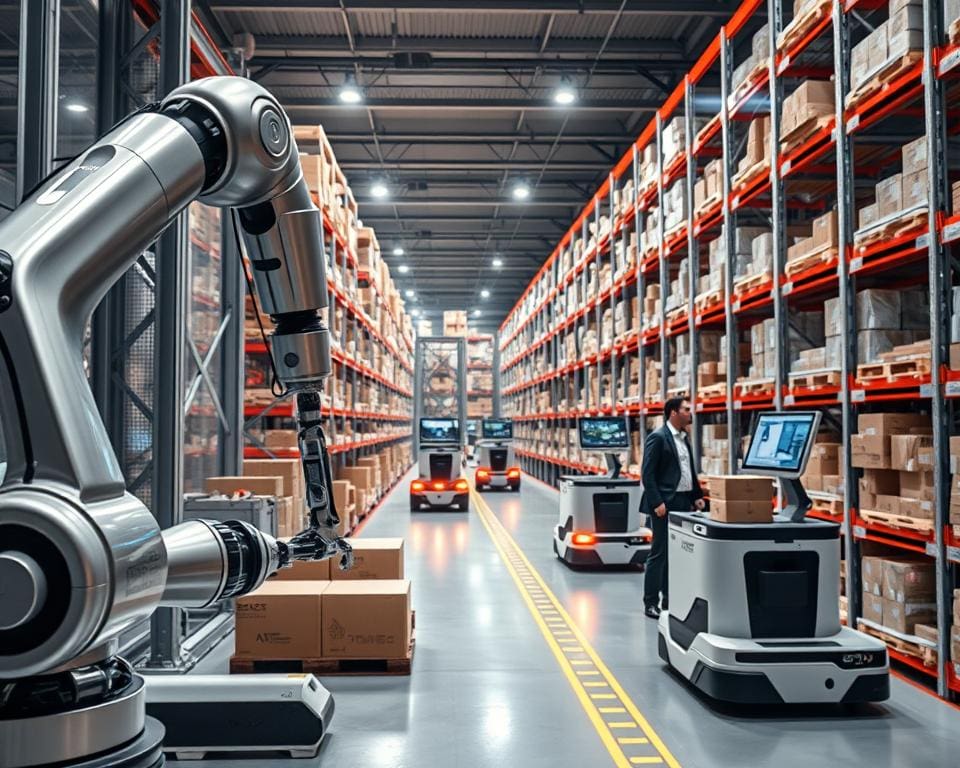
You are seeing autonomous warehouses appear across the UK because market pressures no longer make manual-only operations viable. Rapid e-commerce growth, tighter delivery windows and volatile peak seasons force retailers and 3PLs to seek solutions that raise throughput and resilience without proportionate increases in labour or footprint.
Major players such as Amazon and Ocado have invested heavily in robotics and automation, proving commercial feasibility and prompting rivals and automation vendors to follow. That visible investment accelerates vendor ecosystems and a rising number of pilots and live sites across Europe, showing you that warehouse automation UK is moving from niche trials to mainstream deployment.
For your operation, the benefits of autonomous warehouses are practical and measurable. Expect higher order accuracy, better inventory visibility and the ability to scale capacity quickly. Autonomous logistics can deliver these gains while moderating staff costs and improving safety through more predictable workflows.
Investment trends back this up: robotics firms like Fetch Robotics and GreyOrange, plus Amazon Robotics capabilities, are expanding system-integrator partnerships and modular offers. At the same time, regulators and safety standards for mobile robots, and data-protection rules where AI and computer vision are used, shape roll-out timetables and design choices.
This article will next define autonomous warehouses, outline the core technologies, explore market drivers and finish with practical implementation considerations so you can assess suitability and plan a deployment with confidence.
autonomous warehouses: what they are and why they matter
Autonomous warehouses change how you fulfil orders by blending machines, software and sensors to run core tasks with minimal hands‑on input. This short guide explains what are autonomous warehouses, offers a clear warehouse autonomy definition and shows why these systems matter for speed, accuracy and scaling your operation.
Defining autonomous warehouses
An autonomous warehouse combines autonomous mobile robots (AMRs), automated guided vehicles (AGVs), machine vision, machine learning and orchestration software to carry out receiving, putaway, storage, picking, packing and dispatch. Full autonomy remains rare in live sites; most installations use supervised autonomy where people oversee flows, handle exceptions and complete complex tasks.
Real deployments show the range of approaches. Amazon Robotics and Ocado demonstrate systems that mix robotics in warehouses with sophisticated AI warehouse software to speed throughput and reduce errors.
Key technologies powering autonomy: robotics, AI and automation software
Robotics form the physical layer. AMRs and AGVs move goods across the floor. Robotic arms and AS/RS units handle picks and storage. Vendors such as Mobile Industrial Robots (MiR) and Fetch Robotics supply AMRs used in many European fulfilment centres.
AI and computer vision enable item recognition, quality checks and dynamic mapping. Machine learning refines path planning, demand forecasting and exception detection. That intelligence sits inside WMS, WES or bespoke orchestration platforms to drive real‑time decisioning.
Orchestration software synchronises robots, conveyors and human tasks. Integration with ERP and transport systems delivers end‑to‑end visibility. Sensors like LiDAR, RFID and IoT devices, together with robust Wi‑Fi or 5G, support localisation and connectivity. Digital twins help you model flows and test layouts before you commit to hardware.
How autonomy differs from traditional warehouse automation
Fixed automation relies on conveyors, sorters and static AS/RS. Autonomous solutions favour flexibility and software‑driven optimisation. AMRs navigate changing layouts while fixed systems demand bespoke civil works and higher capital outlay.
Operationally, autonomy lets you reconfigure lanes and pick paths quickly to meet changing SKU mixes or seasonal demand. Your staff shift from repetitive handling to supervision, exception management and maintenance roles.
Benefits for your supply chain: speed, accuracy and scalability
Autonomous picking and goods movement cut travel time and raise orders per hour, helping you meet same‑day commitments. Computer vision and automated scanning reduce picking errors and improve cycle counts, lowering returns and boosting customer satisfaction.
Modular autonomous systems scale to seasonal peaks or new micro‑fulfilment locations without major rebuilds. Upfront costs can be high, but total cost of ownership often improves through lower labour spend, better space utilisation and fewer errors. ROI depends on throughput, labour rates and SKU complexity.
Automation also improves safety and ergonomics by reducing manual lifting. The strategic value extends beyond cost: you gain the agility to serve urban markets faster and test new fulfilment models closer to customers.
Market drivers increasing adoption of autonomous warehouses
You face a fast-changing logistics landscape. Growth in online retail, subscription boxes and omnichannel fulfilment has pushed order volumes up and delivery windows down. This e‑commerce impact on warehouses shows up during peaks such as Black Friday and Christmas, when manual processes strain to meet demand.
Your customers expect same‑day or next‑day delivery, clear tracking and simple returns. Those expectations force you to raise throughput and reliability. These pressures are among the primary drivers for autonomous warehouses as operators seek speed without proportionate increases in headcount.
Recruitment and retention have become harder across the UK. Post‑Brexit labour shifts, seasonal hiring spikes and high turnover in warehouse roles create a persistent labour shortage logistics UK problem. Automation reduces reliance on temporary staff and shields operations from market swings.
You will need new skills as roles change. Technicians, systems operators and data analysts replace some manual jobs. Training and upskilling form part of capital plans for many adopters, helping long‑term resilience and talent retention.
Rising costs for labour, property and transport tighten margins. That makes warehouse cost reduction a central business case for automation. Autonomous systems improve space use, cut picking times and lower error rates, which reduces returns and customer service costs.
Vendors now offer robotics‑as‑a‑service and leasing options. Those models shift large upfront expenses into operating budgets, widening access for third‑party logistics providers and mid‑sized retailers that need lower initial outlay.
Pressure to meet corporate sustainability goals and tighter regulation drives interest in sustainable warehousing. Autonomous sites can cut energy use through optimised travel paths, regenerative braking on vehicles and denser racking that reduces building footprint.
Automation also delivers better measurement. Precise energy and throughput data helps you report emissions accurately and supports net‑zero planning across Scope 3 activities. That visibility strengthens both compliance and brand claims.
Each driver—market demand, labour availability, cost pressures and sustainability—interacts with the others. Together, they form a compelling case for the wider roll‑out of autonomous solutions in UK warehousing.
Practical considerations for implementing autonomous warehouses
Start by building a clear business case that quantifies throughput targets, labour savings, error reductions and service levels. Use pilot data or benchmarking to model ROI and payback period so you can compare CapEx purchase, leasing or RaaS options and choose the right commercial model.
Assess your site and SKU profile: dimensions, weight distribution, turnover and storage density will determine whether AMRs, AS/RS units or robotic arms suit your needs. Check power, floor quality, Wi‑Fi/5G coverage and charging locations early so physical infrastructure supports phased warehouse automation implementation.
Integration is critical. Plan WMS integration, ERP and TMS compatibility, vendor APIs and middleware plus cybersecurity standards. Clean master data for SKU, bin and inventory records before you deploy; poor data will undermine performance and slow any AMR deployment checklist you follow.
Adopt a phased approach: proof of concept, controlled pilot and staged scaling. Set KPIs such as orders per hour, pick accuracy, cost per order and uptime, and use analytics or a digital twin to iterate on slotting and routes. Factor in routine maintenance, spare parts and vendor SLAs so support and upgrades are budgeted and reliable.
People and safety matter. Plan change management in warehouses with retraining for maintenance, robot supervision and exception handling. Conduct HSE risk assessments, install safety zones and sensors, and ensure robots meet UK safety certifications to keep staff and operations protected.
Finally, evaluate vendors for proven UK deployments, integration capability and total cost of ownership. Use a final decision checklist to answer key questions on expected throughput gains, integration complexity, workforce impact, capital availability and sustainability before you commit to full implementation.