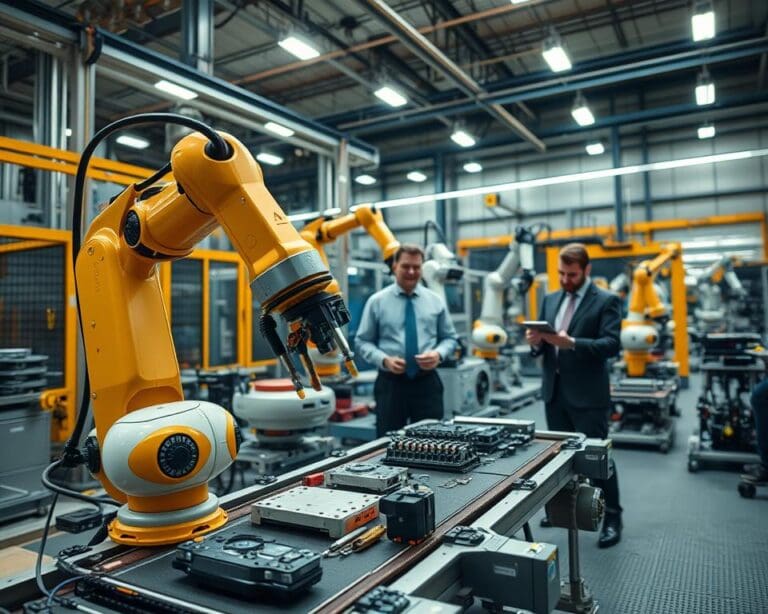

Artificial intelligence brings together machine learning, deep learning, computer vision, natural language processing and robotic process automation to reshape modern industry. In manufacturing, healthcare, finance, retail and logistics, AI acts as both an efficiency tool and a catalyst for innovation. This section defines the scope of AI and why the artificial intelligence impact is now central to strategic planning.
Adoption is rising fast across the UK and worldwide. The UK AI Strategy and increased venture investment spotlight AI innovation UK, while cloud services from Google Cloud, Microsoft Azure and Amazon Web Services make AI in business easier to deploy. Small and large firms alike report projects that move from pilot to production at greater speed.
Organisations such as the OECD and McKinsey estimate notable gains in GDP and productivity from AI transformation industry initiatives. Evidence shows AI can cut costs, shorten time-to-market and enhance customer experience. These gains explain why businesses prioritise AI as a source of new value.
This article will examine core mechanisms of change—automation, data-driven decision making and new business models—then explore operational benefits like efficiency, safety and cost reduction, before addressing strategic and societal impacts such as workforce change, regulation and ethics. The aim is to give UK business leaders and policy-makers practical insight into how is artificial intelligence transforming industry.
How is artificial intelligence transforming industry?
AI is reshaping ways firms operate and compete. Organisations from manufacturing to healthcare use intelligent systems to cut routine work, uncover patterns in data and create new commercial offerings. Practical adoption spans the AI automation industry and supports a broader machine learning industry transformation across the UK and Europe.
Automation of routine and complex tasks
Robotic process automation combined with natural language processing handles clerical duties such as invoice processing, claims handling and customer chat. These systems reduce error rates and free staff to focus on higher-value work.
In factories and labs, computer vision inspects quality and reinforcement-learning robotics guide assembly lines. Clinical teams use AI-assisted diagnostics to triage radiology images faster, improving patient pathways. Siemens and ABB provide AI-enabled systems for predictive maintenance and robotic automation, while banks deploy models for transaction monitoring and fraud detection. The NHS runs pilot programmes to test triage tools at scale.
Limits remain: legacy IT, the need for labelled data and the necessity of human-in-the-loop oversight for critical decisions. Successful integration depends on careful change management and realistic data strategies.
Data-driven decision making and predictive analytics
Machine learning models turn large datasets into actionable insight. Use cases include demand forecasting, dynamic pricing, churn prediction and optimisation of marketing spend. Tools such as TensorFlow, PyTorch and Databricks, plus cloud services from Microsoft, Google and AWS, power these efforts in many UK firms.
Predictive maintenance uses sensor telemetry and time-series analysis to detect faults before they cause downtime. Industrial case studies report higher uptime and lower maintenance costs when models are correctly implemented and maintained.
Trust requires governance. Data quality, feature engineering, model validation, explainability and compliance with UK GDPR form the foundation of any credible predictive analytics business.
New business models and revenue streams
AI enables product-as-a-service and outcome-based contracts where equipment is monitored and billed by output or uptime. Firms in engineering and construction offer simulation-as-a-service and digital twins, turning expertise into subscriptions.
Platformisation creates marketplaces with smarter matching for logistics and talent, increasing network effects and scale. Companies monetise through licensing models, selling aggregated insights or embedding AI features that justify premium pricing.
These shifts grow AI revenue streams UK-wide and spur AI-driven business models that change how value is delivered to customers in both B2B and B2C markets.
Operational benefits: efficiency, safety and cost reduction
AI is reshaping operations across British industry, turning data into steady gains in efficiency, safety and cost control. Manufacturers, logistics teams and safety managers use intelligent tools to cut waste, speed decision making and protect people on site. These advances support net zero aims and boost competitiveness for firms across the smart manufacturing UK landscape.
Process optimisation and smart manufacturing
Process optimisation AI draws on real-time sensor feeds, machine learning and control systems to tune production settings as conditions change. In chemical plants, predictive control algorithms keep reactions within tight bands to reduce scrap and energy use. Automotive lines use computer vision to find defects early, raising yield and cutting rework.
Adoption of IIoT combined with AI enables continuous improvement cycles. UK manufacturers gain leaner operations and improved energy efficiency, which helps meet carbon-reduction targets and compliance demands. Case studies report lower cycle times, higher throughput and measurable energy savings from smarter scheduling and adaptive process control.
Supply chain resilience and inventory forecasting
Inventory forecasting AI improves accuracy by modelling seasonality, promotions and external shocks such as weather or geopolitical events. Retailers and grocery chains in the UK use these models to reduce fresh produce waste and improve shelf availability.
AI supply chain resilience depends on tools for anomaly detection, route optimisation and supplier risk scoring. Logistics providers reroute shipments when hubs close and manufacturers balance multi-tier supplier networks to keep lines moving. The economic impact shows in lower carrying costs, less obsolescence and higher fulfilment rates.
Workplace safety improvements through AI monitoring
AI workplace safety solutions use computer vision, audio analytics and wearables to spot hazards, check PPE compliance and detect fatigue on factory floors and construction sites. Edge-AI gives real-time alerts so teams can act fast and reduce incidents and near-misses.
Deployments that combine intelligent sensors and clear response protocols report faster emergency responses and safer sites. Legal and privacy concerns require firms to craft transparent policies, consult unions and follow UK employment and data protection law. Ethical, open roll-outs build trust and keep safety gains durable.
Strategic and societal impacts of AI adoption
AI strategic impact is reshaping how UK firms plan for the future. Automation of routine tasks shifts demand towards roles that require creativity, complex problem‑solving and oversight of AI systems. This AI workforce transformation raises the need for large-scale upskilling and reskilling programmes, and private–public partnerships such as those between Nesta, the Open University and leading tech employers are helping to fill skills gaps.
New occupations are emerging alongside traditional roles: data scientists, machine learning engineers, AI ethicists and MLOps specialists are in growing demand. Tech clusters in London, Cambridge and Manchester already provide rich opportunities, while regional initiatives aim to spread jobs more evenly across the UK. Businesses that invest in talent and data infrastructure gain a clear strategic advantage.
Regulation of AI and AI ethics UK are central to trust and adoption. The UK GDPR, sector safety standards and the government’s evolving AI governance framework require firms to prioritise transparency and accountability. Practical steps such as model audits, impact assessments and stakeholder engagement help reduce algorithmic bias and improve explainability, supporting both compliance and consumer confidence.
The societal impact artificial intelligence brings both opportunity and risk. Productivity gains can fund better public services but may also widen regional inequality if benefits concentrate in a few hubs. Inclusive policies are needed: targeted education, support for SMEs to adopt AI and investment outside London will help ensure more equitable outcomes. For business leaders, clear AI strategies, pilot projects that scale and responsible‑AI frameworks are practical moves. For policy‑makers, fostering pro‑innovation regulation, funding reskilling and collaborating internationally on standards will determine whether AI strengthens the UK economy and society in the long term.