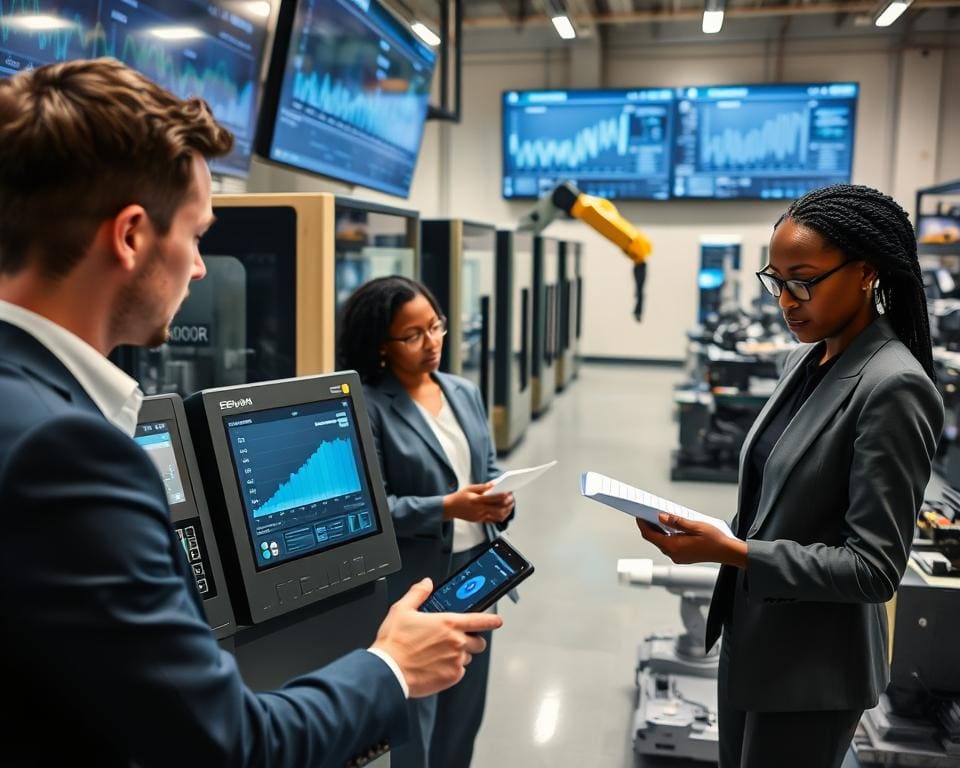
This article explains how machines produce and share useful information, and why the right choices in hardware and design matter. Machine data collection covers sensor data gathering from temperature, vibration, pressure and flow sensors, embedded system logs from controllers and PLCs, and telemetry collection from applications and devices. Data may stream continuously or arrive as event-driven logs and alarms.
Industrial data capture serves many goals: operational monitoring, predictive maintenance, compliance reporting, performance optimisation and product development. Practical examples include National Instruments DAQ units recording test signals, Siemens and Rockwell Automation PLCs emitting status metrics, and Bosch or Honeywell sensors supplying environmental readings.
Key performance indicators for effective collection are sampling rate, resolution, latency, data integrity, uptime, environmental robustness and total cost of ownership. These metrics guide decisions about edge processors such as NVIDIA or Intel hardware when preprocessing and low-latency inference are needed.
Read on for a technology overview, and for guidance on how hardware is selected for specific tasks, sensor and signal-conditioning practice, DAQ and edge processing roles, secure transmission, and the trade-offs of cost and compliance. Choosing the right hardware unlocks actionable insights and operational transformation.
Overview of machine data collection methods and technologies
Machine data drives smarter decisions across industry and consumer domains. Readers will find a clear map of common approaches, from raw sensor streams to central cloud analytics. This section sets out practical choices and trade-offs for engineers and managers planning data capture.
Types of machine data matter when you design a system. Sensor data delivers analogue or digital readings from transducers that measure temperature, pressure, vibration, strain, acceleration, proximity, optical and chemical properties. Sampling fundamentals such as the Nyquist criterion and aliasing risks determine the minimum sampling rate. Bit depth and resolution affect measurement fidelity and the ability to detect small changes.
Log data records events from firmware, operating systems, PLCs and applications. Logs arrive as structured formats like JSON or CSV and as unstructured text. Timestamps and severity levels help correlate logs with sensor streams for troubleshooting and root-cause analysis.
Telemetry sits between sensors and logs as structured metric streams. It provides periodic or on-demand aggregates such as mean, min and max over intervals. Examples include vehicle telematics and industrial remote monitoring, where telemetry reduces bandwidth by pre-processing data at source.
Sensor vs log data decisions shape storage and processing. Use high-rate sensor capture for control and vibration analysis. Rely on logs for event sequencing and firmware diagnostics. Telemetry helps when you need regular health metrics without raw waveform retention.
Edge computing moves processing to the device or nearby gateway. Microcontrollers, single-board computers such as Raspberry Pi and industrial edge gateways from Siemens and Advantech enable low latency, privacy-preserving pre-processing and real-time control. Edge solutions cut bandwidth use and improve resilience where connectivity is poor.
Fog computing provides an intermediate layer that aggregates multiple edge nodes. Local servers or campus gateways perform heavier analytics, buffer bursts and prepare data for onward transfer. This model suits factory floors and campuses where site-level context matters.
Cloud data acquisition delivers centralised storage and scalable analytics on platforms like AWS, Microsoft Azure and Google Cloud. Cloud approaches enable long-term retention, cross-site correlation and machine learning. Trade-offs include latency, data egress costs and reliance on stable connectivity.
Common communication protocols connect devices across industrial and consumer networks. Modbus remains widespread in legacy and simple PLC environments, available as RTU over serial and TCP for Ethernet networks.
OPC UA offers secure, standardised data exchange for modern industrial interoperability. Use OPC UA where systems require modelled data, security features and vendor-agnostic integration.
MQTT is a lightweight publish/subscribe protocol ideal for constrained networks and many devices. Choose MQTT over HTTP when bandwidth is limited and you need efficient, reliable telemetry distribution. HTTP/REST and CoAP remain useful for request/response patterns and constrained devices respectively.
Wireless options vary by range and energy profile. BLE suits short-range consumer devices. LoRaWAN supports long-range, low-power sensing across wide outdoor areas. Cellular technologies and NB‑IoT deliver wide-area connectivity for remote installations.
Physical layers and fieldbus choices matter for determinism and throughput. RS‑232/485 provide reliable serial links. Ethernet and industrial fieldbuses such as PROFIBUS, PROFINET, EtherCAT and CAN/CANopen serve high-throughput or deterministic control needs.
Practical examples clarify protocol choice. Pick MQTT for fleets of sensors that send small updates. Use OPC UA when integrating heterogeneous control systems on a factory floor. Select LoRaWAN for sparse, battery-powered sensors that need long range and minimal maintenance.
How is hardware selected for specific tasks?
Selecting hardware requires aligning technical requirements, operational constraints and business goals. This section centres on how is hardware selected for specific tasks and offers practical guidance on hardware selection criteria for projects large and small.
Matching processing power to data volume and latency needs
Begin by quantifying data throughput: samples per second × bytes per sample × number of sensors. Estimate peak versus average loads and storage needs. For vibration monitoring a single sensor might produce kilobytes per second during peaks. Environmental sensing often yields much lower steady rates.
Latency matters. Control loops demand millisecond-level, deterministic performance. Use real-time controllers or PLCs for those tasks. Monitoring and analytics can tolerate seconds or minutes, which allows edge nodes or the cloud to be used.
Choose processing classes to fit the task. ARM Cortex‑M microcontrollers handle simple sampling and ultra-low-power jobs. Single-board computers such as the Raspberry Pi Compute Module or NVIDIA Jetson Nano suit moderate computation and protocol stacks. Industrial PCs and rack servers meet high-throughput local analytics and storage needs. Factor in headroom for future growth in CPU, GPU and I/O capacity.
Connectivity options: wired, wireless and hybrid considerations
Connectivity options shape system reliability and cost. Wired options like Ethernet and industrial fieldbuses deliver determinism and bandwidth, ideal for factories and fixed installations. Wireless choices include Wi‑Fi for high bandwidth, BLE and Zigbee for short-range low-power links, LoRaWAN and NB‑IoT for long-range, low-bandwidth sensing, and cellular (4G/5G) for mobility or remote sites.
Hybrid architectures often work best: a wired backbone with wireless edge nodes and gateways that translate protocols and buffer data. Consider interference, range, throughput, security and maintenance costs when weighing connectivity options.
Durability, environmental rating and lifecycle expectations
Specify environmental ratings to match deployment conditions. Use IP65–IP69K for ingress protection in wet or dusty sites. Check operating temperature ranges, vibration and shock tolerances against IEC standards or MIL‑STD where relevant. Corrosion resistance matters in coastal or chemical environments.
Plan for MTBF, availability targets and serviceability. Hot‑swappable modules, remote firmware updates and spare-part strategies reduce downtime. Verify regulatory certifications such as ATEX/IECEx for explosive atmospheres and UKCA/CE marking or UL listings for electrical safety.
Power consumption and energy efficiency trade-offs
Power drives design choices. Battery-powered sensors demand ultra-low-power microcontrollers and duty-cycling strategies. Consider energy harvesting using solar or vibration where feasible. For mains-powered units prioritise performance while accounting for cooling and thermal management.
Calculate total cost of ownership to include energy costs, battery replacement and cooling infrastructure. Examples help choose parts: a Siemens Simatic IOT2040 gateway fits many industrial edge roles. Nordic Semiconductor nRF52 series suits BLE sensor nodes. Intel NUCs or NVIDIA Jetson modules provide local ML inference when processing power for IoT is required.
- Estimate throughput and latency before selecting hardware.
- Match processing power for IoT workloads to the use case.
- Choose connectivity options that balance reliability with cost.
- Specify industrial hardware durability to meet operating conditions.
- Weigh energy efficiency in sensors against lifecycle and maintenance budgets.
Sensor selection and signal conditioning for accurate measurements
Choosing the right sensor is the first step towards precise data. Match range, sensitivity and bandwidth to the task so the device captures the true behaviour of the system. Consider form factor and mounting, check cross-sensitivity to humidity or temperature, and weigh technology trade-offs between MEMS and piezoelectric accelerometers or optical and ultrasonic distance sensors.
Trusted manufacturers help reduce risk when selecting transducer types. For environmental sensing, Sensirion and Honeywell offer reliable modules. STMicroelectronics and Analog Devices supply established MEMS devices. For high-end vibration work, Kistler remains a common choice. These brands make practical selection easier when you balance cost and performance.
Signal conditioning prepares raw outputs for conversion and analysis. Low-level sources such as strain gauges or thermocouples need amplification to improve signal-to-noise ratio. Instrumentation amplifiers excel here by offering low drift and high common-mode rejection for differential signals.
Filtering and protection are essential to prevent artefacts and damage. Anti-aliasing analogue filters should precede ADCs, while digital techniques such as moving averages or Kalman filters refine the data stream. Use isolation amplifiers, opto-isolators and surge suppression to prevent ground loops and high-voltage transients from harming data acquisition hardware.
A/D conversion choices affect final fidelity. Choose resolution from 12 to 24 bits based on dynamic range needs. Match sampling rate to bandwidth and select differential inputs where noise rejection is critical. Check input impedance and topology to avoid loading sensors and biasing readings.
Sensor calibration keeps systems trustworthy over time. Establish schedules with traceability to national standards like the National Physical Laboratory. Combine on-site checks with occasional laboratory calibration for critical channels. Use reference instruments and automated routines to correct drift, temperature coefficients and ageing.
Document calibration records to meet ISO 9001 or ISO 17025 requirements. Ensure firmware allows calibration offsets and coefficients so field adjustments propagate through the signal chain. Practical kits from Fluke or TSI can save time when performing regular maintenance.
Apply these steps together to secure accurate measurements across use cases. Thoughtful sensor selection, robust signal conditioning and disciplined sensor calibration create a measurement chain that inspires confidence and supports long-term performance.
Data acquisition systems, edge computing and on-device processing
Modern industrial and commercial projects thrive when capture, preprocessing and control happen close to the source. Data acquisition systems bridge sensors and analysis engines. They let teams collect clean, time-aligned measurements for immediate use.
DAQ devices range from modular PXI and DAQ chassis by National Instruments to compact USB and Ethernet units from Measurement Computing and Keysight. Modular frames suit multi-channel, high-speed work. Compact units fit lab benches and portable test rigs. All handle analogue and digital I/O, multiplexing, timing, triggers and synchronisation for sample-accurate capture.
Embedded controllers and PLCs from Siemens, Schneider Electric and Rockwell sit on the factory floor. They provide deterministic control, robust I/O and industrial-grade resilience. Their interoperability with SCADA and MES systems keeps production systems coordinated and auditable.
Role of DAQs and embedded controllers in real-time capture
Accurate timing matters. Hardware triggers and precise time bases keep multiple channels synchronised. This makes transient event capture and phased measurements reliable. DAQ modules offload low-level acquisition tasks so higher-level systems focus on analysis.
PLCs and embedded controllers take real-time decisions. They read sensors, actuate outputs and run control loops without cloud latency. That deterministic behaviour protects safety, uptime and product quality.
Benefits of edge computing for bandwidth and latency reduction
Edge nodes reduce upstream bandwidth by pre-processing, compressing and summarising data. For example, a vibration stream can be transformed to FFTs at the edge and only anomaly summaries sent to central servers.
Keeping latency-sensitive logic local speeds responses for control and safety. Local analytics remain available when connectivity drops. Privacy improves when sensitive signals undergo on-device processing rather than wide-area transmission.
Deployment options vary. Containerised analytics on gateways with Docker suit complex stacks. Real-time OS choices such as FreeRTOS or Zephyr support low-latency tasks. Device management platforms like AWS IoT Greengrass and Azure IoT Edge ease updates and orchestration.
Hardware accelerators and specialised chips for preprocessing
Choose accelerators to match workload, cost and power. NVIDIA Jetson devices excel at parallel ML inference for images and audio. Google Coral and Intel Movidius Myriad X offer efficient TPU/NPU options for neural networks.
FPGAs from AMD (Xilinx) and Intel (Altera) deliver ultra-low-latency, deterministic preprocessing and custom pipelines. Digital signal processors remain a strong choice for real-time filtering and vibration analytics.
Balancing development complexity against performance and energy is essential. A hybrid approach often works best: use embedded controllers for control, DAQ modules for precise capture, and hardware accelerators for heavy on-device processing.
Data transmission, security and integrity during collection
Safe and dependable flow of sensor information begins with robust design. Good practices cover secure transport, checks that prove data integrity and network resilience to keep streams moving when links falter. These measures support reliable data capture from devices in factories, vehicles and buildings.
Secure transport layers and encryption
Use proven protocols for confidentiality and authentication. Transport Layer Security (TLS) suits TCP/IP traffic and Datagram TLS (DTLS) fits UDP-based streams. Constrained devices benefit from lightweight approaches such as OSCORE. Mutual authentication with client and server certificates reduces impersonation risks. Pair PKI with hardware security modules or secure elements like Infineon OPTIGA and Microchip ATECC to protect keys. Protect the device supply chain with secure boot and signed firmware and adopt ARM TrustZone or TPM modules where hardware support is available.
Data integrity checks, time-stamping and provenance
Detect tampering with cryptographic checksums such as HMAC or SHA‑2 family digests. Add sequence numbers and monotonic counters to reveal missing or reordered packets. For systems that merge streams from many sensors, precise time-stamping is essential. Use NTP for general synchronisation and IEEE 1588 PTP where sub-microsecond alignment is required. Store provenance metadata — device ID, firmware version and calibration state — so each record can be traced and audited. Where regulators demand immutable audit trails, append-only logs or blockchain-style records can be considered.
Network resilience, buffering and retry strategies
Design devices and gateways to buffer locally and forward when connectivity returns. Circular buffers, journalling filesystems or local databases such as SQLite prevent transient loss. Implement exponential backoff and acknowledgement mechanisms for retries and use MQTT QoS levels to match delivery guarantees to risk. Redundancy also improves uptime: combine Ethernet with cellular links, add redundant gateways and plan failover behaviour. Monitor packet loss, latency and device health with tools like Prometheus and Grafana to spot issues before data streams break.
For practical examples of how smart sensing and timely analytics improve machine safety and operational decisions see smart sensor use cases. Adopting these patterns strengthens data transmission security, delivers consistent time-stamping and preserves data integrity while enabling reliable data capture across challenged networks.
Evaluating cost, scalability and regulatory compliance for hardware choices
A clear hardware cost analysis begins with breaking down upfront capital expenditure and ongoing operational expenditure. Upfront costs include devices, installation and integration. Operational costs cover energy, maintenance, connectivity, cloud fees, calibration and spare parts. Indirect costs such as downtime, lost-data opportunity cost and staff training must also be quantified to reveal the true total cost of ownership for any deployment.
Compare simple, low-cost sensor nodes with managed industrial solutions in example TCO scenarios. A basic node may be cheaper to buy but can incur higher servicing and replacement costs. By contrast, a managed system with vendor support and service-level agreements often reduces hidden expenses and speeds recovery from faults. Practical hardware procurement for IoT should favour pilot deployments and phased rollouts to validate assumptions before full-scale investment.
Scalability of data collection demands attention to both horizontal growth—adding devices—and vertical growth—increasing data per device. Choose platforms that support streamlined device onboarding, over-the-air firmware updates and robust telemetry handling. Device management tools such as AWS IoT Device Management, Azure IoT Hub or cloud-agnostic solutions like Balena help with remote diagnostics, provisioning and fleet monitoring while enabling sensible retention policies and cold versus hot storage to control long-term costs.
Regulatory compliance must be integral to selection. Ensure hardware meets UKCA/CE marking, RoHS, WEEE and EMC rules, and observe GDPR for personal data. For industrial settings, factor IEC 62443 and IEC 61010; for hazardous sites, consider ATEX or IECEx. Industry-specific standards such as MHRA for medical devices or ISO 26262 for automotive will affect design and evidence needs. Maintain calibration certificates, safety data sheets, test reports and supply-chain traceability to satisfy audits and demonstrate adherence to regulation and best practice.
Use a short decision checklist when comparing options: what fidelity and latency are required, what environmental stresses will hardware face, what is the expected lifetime and upgrade path, how will data be secured and who owns it, and what is the projected total cost of ownership alongside a scalability plan. Thoughtful hardware cost analysis combined with clear regulatory compliance and a phased procurement strategy converts machine data into reliable insight and measurable business value for UK organisations.