
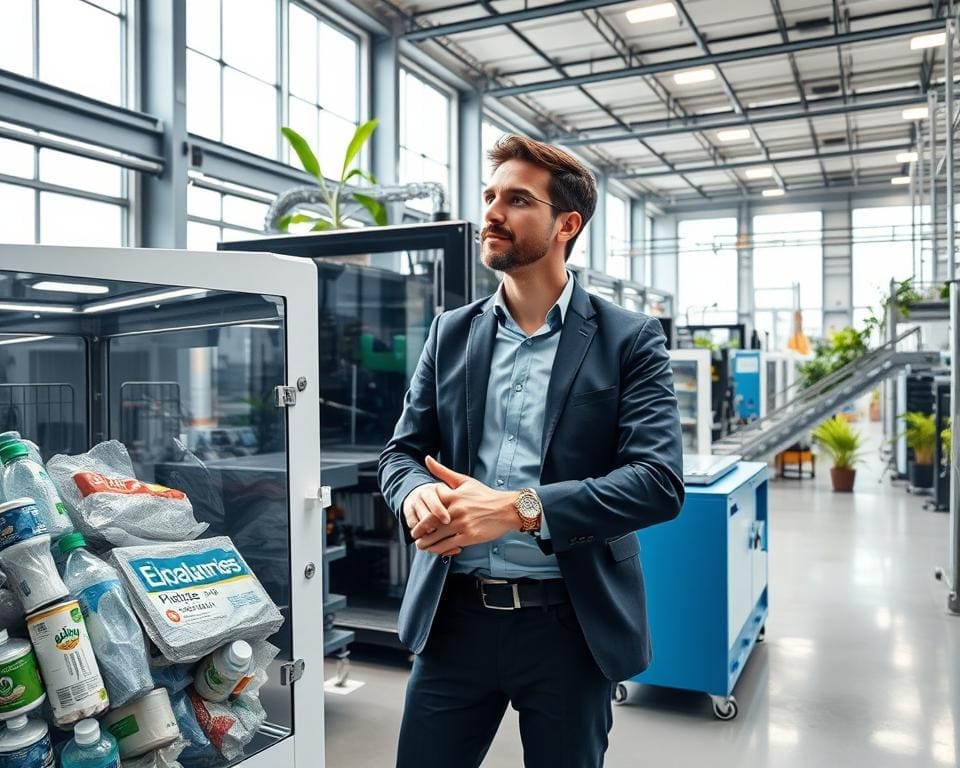
You rely on technologies that make production leaner, cleaner and more profitable. This article shows how waste reduction manufacturing tech helps you reduce manufacturing waste, meet regulatory demands and improve yields across your operations.
Manufacturing remains a major user of materials and a source of solid waste. In the UK, rising raw material costs, tighter rules such as Extended Producer Responsibility and corporate net‑zero commitments put pressure on margins and compliance. Using manufacturing waste technology can cut scrap, lower energy use and reduce rework while supporting sustainable manufacturing UK goals.
We will cover key technology categories that deliver production waste reduction: automation and robotics; sensors and the Internet of Things (IoT); predictive maintenance; machine vision and real‑time inspection; digital twins and simulation; and material‑efficient and circular approaches such as additive manufacturing, advanced recycling and remanufacturing.
These solutions also come from recognisable suppliers and platforms you may already know. ABB, Siemens, Rockwell Automation and Schneider Electric lead in automation and controls. Cognex and Keyence supply machine vision systems, while PTC, Siemens and Dassault Systèmes support digital twin platforms. Many UK SMEs access these systems via integrators and grant programmes including Innovate UK and UK Research and Innovation (UKRI).
Across the rest of the article you will find practical detail on how each technology works, measurable outcomes such as reduced scrap and downtime, and implementation considerations like integration, required skills and return on investment.
Waste reduction manufacturing tech: key solutions and benefits
Start by defining waste in your factory: raw material scrap, defective items, excessive energy use, packaging loss and end‑of‑life material leakage. This clear view shapes which manufacturing waste solutions you adopt and where industrial sustainability technologies will have most impact.
Overview of waste reduction manufacturing tech
Several technology families form the core of modern waste reduction strategies. Automation and robotics deliver repeatable tasks that cut handling damage and human error. Sensors, IoT and edge computing give continuous visibility into process variables. Data analytics and industrial AI reveal patterns that lead to rejects. Inspection systems such as machine vision and laser scanning catch defects early. Digital twins let you test changes virtually before risking production. Additive manufacturing reduces raw material use for complex parts. Advanced recycling and remanufacturing close loops and support circular manufacturing benefits.
How automation and robotics cut material waste
Robots in manufacturing perform precise welding, trimming and dosing that lower rework and excess use of adhesives. Robotic material efficiency shows up as smaller scrap piles and reduced finish rework. Collaborative robots from Universal Robots or Fanuc permit flexible automation for small batches, a common need for UK SMEs. Automated guided vehicles and autonomous mobile robots from Mobile Industrial Robots and Omron cut transport damage and wasted handling time.
Data-driven decision making with sensors and IoT
Sensors reduce scrap by monitoring temperature, vibration, force and flow so you spot deviations before parts fail. Edge devices act fast, local controllers correct issues and cloud platforms from Siemens MindSphere, PTC ThingWorx or Microsoft Azure IoT enable deeper analysis. This industrial IoT waste reduction pipeline supports KPIs such as first-pass yield, scrap rate and mean time between failures.
Sustainability benefits for your operations and supply chain
Implementing these manufacturing waste solutions delivers measurable outcomes: scrap reductions often fall between 10–50% and unplanned downtime can drop by up to 40% when predictive maintenance is used. Energy per unit falls with optimised process control, creating clear sustainable manufacturing benefits.
Across automotive, aerospace, electronics, food and metal fabrication, these technologies improve part quality and supplier reliability. You gain supply chain waste reduction as returns and customer complaints fall. Traceable data also supports reporting frameworks such as SECR and helps you meet UK and EU circular economy rules.
When planning deployment, balance capital cost, integration effort and safety with long‑term gains. Follow Health and Safety Executive guidance for guarding and workcell design. Train staff to program and operate automation so your workforce evolves as the plant becomes more efficient and resilient.
Process optimisation technologies that minimise scrap and defects
Optimising processes cuts scrap and improves yield. You can combine condition monitoring manufacturing with analytics to spot wear and drift before parts go out of tolerance. Start small and focus on the assets that cause the most defects.
Predictive maintenance to prevent downtime and defective output
Predictive maintenance reduce waste by using condition monitoring manufacturing and predictive analytics maintenance to forecast failures. Techniques include vibration analysis, oil analysis, thermal imaging and acoustic emission. Vendors such as SKF, Siemens, Honeywell, IBM Maximo and PTC supply toolsets that UK integrators tailor to your site.
In practice, predictive maintenance typically cuts unplanned downtime by 20–50% and lowers scrap caused by degraded equipment, for example misaligned tooling that creates dimensional faults. You should collect baseline data, set digital thresholds and involve maintenance teams so alerts become practical work orders.
Advanced quality control: machine vision and real-time inspection
Machine vision reduce scrap by catching defects at speed. High‑speed cameras, controlled lighting and AI models inspect dimensions, surfaces and labels in line. Systems from Cognex, Keyence, Basler and Teledyne DALSA pair with anomaly detection software to power automated quality control.
Real-time inspection manufacturing prevents faulty parts progressing down the line. Automated optical inspection in electronics finds solder faults early, cutting rework and waste. Ensure correct lighting, fixturing and calibration, and feed inspection results into MES or ERP so quarantine and corrective actions happen immediately.
Digital twins and simulation for process refinement
Digital twin manufacturing creates a virtual replica of equipment or a line so you can test changes without risking scrap. Use virtual commissioning to validate new setups and run scenarios that identify parameters which reduce errors.
Simulation reduce scrap by lowering trial runs on the shop floor, speeding ramp‑up and smoothing changeovers. Tools from Siemens, Dassault Systèmes, PTC and ANSYS model behaviour when accurate sensor and PLC data feed the twin. Begin with high‑value products and involve process engineers to validate models.
Lean manufacturing tools enhanced by software
Digital lean tools transform Kaizen practices into traceable actions. Lean manufacturing software offers digital Kanban, visual dashboards and takt time monitoring so waste becomes visible and measurable. Platforms such as Rockwell Automation MES or specialised tools like KaiNexus capture improvements and manage Kaizen digital tools in real time.
When you align digital lean tools with shop‑floor routines, you cut overproduction, reduce errors and speed corrective action. Train frontline staff, maintain a feedback loop and prioritise usability so improvements stick and scrap falls steadily.
Material-efficient innovations and circular approaches
You can reduce waste by embracing circular economy manufacturing that designs out loss, keeps materials in use and regenerates systems. Technology underpins each stage: design tools guide disassembly, digital tracking secures provenance, and lifecycle assessment quantifies gains. Start by mapping material flows to spot high-loss areas and set measurable targets for reuse and recovery.
Additive manufacturing reduce waste because AM builds parts layer‑by‑layer instead of cutting from solid stock. In aerospace and medical sectors, companies use metal and polymer 3D printing to consolidate assemblies, cut scrap and shorten supply chains. Suppliers such as GE Additive and Renishaw provide metal AM systems that improve yield and enable complex geometries with less excess material.
Material substitution and advanced powders also help. Powder metallurgy and high‑performance alloys lower the need for oversized allowances and boost component life. For recycling, near‑infrared and X‑ray sorting systems recover clean streams, while chemical recycling can reclaim polymers and metals. Tomra and Veolia operate technologies and services in the UK that support closed‑loop supply chains and higher recovery rates.
Remanufacturing UK benefits from digital tracking—RFID tags and blockchain solutions make reverse logistics manageable and prove provenance for refurbished parts. Product‑as‑a‑service and take‑back schemes incentivise design for disassembly, so you save raw materials and energy over a product’s lifetime. To implement this, pilot AM for low‑volume complex parts, partner with local recyclers, form cross‑functional teams and invest in training and capital planning to close the loop effectively.