
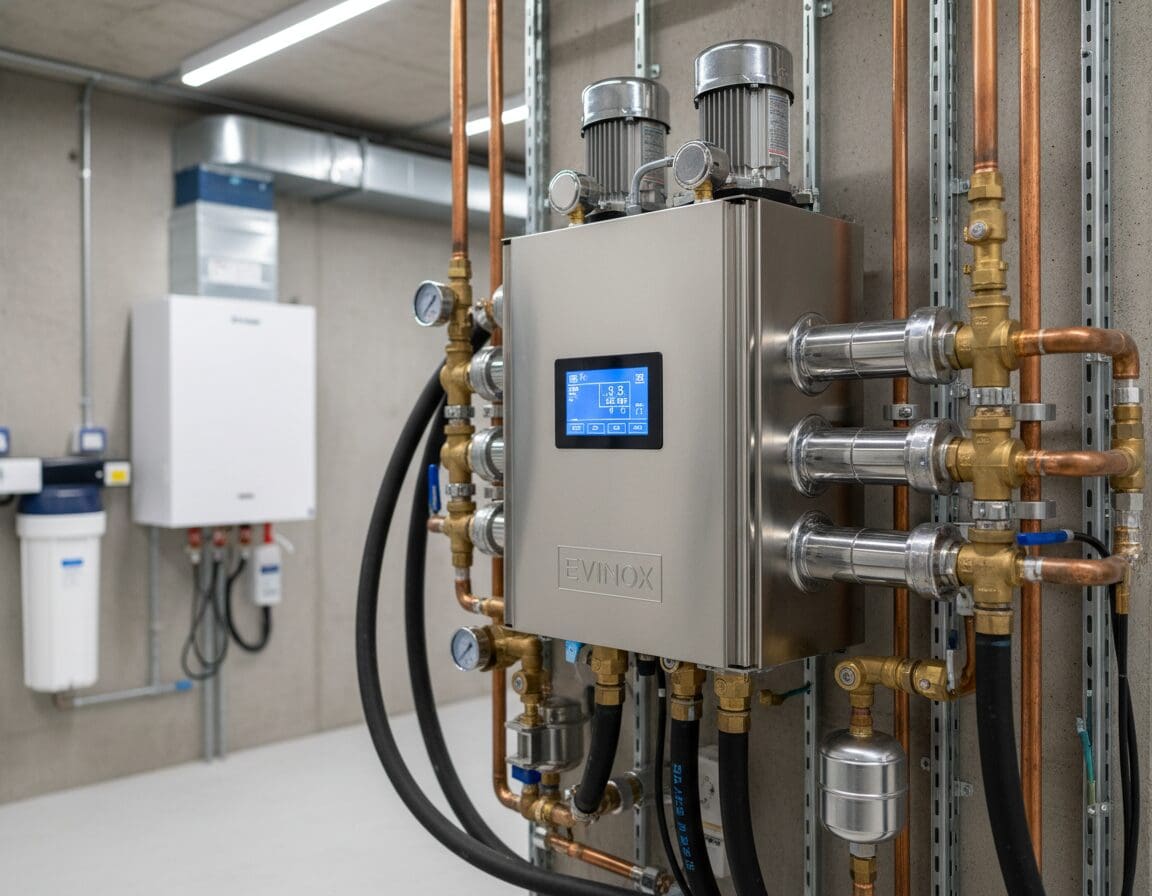
Evinox heat interface units sit at the heart of many communal heating HIU systems across the UK. A decentralised solution, an Evinox HIU transfers heat from a primary network into a dwelling’s heating and domestic hot water circuits using plate heat exchangers, circulating pumps, valves and electronic controls. The ModuSat family is a widely used example of Evinox HIU systems and often shapes the fault patterns technicians see on site.
Reliable operation of Evinox HIU systems matters for resident comfort, safety and compliance. Failures can cause cold radiators, unpredictable hot water temperatures and even scald risk, all of which affect energy efficiency and landlord obligations under building management standards. Prompt Evinox HIU service and maintenance keeps systems safe and efficient.
This article identifies the common fault categories encountered in HIU heating interface units UK installations. We cover mechanical and plumbing faults, electrical and control issues, ModuSat-specific performance problems and practical maintenance and repair strategies. The guidance is written for facilities managers, social housing providers, M&E contractors and maintenance engineers working on communal heating HIU systems.
Readers can expect a logical progression: first common mechanical issues, then controls and electrical diagnosis, then ModuSat performance faults and finally best-practice maintenance and optimisation. For specialist support, R&B London HIU Engineers are positioned as an experienced provider of Evinox HIU service and maintenance for large-scale communal heating schemes.
Typical mechanical and plumbing faults in HIU heating interface units
Mechanical and plumbing faults in communal heating HIU systems often start small and grow fast. A clear inspection routine, combined with informed HIU repairs and fault diagnosis Evinox, helps protect apartments and plant rooms from water damage and repeated downtime.
The next sections explain common fault types, how they arise and practical remedial steps. They focus on physical causes you can spot during routine checks and during targeted HIU repairs and fault diagnosis Evinox work.
Leaking pipework and connections
Leaks tend to occur at compression fittings, soldered joints, push-fit connections, isolation valves, union joints and flexible hoses within and around the Evinox HIU. Poor installation practice, mechanical vibration and thermal cycling increase the risk of failure.
Older systems may suffer corrosion, while incorrect assembly during commissioning or maintenance can leave seals compromised. Consequences include reduced primary circuit pressure, ingress of air and accelerated wear of Evinox HIU components and controls, plus water damage to adjacent areas.
- Pressure-test repairs after work is complete.
- Replace degraded seals and gaskets with correct parts.
- Use proper jointing compounds and torque settings.
- Schedule follow-up inspections after initial fixes.
Blocked strainers and debris in heat exchangers
Debris enters systems during commissioning, from corroded network pipework or as magnetite and scale when water treatment is inadequate. These materials restrict flow through primary and secondary circuits.
Restricted flow reduces the transfer efficiency of plate heat exchangers, raises pump load and can trigger low-flow or overheating alarms. Simple checks help reveal the problem.
- Measure pressure drop across strainers to identify restriction.
- Verify flow rates and inspect removable strainers or screens.
- Monitor outlet temperatures for signs of reduced heat transfer.
Remedial actions include strainer cleaning or replacement, flushing and chemical cleaning of the system, and fitting magnetic filters with corrosion inhibitors as part of a water-treatment plan.
Valve failure and sticking actuators
Common faults include seized ball valves, worn seatings, leaking thermostatic mixing valves and sticking motorised actuators on diverter or three-way valves. Limescale build-up and wear accelerate these failures.
Electrical supply issues to actuators and mechanical damage from debris can cause loss of control. When valves stick, the unit cannot divert or regulate flow properly, leading to temperature instability or loss of heating.
- Replace or recalibrate actuators where voltage or torque is incorrect.
- Refurbish valves or replace worn seatings and seals.
- Exercise valves regularly during maintenance to prevent seizure.
Pressure loss and sealing issues in communal systems
Primary networks in communal heating HIU systems can produce intermittent pressure dips, micro-leaks or sealing failures at HIU interfaces. These faults often show as persistent low system pressure alarms at HIUs.
Symptoms include loss of domestic hot water or central heating and repeated topping up of the primary system. Diagnostic steps focus on locating leak paths and checking pressure-related components.
- Trace primary leak paths and inspect communal manifolds for failed seals.
- Check expansion vessel condition and relief valve operation.
- Verify static and dynamic pressures across the network.
Repairs typically involve restoring correct sealing surfaces, replacing expansion vessels or PRVs when needed and introducing scheduled pressure monitoring and leak detection protocols to limit recurrence.
Evinox HIU components and controls — diagnosing electrical and control issues
Electrical and control faults can undermine performance and comfort in communal heating systems. A clear diagnostic routine helps spot HIU control faults early, protecting occupants and reducing expensive downtime.
Control board and sensor faults
The main control board directs pumps, valves, thermostats, temperature sensors and safety interlocks within an Evinox HIU. Common failures include corrupted firmware, power surges that damage components, failed NTC thermistors and intermittent relay faults.
Diagnose by checking mains supply and fused connections, reading LED error codes or fault logs on the controller and measuring sensor resistance or voltage with a multimeter. Follow Evinox technical documentation for fault codes. Fixes range from replacing failed sensors and relays to reloading firmware or fitting surge protection. In complex cases, replacing the control board may be necessary.
Thermostat and room sensor calibration problems
Inaccurate thermostats or room sensors cause over- or under-heating, which harms occupant comfort and reduces HIU efficiency and system optimisation. Errors often stem from poor sensor placement, drift in accuracy or mismatched control profiles.
Check ambient and flow/return temperatures using a calibrated instrument. Compare readings and review setpoints and hysteresis values in the controller. Recalibrate or replace sensors, reposition room sensors away from drafts or heat sources and update control setpoints to match design criteria.
Actuator and motorised valve electrical failures
Actuators suffer electrical faults such as open or short circuits, worn motor brushes and incorrect control signals. Mechanical seizure from scale or debris adds to the risk.
Test for correct 230 V or 24 V supply, verify control signal continuity and, where safe, manually operate valves to confirm mechanical freedom. Inspect end-switch operation. Remedy failures by fitting manufacturer-approved actuators, checking wiring and fusing and scheduling regular actuator exercise to reduce seizure risk.
Communication errors with building management systems
Evinox HIUs typically communicate with BMS via Modbus, BACnet or proprietary interfaces. Communication faults cause loss of remote monitoring, missed alarms and incorrect telemetry that hinder HIU maintenance and repairs by R&B London HIU Engineers.
Troubleshoot by verifying cabling, addresses and protocol compatibility, and comparing firmware versions on both HIU and BMS. Review error logs on each system and confirm gateway configuration. Solutions include firmware updates, correcting addressing and protocol mapping and repairing network infrastructure. For complex integrations, engage BMS specialists or Evinox support to restore reliable communication.
Common faults specific to Evinox ModuSat unit performance
The Evinox ModuSat unit delivers elegant hot water and heating HIU solutions for communal systems. Small faults can reduce comfort and raise running costs. This section outlines typical issues, how to spot them and practical steps for correction.
Reduced heat output and flow rate irregularities
ModuSat units rely on correct pump speeds, thermostatic valve operation and unobstructed plate heat exchangers to meet design heat outputs. Partial blockages, incorrect pump profiling, airlocks or closed isolation valves cause low flow and weak heat delivery.
Diagnosis uses simple measurements. Check flow rates and delta-T across the plate heat exchanger. Verify pump RPM or electronic speed settings. Inspect the secondary circuit for trapped air pockets.
Remedies include adjusting the pump curve or variable-speed drive profiles, purging air from circuits, clearing any blockages and re-commissioning flow rates to manufacturer recommendations. These actions restore Evinox ModuSat heat interface unit performance and reduce repeat service visits.
Hot water temperature fluctuations and scald protection
Domestic hot water control in ModuSat designs uses thermostatic mixing valves or electronic control to balance safety and comfort. Failing TMVs, incorrect sensor feedback or blocked secondary circuits cause unstable temperatures.
Unpredictable hot water risks scalding and leads to cold-water complaints in communal settings. UK guidance requires effective scald protection and consistent delivery for resident safety.
Corrective action involves testing and replacing thermostatic mixing valves where necessary, checking sensor calibration, adjusting setpoints and verifying scald protection interlocks. Prompt attention improves resident confidence in hot water and heating HIU solutions.
Heat exchanger efficiency loss and limescale build-up
Thermal transfer falls when scale, sediment and corrosion coat plates inside the ModuSat heat exchanger. Symptoms include increased flow resistance, rising primary delta-pressure and a reduced secondary temperature rise for a given primary input.
Detect problems by noting higher pump loads and degraded secondary ΔT. Treatment options range from chemical descaling to full heat exchanger replacement when cleaning is no longer effective.
For long-term resilience, specify water-softening or scale-inhibitor regimes on susceptible networks. These measures protect Evinox ModuSat heat interface unit performance and cut the frequency of HIU repairs and fault diagnosis Evinox teams must undertake.
ModuSat-specific commissioning and programming errors
Commissioning faults often stem from incorrect software parameters or wrong unit configuration for the primary system type, such as treating a variable-flow primary as constant flow. Entering inaccurate pump curves or leaving default control profiles can harm efficiency.
Poor configuration leads to wasted energy, occupant discomfort and unnecessary service calls. A disciplined commissioning process prevents these outcomes.
Follow Evinox documentation carefully, input accurate building and primary network parameters, validate firmware versions and keep commissioning reports. Use trained technicians or factory-trained engineers, for example R&B London HIU Engineers, for ModuSat commissioning and periodic revalidation to protect long-term Evinox ModuSat heat interface unit performance.
Maintenance, repair and optimisation for communal heating HIU systems
A proactive maintenance strategy keeps communal heating HIU systems reliable and efficient. Schedule routine checks of strainers, valves, pumps and heat exchangers, and verify sensors, expansion and safety devices. Quarterly visual inspections with an annual full service and commissioning recheck provide a sensible baseline, adjusted for building criticality and manufacturer guidance.
Diagnosis and repair follow a clear, stepwise approach. Isolate whether faults are mechanical, hydraulic, electrical or software-related, collect fault codes and telemetry, and perform non-invasive checks before targeted component replacement. Use genuine Evinox spare parts and adhere to wiring and commissioning schematics to protect warranties and safety when arranging Evinox HIU service and maintenance.
Optimising performance improves comfort and reduces bills. Tune control algorithms, consider weather compensation, balance flow rates across apartments and confirm DHW scald protection setpoints. Remote monitoring and data logging help spot degradation trends early, supporting HIU efficiency and system optimisation and enabling smarter interventions by specialist teams.
Water quality and regulatory obligations matter as much as mechanical care. Apply corrosion inhibitors, appropriate filtration and softening in hard-water areas to extend heat exchanger life. Keep commissioning certificates, service reports and O&M manuals accessible, and comply with UK hot water, gas and electrical safety requirements. For complex diagnostics and major works, engaging factory-trained engineers such as R&B London HIU Engineers for Evinox HIU services by R&B London HIU Engineers or HIU maintenance and repairs by R&B London HIU Engineers reduces downtime, prolongs equipment life and improves occupant satisfaction.