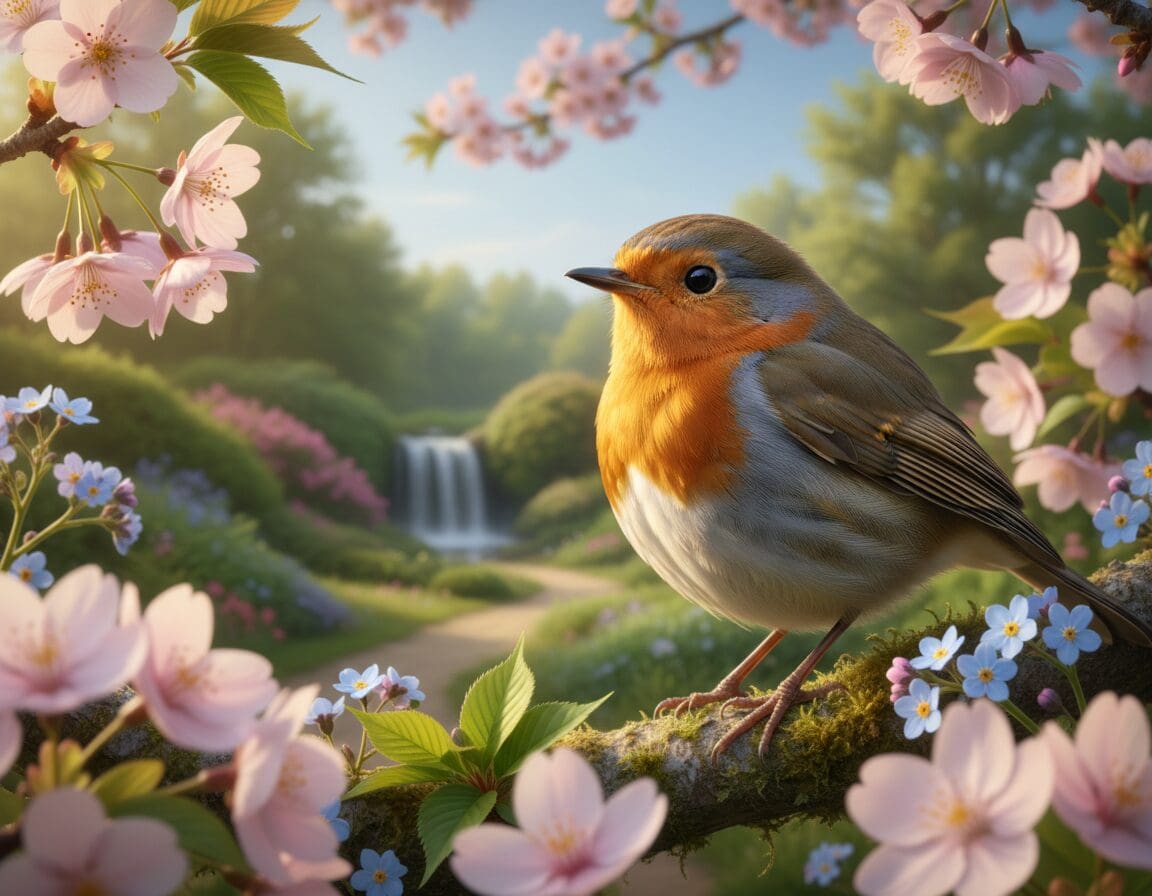
The robin (Erithacus rubecula) is one of the United Kingdom’s most recognisable garden birds. With its orange-red breast, confident manner at the feeder and clear, fluting song, the bird is both ordinary and oddly charged with meaning.
This short section sets out the purpose of the article: to explore what does a robin mean and how robin symbolism appears across British culture, spirituality and everyday life. Readers will find a concise overview of robin meaning and robin spiritual meaning, and a preview of the themes that follow.
At once a literal visitor to back gardens and a recurring figure in stories, the robin carries layered associations. In many people’s minds the bird stands for hope and renewal, comfort in grief and the persistence of memory. The prominence of robin symbolism UK owes as much to the bird’s behaviour as to centuries of folklore and artistic use.
The piece that follows moves from folklore and Christian associations to emotional responses, then examines art, literature and popular culture before grounding symbolism in natural history. Sources include material from the Folklore Society, scholarship on Christian iconography, Victorian accounts, critics such as those who have written on John Keats and Christina Rossetti, and ornithological authorities like the RSPB and the British Trust for Ornithology.
what does a robin mean in folklore and tradition
The robin has long held a quiet place in British life, where stories and customs give it a voice beyond its size. In gardens, churchyards and cottages the bird appears in tales that link the natural world to human experience. These accounts form a living robin tradition that surfaces in parish records, oral memory and printed collections.
Robin symbolism in British folklore
Across England, Scotland and Wales many villagers treat the robin as a messenger. Folk tales describe robins guiding lost travellers, alighting on windows at moments of change, or warning householders of danger. This motif underpins wider robin British folklore about garden boundaries, hearths and crops.
Regional variants give texture to the tradition. In some counties a nest near the home is thought lucky; in others, to harm a robin invites misfortune. Folklore Society collections and local parish notes preserve these diverse strands of belief.
Christian and spiritual associations
Christian imagery shaped popular understanding of the robin. A familiar Victorian account links the bird’s red breast to the Passion of Christ, telling how a robin tried to ease the crown of thorns and was stained with blood. That tale appears in children’s books and churchyard lore.
Preachers and artists have used the robin as a symbol of humility and small sacrifice. In contemporary spiritual readings the bird often stands for hope, resurrection and the soul’s continuity. Such robin spiritual associations appear in sermons and devotional writing.
Victorian and rural stories about robins
The 19th century made the robin an emblem of domestic feeling. In illustrated periodicals and greeting cards the bird suited Victorian tastes for intimate, moral scenes. That print culture helped spread Victorian robin stories into wider popular use.
Rural oral histories add a different note. Farmers and allotment keepers recall tame, territorial robins that followed them while they worked. These everyday accounts reinforced the bird’s role as a companion and a national symbol, shaping later literature and art.
Emotional and psychological meanings of seeing a robin
The small visit of a robin can stir a deep, private response. Sightings often prompt reflection on loss, hope and change. People bring different histories to the moment, which shapes the emotional meaning robin carries for them.
Robins as symbols of hope and renewal
In winter gardens a bright-breasted robin stands out against grey, acting as a seasonal signifier. Its presence suggests resilience and the promise of spring. The robin hope symbol appears in cards, hymns and household stories, cementing its role as a marker of renewal.
The sight and song of a robin can lift mood through simple contact with nature. Biophilia research shows that familiar wildlife calms people and improves wellbeing. That mechanism helps explain why the psychological symbolism robin is powerful across ages and settings.
Comfort, grief and the idea of visitations
Many bereavement accounts record robins arriving at moments of mourning. Some interpret these encounters as robin visitations from lost loved ones, or as gentle reminders that memory endures. Such reports appear in hospice narratives and online support threads.
Christian and folk traditions that portray the bird as a messenger add depth to those interpretations. Grief psychologists note that people commonly use meaningful coincidence to cope. A robin sighting can act as an anchor for memory and bring unexpected solace.
How personal experience shapes interpretation
Individual response depends on upbringing, religion and local customs. Someone raised with Victorian Christmas imagery may read a different meaning into a robin than a person trained in ecology. Personal stories, like a tame bird feeding from a hand, often become lifelong symbols.
Practical steps can help make sense of a moving encounter. Keep a memory journal, share the moment with family, or consult local folklore to explore layers of meaning. Such actions let the emotional meaning robin holds become a considered part of one’s story.
Robins in art, literature and popular culture
The robin has threaded through British creative life for centuries, appearing in poems, paintings and screen stories. Its bright chest and modest size make it an easy emblem for poets, painters and advertisers. This short survey looks at how the bird carries meaning across media, from pastoral verse to festive cards and modern film.
Notable literary references and poems
Romantic and Victorian poets often used the robin as a voice of the countryside. William Wordsworth and John Clare placed the bird within intimate nature scenes, while Christina Rossetti gave it a quiet, spiritual presence. Children’s authors such as A. A. Milne and Beatrix Potter brought robins into nursery settings, where they appear in simple tales and playful rhymes.
Modern novelists keep the robin as a memory marker. In contemporary fiction the bird can signal homecoming, loss or a sudden shift in feeling. Critics note the robin’s flexibility: it serves as pastoral symbol, spiritual messenger and a sign of domestic continuity in both short lyric pieces and longer narratives.
Robins in visual art and Christmas imagery
From early Victorian illustrations to present-day card designs, the robin became a staple feature on the Christmas card. Mid-19th century engravings placed the bird on holly branches to signal seasonal cheer, a motif that greeting card publishers and textile makers still use today.
Fine artists such as John Constable and later rural watercolourists included robins in landscape and domestic scenes to add charm and local colour. Commercial designers today repeat these cues, using the robin’s red breast and compact form to suggest warmth, hearth and festivity.
Modern media, songs and film appearances
Songwriters in folk and pop traditions have long referenced robins as symbols of longing, home and hope. Musicians use the image to give lyrics emotional weight. Film and television place robins in rustic settings or insert them into poignant moments where a small bird can carry a large symbolic charge.
Brands sometimes adopt the robin to evoke tradition or seasonal goodwill. The bird’s steady presence across media keeps its meanings alive, letting new audiences pick up on themes that date back through poetry and painting into everyday popular culture.
Practical natural history: understanding the bird behind the symbol
The European robin (Erithacus rubecula) is a small passerine well known to gardeners across the UK. Robin identification is straightforward: a round body, orange-red breast and face, grey-brown upperparts and a whitish belly. Large dark eyes and an upright posture give the bird a perky, familiar look that helps explain its place in homes and stories.
European robin behaviour includes strong territoriality, often year-round, with males defending small garden areas. This boldness means robins will approach feeders and people, a trait that links natural history to folklore. Their diet is mainly insectivorous in spring and summer—beetles, larvae and spiders—shifting to seeds and berries in autumn and winter. They readily take mealworms and suet from low feeders.
Robins are notable for their melodious robin song, used to defend territory and attract mates. The winter song, often heard in gardens, reinforces the bird’s presence through colder months. Robin breeding typically sees two broods in a season, with nests in cavities, walls or dense shrub; clutch sizes are usually four to six eggs. These facts underpin the cultural image of renewal and continuity.
From a conservation and practical perspective, the species remains common and is listed as Least Concern, though local declines can occur. To encourage robins, provide dense shrub cover, log piles and leaf litter to support invertebrates, and use low feeders for mealworms. Take humane measures against cat predation and window collisions by supervising pets and reducing reflective glass risks. Sources such as the RSPB and British Trust for Ornithology corroborate these observations.