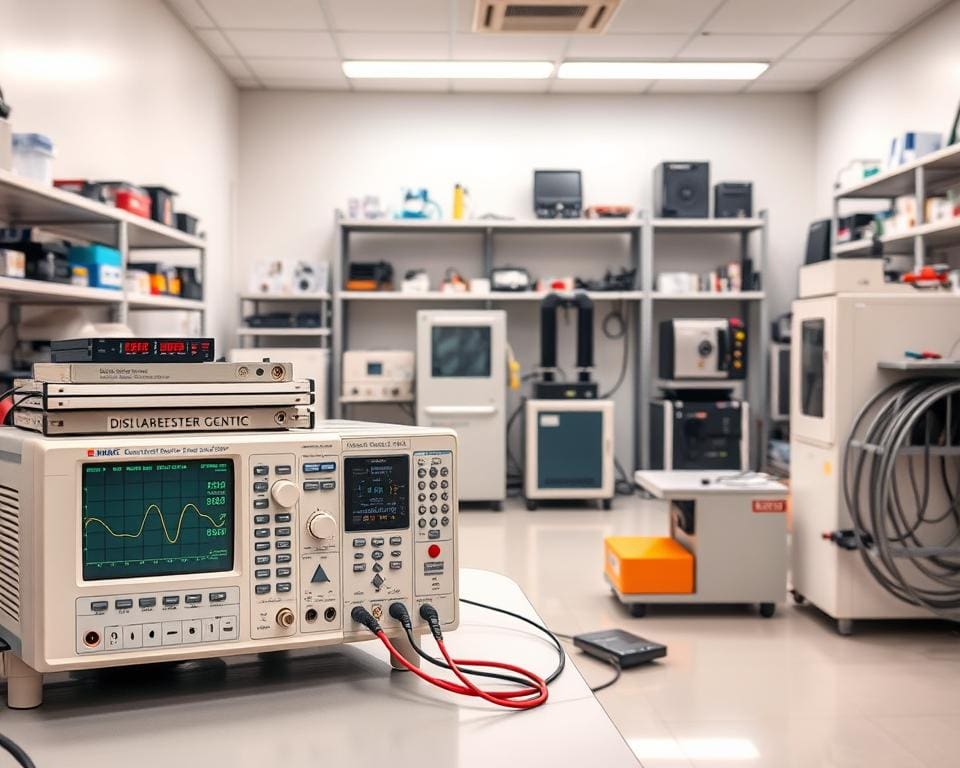
This short introduction defines the scope for readers seeking a concise lab equipment overview and a practical guide to testing lab hardware across the United Kingdom. It frames the article as a product-review resource to aid procurement and upgrade decisions for university, commercial and regulatory test facilities.
Hardware selection shapes test repeatability, throughput and data integrity. The right choices support regulatory compliance such as MHRA guidelines and ISO 17025 accreditation, and reduce debugging time to speed time-to-market. Total cost of ownership depends on accuracy, service support and ease of calibration.
Typical roles dictate distinct needs. Test engineers favour precision laboratory instrumentation UK, like oscilloscopes and spectrum analysers from Keysight Technologies, Tektronix and Rohde & Schwarz. Mechanical engineers rely on environmental chambers, vibration rigs and Instron material testers. Systems engineers require robust servers and network emulators from Dell EMC, HP or Lenovo, while lab managers prioritise workstations, collaboration hardware and NAS solutions from Synology and QNAP.
Leading brands such as Fluke, National Instruments, Bosch, ETS-Lindgren, FANUC and KUKA appear throughout UK test lab infrastructure. The following sections review project-management workstations and orchestration servers; electronic test benches and benchtop instrumentation; mechanical and environmental test systems; network and RF equipment; automation and robotics; data acquisition, storage and processing; and safety, calibration and support hardware.
What tools help manage complex projects?
Coordinating test programmes relies on strong hardware choices as much as on software. Project teams in UK labs need reliable platforms that host project management tools for labs and support secure, repeatable workflows. Choosing the right combination of workstations, servers and collaboration gear turns planning into action.
Lab leads benefit from powerful desktops and laptops such as Dell Precision, HP Z and Lenovo ThinkStation or ThinkPad P series. These systems with Intel Xeon or AMD Threadripper/EPYC options, ECC memory and professional GPUs like NVIDIA RTX A-series run CAD and simulation smoothly.
Key features include NVMe storage for rapid access, multiple 4K displays for complex timelines, TPM-backed secure credential storage and remote-access options via VPN or VNC. Rackable desktop choices help in space-constrained facilities. ISV certifications for ANSYS and SolidWorks improve predictability when using project management tools for labs.
Integrated server solutions for test orchestration
Central orchestration runs on rack or blade servers from Dell EMC PowerEdge, HPE ProLiant and Lenovo ThinkSystem. These platforms host continuous-integration servers such as Jenkins or GitLab runners and virtualised testbeds that form the backbone of test orchestration infrastructure.
Purpose-built appliances like National Instruments PXI controllers and Keysight PathWave servers aggregate instruments and reduce configuration time. Redundant power supplies, RAID arrays and UPS integration keep long sequences running. Containerisation with Kubernetes on on-premise lab orchestration servers enables scalable, reproducible automation frameworks.
Collaboration hardware: displays, conferencing and whiteboard systems
Large-format 4K displays and interactive whiteboards from Microsoft Surface Hub or vendors such as Sharp and NEC help teams review results and annotate designs in person or remotely. These units pair with conferencing kits from Poly and Logitech Rally to deliver clear video and robust audio in noisy test halls.
Microphone arrays, echo cancellation and secure room-control systems protect sensitive IP while simplifying guest access and calendar integration. Procuring the right collaboration hardware for engineering teams reduces friction when sharing test data and accelerates decision making.
Procurement planning should cover service contracts, on-site spares, rack-space, cooling and electrical requirements. Lab managers must prioritise cybersecurity hardening and managed support to keep test orchestration infrastructure and lab orchestration servers resilient under continuous use.
For guidance on remote team practices that complement these hardware choices, see this practical resource on remote workflows: remote working tips.
Core laboratory test benches and rigs for electronic testing
Well-equipped labs begin with the right electronic test bench equipment. This short guide outlines the core platforms and instruments engineers choose for reliable validation and verification. Practical examples and selection pointers help teams match gear to project demands.
Modular benchtop systems and chassis
Modular platforms such as PXI from National Instruments, VXI and LXI-controlled systems give flexibility for expanding test coverage. PXI excels when tight time-correlated measurements matter, while LXI offers network-based control for distributed setups across a lab or multiple racks.
Rack-mount chassis from Keysight and Rohde & Schwarz support a mix of digitizers, DIO modules, switch matrices and signal conditioning cards. Choose chassis size by slot count, cooling capacity and slot compatibility to avoid thermal throttling during long runs.
Oscilloscopes, multimeters and spectrum analysers
Digital oscilloscopes from Tektronix and Keysight cover bandwidths from 100 MHz to multi-GHz. Look for sample rate, deep memory and built-in math for signal analysis. Real-time scopes suit transient capture, sampling scopes work for repetitive high-frequency signals.
Bench digital multimeters by Keithley and Fluke offer 6+ digit resolution, low-noise performance and true RMS AC measurement. These features matter for precision DC characterisation and reliable test reports.
Spectrum analysers and VNAs from Rohde & Schwarz and Keysight should be assessed for frequency range, phase-noise and dynamic range. A focused spectrum analyser review helps specify RF/EMC pre-compliance checks and chamber compatibility for ETS-Lindgren or Rohde & Schwarz test enclosures.
Power supplies, electronic loads and signal generators
Programmable DC units from Keysight, Rigol and TDK-Lambda provide multi-channel outputs, SCPI or IVI remote control and sequencing for DUT power cycling. These features streamline automated test scripts and protect delicate electronics during turn-on.
Electronic loads from Chroma and BK Precision are essential for current-draw characterisation, battery evaluation and transient load simulation. Match load resolution and response time to the test profile.
Function and arbitrary waveform generators by Teledyne LeCroy, Keysight and Rohde & Schwarz differ by sampling rate, update rate and analogue bandwidth. Select AWGs with sufficient modulation capability for communications tests and complex waveform playback.
Buying tips: match instrument specifications to DUT needs, prioritise modularity and vendor support, plan calibration intervals for traceability and consider rental for temporary capacity spikes. These steps cut risk and speed up validation cycles.
Mechanical testing hardware and environmental chambers
Reliable mechanical testing equipment forms the backbone of any lab tasked with proving durability and performance. This short survey highlights practical choices, standards compliance and real-world examples that help engineers choose the right kit for their test programmes.
Vibration and shock testing demand precise control and rugged installation. Electrodynamic shakers from MB Dynamics and Dytran serve high-frequency, low-mass tests, while hydraulic shakers suit heavy payloads and low-frequency shock profiles. Key specs to check include force in kN, frequency range, payload capacity and control modes for sine, random and shock profiles that meet MIL-STD-810 and IEC 60068.
Slip-tables and bespoke fixtures ensure compatibility with large devices under test. Use IEPE accelerometers or charge sensors for closed-loop feedback and tight control of vibration signatures. Proper mounting, cabling and accelerometer placement cut variability and speed up repeatable results.
Thermal exposure and humidity control are essential for environmental stress screening. Leading thermal chambers suppliers such as Thermotron, Weiss Technik and Angelantoni offer benchtop units and walk-in chambers with ranges from sub-zero to around +200°C. Ramp rates, temperature uniformity and chamber airflow are critical parameters to compare when specifying equipment.
Combined climatic chambers deliver controlled temperature and humidity (thermal-hygro) for tests on moisture-sensitive components. Thermal shock methods use cascade systems or liquid nitrogen transitions for rapid excursions. For electronics burn-in and long-duration ageing, check condensate management, calibration intervals and the chamber’s heating method: conductive or convective.
Material characterisation relies on universal testing machines and specialised rigs. Brands such as Instron, ZwickRoell and MTS Systems produce tensile testing machines and UTMs that span low to high force capacities, with crosshead speed control and extensometer support for accurate stress–strain curves.
Fatigue testing rigs offer servo-hydraulic or electromechanical actuation for cyclic loading. Choose fixtures matched to composites, films or metallic specimens to avoid slippage and stress concentrators. Safety enclosures, interlocks and robust gripping systems reduce test variability and protect operators.
- Standards: follow BS, ISO and IEC norms for test methods and reporting.
- Site needs: power, HVAC and foundation loading affect installation of heavy vibration tables.
- Procurement: plan lead times, on-site installation and calibration by accredited engineers.
Network and communication testing equipment
Reliable lab validation demands a clear separation between wired and wireless test domains. Choose tools that cover physical layer checks, protocol stacks and real-world emulation. This ensures devices behave as expected across scenarios found in the network test equipment UK market.
Network traffic generators from Keysight (IXIA) and Spirent lead for throughput, latency and jitter trials. Use line-rate testing at 1/10/25/40/100GbE, traffic profile scripting and L2–L7 stack support to stress devices. A balanced protocol analyser review helps you select packet capture appliances that offload processing, add precise time-stamping and integrate with Wireshark for deep packet inspection.
Portable wireless test sets from Rohde & Schwarz and Keysight are essential for transceiver characterisation. RF test sets measure power, modulation accuracy and sensitivity on the bench or in the field. Pair these with spectrum monitoring kit to locate interference in crowded UK bands and to meet pre-compliance EMI needs.
RF shielded enclosures and anechoic chambers from ETS-Lindgren, Rohde & Schwarz and Chelton enable repeatable over-the-air tests. Choose appropriate absorber types and chamber sizes for OTA and SAR testing. Controlled environments improve measurement fidelity and protect against stray transmissions when testing live radio units.
Lab-grade switches and routers from Cisco, Juniper and Arista recreate realistic topologies for VLAN, QoS and telemetry experiments. Look for sFlow, programmable ASICs and P4-capable platforms to support advanced observability and custom packet processing. These features speed troubleshooting and add realism to test scenarios.
Network emulation appliances from Apposite and Netropy simulate WAN impairments such as latency, jitter and packet loss. Use these appliances to validate application performance under constrained conditions and to reproduce issues before field deployment. Emulation helps teams tune buffers, retry logic and QoS policies.
Best practice combines dedicated test VLANs, time-synchronised clocks (PTP/NTP) and environmental control during RF trials. Maintain secure isolation for devices with active radios and document test scripts to preserve repeatability. This disciplined approach lifts confidence in measurement results and accelerates certification paths.
Automated test systems and robotics
Automation hardware transforms throughput, repeatability and safety in modern testing labs across the UK. Engineers combine robotics, conveyors and ATE platforms to speed validation while keeping results consistent. Careful selection of components reduces downtime and protects delicate devices under test.
Robotic arms from FANUC, ABB and KUKA excel in repeatable handling and assembly tests. Collaborative robots from Universal Robots suit close human interaction and smaller footprints. When choosing for robotics for testing, compare payload, reach and repeatability.
Force‑torque sensing and safety‑rated monitored stop modes matter for connector mating cycles and endurance tasks. Programming options range from vendor languages to ROS, while vision systems help with alignment and defect detection.
Robotic arms for repeatable handling and assembly tests
Payload and reach dictate which arm fits a bench or line. High repeatability supports precision measurement cycles. Integrate grippers and sensors early in the design to avoid rework during validation.
Automated test equipment (ATE) frameworks and customised fixtures
ATE frameworks from Teradyne and Advantest remain central to semiconductor and PCB testing. Modular test heads and handler integration speed DUT loading and parallelise measurement. ATE frameworks support ICT, flying probe and JTAG boundary‑scan approaches for mixed‑signal boards.
Custom fixtures, whether machined aluminium or 3D‑printed, ensure contact reliability. Bed‑of‑nails and pogo‑pin arrays require repeatable alignment features to protect delicate pads and ensure consistent resistance readings.
Conveyors, pick-and-place and end-of-arm tooling
Conveyors and pick-and-place systems from Panasonic and Juki deliver high-volume throughput for SMT lines. Smaller conveyors from Dorner suit assembly and test stations where space is limited. Effective pick-and-place test automation reduces manual handling and speeds cycle times.
End-of-arm tooling options include vacuum grippers, mechanical fingers, magnetic tools and soft‑grip solutions for fragile parts. Quick‑change tooling systems cut changeover time and boost uptime. Vet end-of-arm tooling suppliers for quality and spares availability.
- Integrate predictive maintenance and spare‑part inventories to avoid costly stoppages.
- Use safety fencing, interlocks and light curtains to meet UK regulations and protect staff.
- Link automated test systems to MES or SCADA for traceability and automated logging.
For broader industrial context and real‑time monitoring examples, read an overview of tech trends that include IoT monitoring hardware and edge gateways in heavy industry.
Data acquisition, storage and analysis hardware
Modern test labs rely on precise capture, safe storage and fast analysis to turn signals into insight. Choosing the right mix of data acquisition hardware UK suppliers and robust lab storage solutions sets the stage for repeatable results and secure IP protection.
High-resolution data acquisition cards and sensors
National Instruments, Measurement Computing and Keysight offer DAQ platforms with varied analogue input counts, sampling rates and resolutions from 12‑ to 24‑bit. Select devices with anti‑aliasing filters and synchronous multi‑device timing when you need coherent measurements across many channels.
Common sensors include strain gauges, thermocouples, IEPE accelerometers, LVDTs, Hall‑effect sensors and current clamps. Use signal conditioning modules, isolators and bridge amplifiers to reduce noise and protect front ends. For scalability, chassis systems such as PXI and cDAQ make it simple to add channels without redesigning the rack.
On‑premise NAS/SAN and high‑performance servers for test data
Synology and QNAP serve many labs with flexible NAS units. For enterprise scale, Dell EMC and NetApp arrays deliver high throughput and advanced RAID options. Plan for SSD caching, tiering and LTO tape for long‑term archiving to meet retention needs.
High‑performance servers for batch analysis use CPUs, GPUs and NVMe pools to shorten compute time. Choose interconnects such as 10/25/40/100GbE or InfiniBand to support parallel workloads. Look for checksumming, immutability and encryption at rest to secure audit trails and intellectual property.
Edge compute devices and real‑time processing appliances
NVIDIA Jetson, Intel NUC Rugged and HPE Edgeline appliances enable local pre‑processing and low‑latency analytics when cloud round‑trips are impractical. FPGA‑based processors, including Xilinx and AMD Alveo cards, provide deterministic inline signal processing for closed‑loop control.
Hybrid architectures combine on‑premise compute with cloud elasticity while keeping data residency in the UK. Deploy edge compute appliances near test rigs to reduce network load and pair them with real‑time processing servers for immediate feedback and control.
Data workflows and tooling
Synchronise time with PTP, tag datasets with consistent metadata and favour standard file formats such as HDF5 or TDMS for reproducible analysis. Integrate instrument capture with MATLAB, Python pandas and NI LabVIEW to automate processing pipelines and simplify collaboration across teams.
Safety, calibration and support hardware for reliable testing
Reliable testing starts with smart safety hardware and clear procedures. Install emergency stop systems, safety light curtains and interlock switches around high-energy rigs, and use safety-rated controllers such as Siemens or Allen-Bradley where appropriate. Protective enclosures and personal protective equipment are essential for electrical, mechanical and RF work, while residual current devices, properly rated fuses, isolation transformers and bonded grounding ensure compliance with UK wiring rules. These measures, along with well‑specified lab safety equipment UK, keep people safe and protect valuable test assets.
Calibration underpins data credibility. Use UKAS-accredited calibration services or manufacturer service centres like Keysight and Fluke Calibration for oscilloscopes, digital multimeters and thermal sensors. Maintain calibration artefacts — reference multimeters, voltage standards, spectrum analyser kits and thermal baths — and keep certificates and traceability chains tied to NPL standards. Regular calibration schedules and clear records support ISO 17025 compliance and make audits straightforward while reinforcing confidence in every measurement.
Support hardware and environmental controls minimise downtime. Fit temperature and humidity loggers, robust UPS systems, emergency power-off circuits and adequate server-room cooling. Provide fume extraction where chemical tests occur, and keep spare parts kits and instrument-specific maintenance tools to hand. Secure storage for hazardous materials and tightly managed permits-to-work reduce risk and simplify test equipment maintenance.
Good risk management and vendor partnerships pay dividends. Implement routine risk assessments, maintenance logs and incident reporting, and arrange vendor service agreements or local UK support partners to speed repairs. Invest in documented maintenance procedures, on-site training from suppliers and reliable test lab support hardware to protect personnel, ensure data validity and deliver predictable uptime for a resilient test programme.