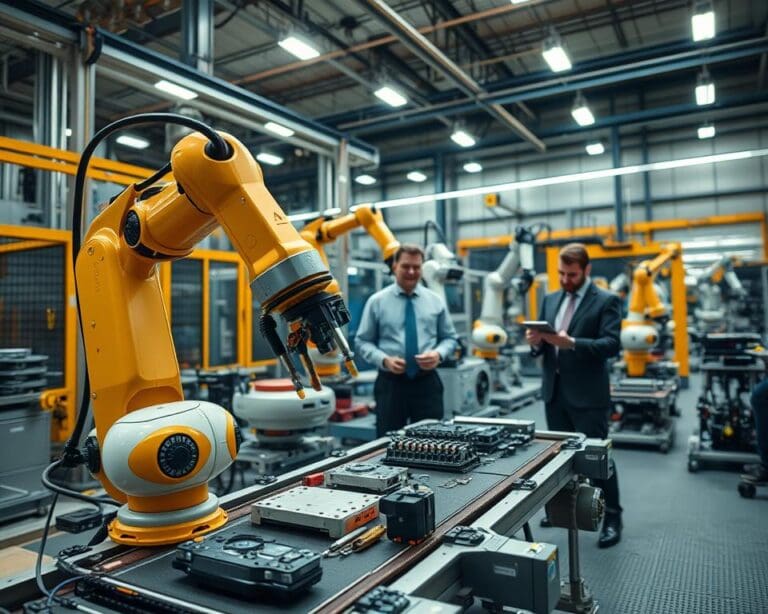
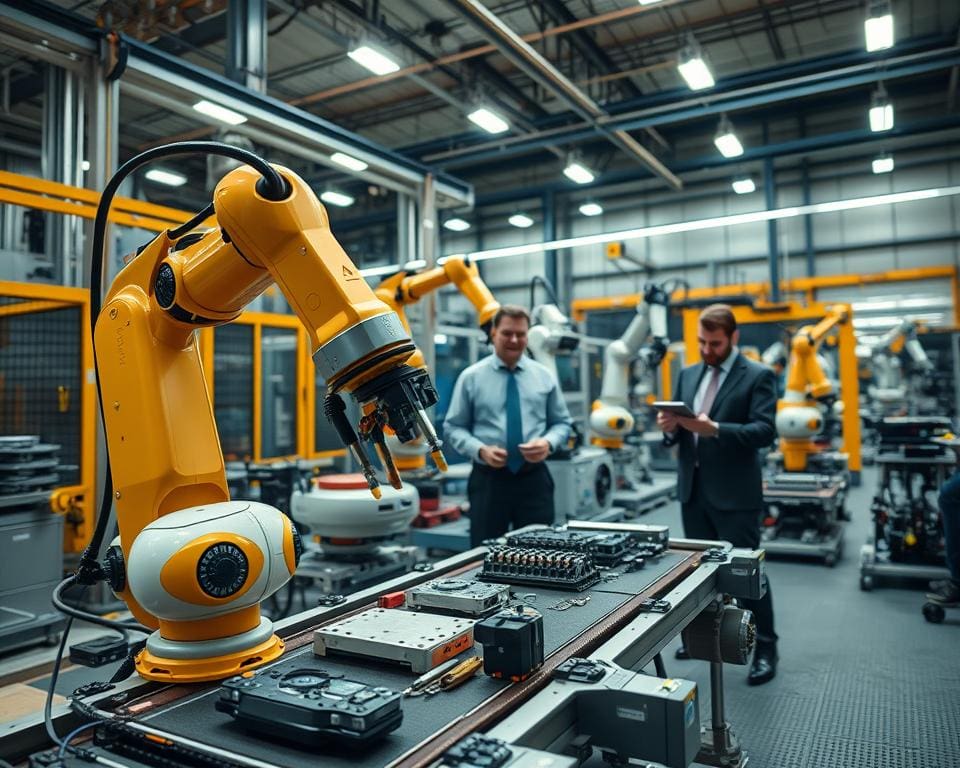
Robotics systems are reshaping how factories operate, and the question of why they are advancing manufacturing matters for every business in the United Kingdom. This robotics revolution manufacturing is driven by clear commercial needs: firms seek higher productivity, steadier quality and shorter lead times to stay competitive on world markets.
Globally, industrial robot installations have climbed steadily, according to the International Federation of Robotics (IFR). Europe has seen notable increases, and sectors in the UK such as automotive, aerospace and electronics report rising uptake of industrial robots UK. Investment trends suggest robotics in manufacturing UK will continue to grow as companies chase the manufacturing automation benefits that deliver measurable gains.
Several practical drivers explain this shift. Labour shortages and skills gaps make automation attractive, while rising wage costs and the demand for consistent high-quality output push firms towards robotic solutions. Reshoring and nearshoring trends, combined with sustainability goals like energy efficiency and waste reduction, further accelerate adoption.
For the UK, strategic implications are significant. Robotics support national manufacturing strategy by boosting competitiveness against lower-cost economies and enabling higher-mix, lower-volume production. Clusters in the Midlands and North East are developing innovation ecosystems where universities, suppliers and manufacturers collaborate to scale new systems and skills.
This is more than a technical change. The case for manufacturing automation benefits is also a social and economic opportunity: new roles for engineers, technicians and data specialists will emerge as firms of all sizes embrace robotics systems. Policymakers and industry initiatives that encourage automation can help ensure the robotics revolution manufacturing revitalises British industry sustainably and inclusively.
Why are robotics systems advancing manufacturing?
Robotic systems are reshaping UK factories by lifting output, sharpening quality and changing how capital is deployed. Manufacturers find that targeted automation unlocks faster cycle times, steadier yields and clearer routes to reinvestment. That shift helps firms compete locally and on global supply chains.
Increased productivity and throughput
Robots take on repetitive, high-speed tasks with minimal downtime, so units per shift climb well past manual rates. In the automotive sector robots from ABB, KUKA and FANUC carry out welding and painting at cycle times far shorter than human operators.
Continuous 24/7 operation and quick changeovers using flexible end-of-arm tooling improve overall equipment effectiveness. Firms measure gains through cycle time reduction, takt time alignment and increased throughput per square metre, all central to productivity robotics manufacturing.
Simulation and offline programming cut commissioning time by optimising cell layouts before physical build. That approach reduces disruption on the shop floor and accelerates returns from throughput automation benefits.
Improved quality and consistency
Robots deliver repeatable precision needed for close-tolerance machining, micro-assembly and consistent surface finishes. Electronics manufacturers use vision-guided cells for accurate placement and precision dispensing, which lowers defects and rework.
Integrated vision systems and closed feedback loops enable self-correction, keeping processes within tight tolerances and supporting standards such as ISO 9001 and IATF 16949. Better first-pass yield and reduced scrap strengthen brand reputation through quality consistency robots.
Customer satisfaction rises when products arrive with predictable performance. That outcome protects margins and builds long-term trust.
Cost savings and return on investment
Savings extend beyond labour substitution. Lower waste, fewer defects, energy-efficient drives and reduced workplace injuries all shrink operating costs. These effects feed into manufacturing ROI robotics calculations used by finance teams.
Typical payback for many robotic cells sits in the 12–36 month band, depending on complexity. True total cost of ownership includes integration, programming, maintenance, end-of-arm tooling and training, giving a realistic view of value.
UK companies can tap grants and support from Innovate UK, regional funds and Catapult centres to trial systems and lower risk. That assistance makes robotic investment more accessible and encourages reinvestment into R&D and workforce upskilling rather than simple headcount reduction.
Key technologies powering modern robotic systems in UK manufacturing
Modern factories blend hardware and software to speed innovation. In the UK this fusion drives productivity and flexibility. Manufacturers adopt modular cells that can evolve with product mixes. The following subsections outline the core technologies shaping that shift.
Collaborative robots change where automation fits on the shop floor. Unlike traditional industrial manipulators, cobots feature force‑limited design, speed and separation monitoring, and simplified programming. Brands such as Universal Robots and the legacy influence of Rethink Robotics have helped create a local ecosystem of integrators and system builders.
Cobots are ideal for SMEs with limited space and budgets. Typical uses include assembly, kitting, machine tending, quality inspection and assisted pick‑and‑place. Their lightweight, mobile form makes redeployment across lines straightforward. That flexibility supports human–robot collaboration by keeping skilled staff in engaging roles while lowering manual handling injuries.
Safety standards guide implementation across the UK and EU. Compliance with BS EN ISO 10218 and ISO/TS 15066 requires risk assessments and appropriate safeguarding. Careful integration ensures teams work side‑by‑side with robots, not apart from them.
Artificial intelligence and machine vision extend robot capabilities beyond fixed programmes. AI in robotics manufacturing enables adaptive grasping, anomaly detection and predictive maintenance. Commercial platforms now offer modules that combine machine learning for path planning with real‑time decisioning.
Vision systems robotics use 2D and 3D cameras, lidar and specialised lighting for tasks that demand precision. Examples include bin picking, OCR of serial numbers, surface defect detection and fine alignment. Suppliers such as Cognex and SICK, together with local integrators, supply vision packages adapted for UK lines.
Closed‑loop control ties sensors and models into continuous improvement cycles. Feedback from vision and force sensors lets systems refine behaviour during production, raising yield and enabling automation of variable tasks. Strong data governance and cybersecurity protect these AI systems when cloud tools are involved.
Connectivity and Industry 4.0 integration make robots part of a wider digital ecosystem. Robots act as nodes that feed MES, ERP and condition‑monitoring systems for real‑time scheduling and predictive maintenance. Digital twins from Siemens and demonstrator projects by AMRC and Catapult centres show how integrated solutions scale from pilot cells to full lines.
Interoperability standards such as OPC UA and MQTT, paired with edge computing, reduce latency for time‑critical control while enabling central analytics. This connected factory robotics approach lets manufacturers start with a single cell and expand to networked production as confidence and return on investment grow.
Economic, social and strategic impacts of robotic adoption
Robotic adoption is reshaping the economic landscape across the United Kingdom. At a macro level, automation lifts productivity and value‑added per worker, helping sectors such as aerospace, automotive and medtech to compete internationally. For firms, higher capital intensity can stimulate investment, boost exports and create clusters that attract suppliers and skilled labour. For smaller businesses, access to robotics may close capability gaps and improve lead times, provided they secure financing and integration support.
The social impact automation brings is complex but promising. While some repetitive roles are displaced, many jobs evolve rather than vanish: demand rises for maintenance technicians, programmers, systems analysts and process engineers. This shift underlines the urgency of reskilling automation for workers. UK training providers, apprenticeships and organisations such as the Institution of Mechanical Engineers and the Manufacturing Technologies Association are expanding courses to equip people with new skills.
Workplace safety and wellbeing also improve as robots take on hazardous tasks and reduce occupational injuries. Yet the social conversation must address regional balance and inclusion. Targeted policy can steer investment to towns and cities beyond established clusters so that the benefits of robotic growth are widely shared and local supply chains remain resilient.
Strategic manufacturing robotics requires aligned public and private effort. Success depends on industrial strategy, sustained R&D funding, modern infrastructure and public–private partnerships. Ethical and regulatory frameworks must cover data protection, accountability for automated decisions and compliance with standards. By cooperating across industry, government, training providers and standards bodies, the UK can harness the economic impact robotics UK promises while managing jobs and robotics UK transitions and ensuring long‑term resilience and sustainability.