
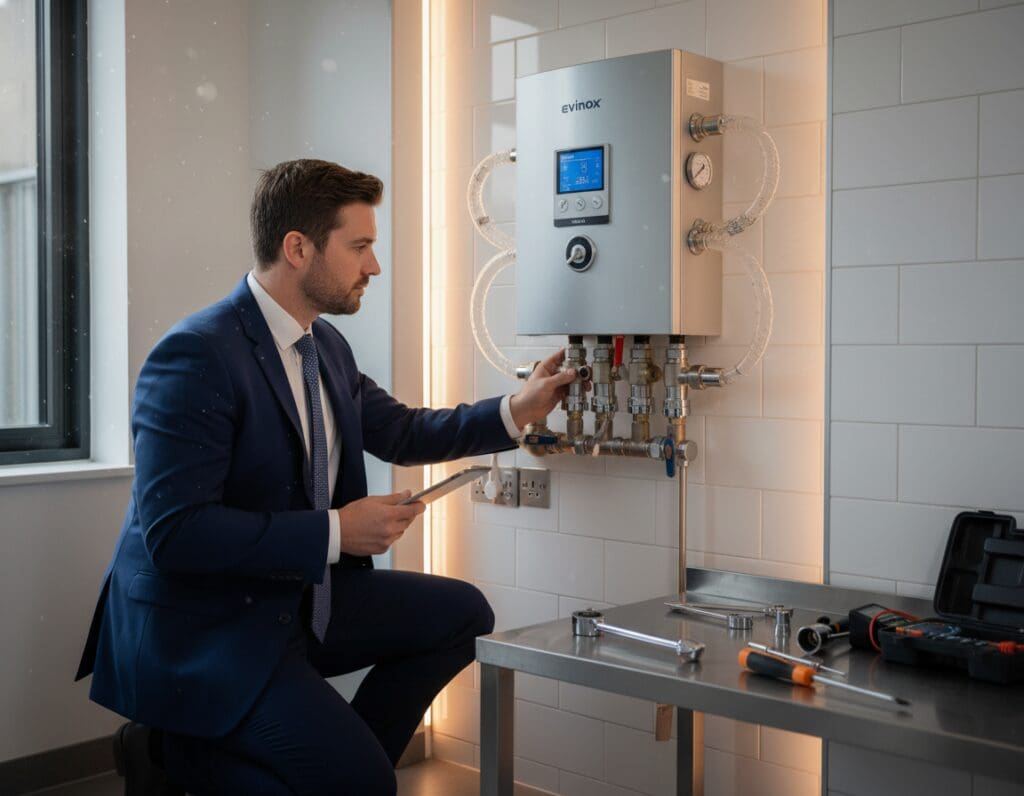
Communal heating HIU systems are common across modern UK developments. Many schemes now use Evinox ModuSat units as the interface between district or communal networks and individual homes. For landlords, housing associations and managing agents, the question is simple: does commissioning professional Evinox HIU service and maintenance deliver clear, measurable benefits?
Proper Evinox HIU maintenance helps protect resident comfort by keeping hot water delivery consistent and by reducing the risk of sudden failures. It also supports compliance with manufacturer guidance and warranty conditions, which matters for long-term asset value and legal duties under UK building and landlord obligations.
This article explores how routine professional service work can improve energy efficiency, lower lifetime costs and extend equipment life. We will consider typical fault modes seen in HIU heating interface units UK, what specialist engineers do during visits, and how to weigh costs against returns. The aim is to reassure stakeholders — from consulting engineers to residents — that planned maintenance is an investment in reliability and efficiency.
Understanding Evinox HIU systems and their role in communal heating
The rise of modern communal heating depends on compact, efficient heat interface units. Evinox HIU systems translate central plant energy into heating and hot water at flat level. They reduce heat loss, simplify riser layouts and give residents control over comfort.
Below are concise explanations of key products, parts and common layouts that shape performance and user experience.
What is an Evinox ModuSat unit and how it works
The Evinox ModuSat unit is a packaged HIU built to deliver space heating and domestic hot water from a district or communal primary circuit. Primary flow passes through compact plate heat exchangers. One exchanger serves central heating; a second provides rapid DHW either instantaneously or via a small cylinder, depending on the model chosen.
Controls in the ModuSat regulate temperature, switch pumps and operate motorised valves to match demand. This protects the primary network from thermal shock and helps manage legionella risk where stored water is used.
Key Evinox HIU components and controls explained
- Primary and secondary plate heat exchangers that transfer heat efficiently.
- Circulating pumps with staged or variable speed control for flow matching.
- Motorised two‑port or three‑port valves to route heating and DHW circuits.
- Thermostatic mixing valves, expansion vessels and pressure relief devices for safety.
- Strainers, commissioning ports, temperature sensors and pressure gauges for service access.
- Electronic controllers and optional heat meters for accurate monitoring and billing.
Correct calibration of pumps and valve sequencing prevents noise, short‑cycling and loss of efficiency. Built‑in fault detection helps avoid scalding and backflow worries.
Benefits of Evinox ModuSat heat interface unit performance for residents
Residents gain fast, reliable hot water and steady heating control at dwelling level. The Evinox ModuSat heat interface unit performance delivers quick DHW recovery and consistent radiator temperatures, cutting complaints about cold spots.
When units are configured and maintained correctly, energy losses fall and flow control improves. Integrated heat meters can support fair billing and drive energy awareness among occupants.
Common configurations for communal heating HIU systems in the UK
- Direct primary‑to‑secondary plate heat exchanger ModuSat for instant DHW with separate heating control.
- Indirect cylinder options for developments with high simultaneous hot water demand or specific legionella management needs.
- Cascaded or multi‑unit riser arrangements suited to medium and high‑rise blocks.
- Integration with building management systems and sub‑metering for communal areas and larger estates.
Design must meet UK building regulations, water bylaws and heat network efficiency targets. Good installation and commissioning align Evinox HIU components and controls with project performance goals for long‑term reliability.
Evinox HIU maintenance: costs, frequency and what professionals do
Keeping communal systems reliable calls for planned attention. Regular Evinox HIU service and maintenance reduces breakdowns, protects resident comfort and helps keep lifecycle costs down. Well-written records from each visit support warranty terms, landlord duties and regulatory checks.
Why schedule regular Evinox HIU service and maintenance
Preventative visits cut emergency call-outs and limit disruption. Routine checks on pumps, valves and heat exchangers improve HIU efficiency and system optimisation, which lowers primary plant fuel use.
Servicing addresses safety and hygiene risks. Technicians confirm safe domestic hot water temperatures, pressure settings and steps that reduce legionella risk. Clear paperwork from each visit also helps asset managers and insurers.
Typical tasks included in professional HIU maintenance visits
- Visual inspection for leaks, corrosion and unusual vibration or noise.
- Cleaning or backflushing strainers and filters; descaling heat exchangers where needed.
- Checking and adjusting pump speeds, valve actuators and thermostats; calibrating sensors.
- Testing expansion vessels, pressure relief and non-return valves; verifying set pressures.
- Measuring DHW delivery temperature and flow rates; logging heat meter readings where fitted.
- Replacing worn seals, gaskets, thermostats and filters, then issuing a detailed service report with photos and remedial recommendations.
How often to service HIUs for optimal performance and longevity
Most manufacturers and installers recommend annual Evinox HIU maintenance as a baseline for residential systems. Annual visits align with warranty conditions and industry best practice.
Sites with heavy use, hard water or prior faults may need six-month or quarterly checks. An initial commissioning visit and a follow-up shortly after installation help set controls and catch early issues. Maintain a service log for each unit to spot trends and plan predictive work.
HIU repairs and fault diagnosis Evinox: when to call a specialist
Call for expert help when residents report loss of hot water, persistent temperature swings, strange pump noises or repeated pressure loss. Complex control errors, heat exchanger leaks or hydraulic imbalance demand trained technicians.
Use accredited engineers who know Evinox product procedures to protect warranties and ensure correct spare parts. Providers that offer planned preventative maintenance, priority response times and reliable parts supply reduce downtime and keep hot water and heating HIU solutions performing well.
Is professional maintenance worth it? ROI, efficiency and trusted providers
Investing in Evinox HIU maintenance delivers clear financial and operational returns. Routine annual service fees and occasional parts replacement are predictable short-term costs, while periodic interventions such as heat exchanger replacement or pump overhaul occur less often. Over time, professional upkeep reduces energy consumption by improving heat transfer and lowering pump power, cutting primary energy use by several percentage points depending on system size and occupancy.
Beyond direct savings, the intangible benefits matter for communal heating HIU systems. Fewer emergency repairs, longer asset life and lower capital replacement spend protect budgets. Improved resident comfort and reduced complaints bolster landlord reputation and aid compliance reporting. Providers such as R&B London HIU Engineers, offering both HIU maintenance and repairs and Evinox HIU services, commonly supply sample reports and KPI data to demonstrate these gains.
Efficiency and system optimisation depend on skilled tuning. Professional teams carry out pump balancing, valve sequencing and control updates to stop short-cycling and thermal stratification. Water quality management and descaling preserve heat exchanger performance. The addition of heat meters and service-data analytics enables targeted upgrades like variable-speed pump retrofits, further improving HIU efficiency and system optimisation.
Choose specialists with proven Evinox experience for best results. R&B London HIU Engineers provides both Evinox HIU services and full HIU maintenance and repair support; always check accreditation, insurance and spare-parts arrangements. For most UK communal heating HIU systems, a planned professional programme—starting with an audit, competitive quotes and an annual PPM schedule with documented outcomes—delivers measurable ROI and long-term peace of mind.