
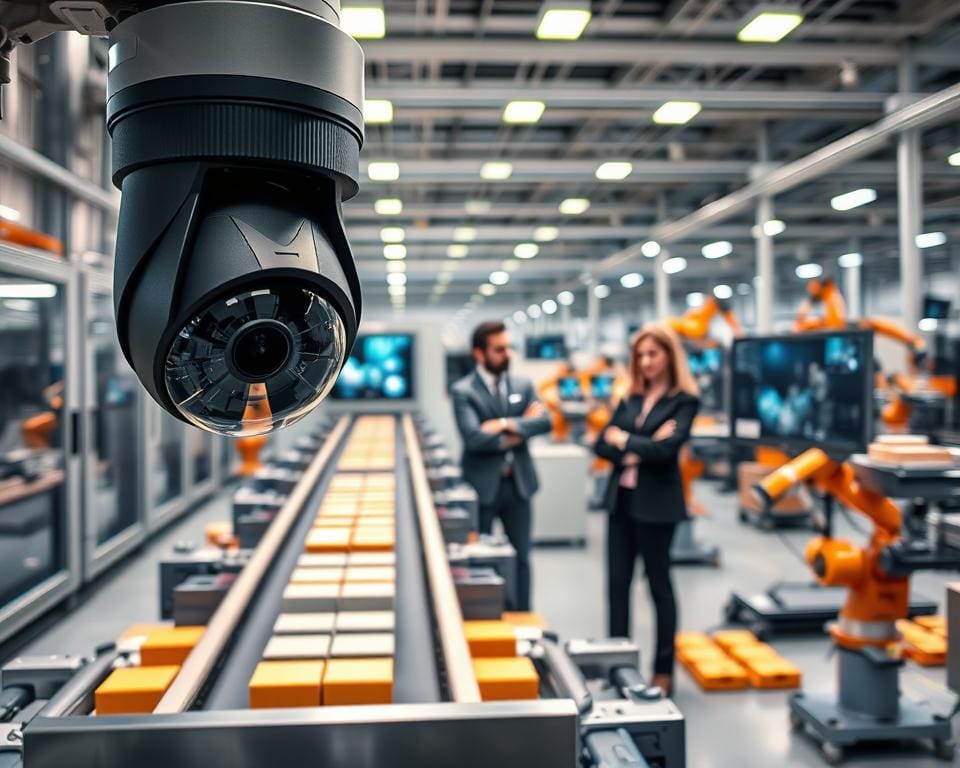
You need a clear definition before you decide on new technology. Computer vision is a branch of artificial intelligence that lets cameras and imaging sensors interpret visual data. In industrial quality control it augments or replaces human visual inspection to spot faults, check assemblies and measure parts.
Think of it as automated inspection that runs consistently across shifts. It applies algorithms to images and video to deliver rapid defect detection, dimensional checks and OCR for batch codes. That makes manufacturing quality assurance more repeatable and traceable.
Business drivers are straightforward. You can cut waste, reduce recalls and meet regulatory demands in sectors such as pharmaceuticals and automotive. Lower camera and compute costs mean both Tier 1 manufacturers and SMEs in the UK can adopt solutions from vendors like Cognex, Keyence and Teledyne DALSA or build custom systems with OpenCV and PyTorch.
Typical use cases include surface defect detection on metal, glass and plastic; dimensional verification of machined parts; assembly presence and orientation checks; and packaging inspection for seals and fill levels. These applications directly improve defect detection rates and inspection throughput.
Expect measurable KPIs: true positive defect detection, false-reject rate, units inspected per minute, and improvements to overall equipment effectiveness. ROI often appears within months to a couple of years depending on scale and integration effort.
Be aware of limitations. Performance depends on consistent lighting, fixturing and quality training data. Some edge cases still need human judgement, and regulated industries require validation. Addressing these points early reduces deployment risk and supports long-term manufacturing quality assurance success.
computer vision in manufacturing: core capabilities and benefits
You will find that manufacturing computer vision turns visual data into fast, repeatable decisions on the factory floor. A short pipeline captures images with industrial cameras and controlled lighting, pre-processes them, extracts features or runs inference, then applies decision logic to trigger actions such as reject, sort or signal a PLC. This flow underpins reliable production line inspection and keeps your operations deterministic so cycle times stay predictable.
How computer vision systems work on the production line
Image acquisition uses GigE, USB3 Vision or Camera Link cameras paired with telecentric lenses where high accuracy is needed. Pre-processing filters noise and normalises contrast to improve detection. Feature extraction or deep-learning inference produces classifications or measurements. Decision logic then outputs pass/fail results, measurement values or robot commands for immediate response.
Types of inspections enabled by computer vision
Dimensional measurement reaches sub-pixel accuracy when you use calibrated cameras and telecentric optics. This capability suits automotive parts, PCB assembly and precision machining where micron-level checks matter.
Surface inspection finds scratches, dents, contamination or coating flaws using bright-field and dark-field illumination, structured light and line-scan cameras for webs and continuous processes. Such systems spot defects that escape the human eye.
Assembly verification covers presence/absence checks, orientation confirmation, screw detection and connector seating. Pattern matching, template methods and deep-learning classifiers confirm correct assembly and reduce field returns.
Benefits for defect detection accuracy and consistency
You gain repeatable sensitivity that does not vary with fatigue, shift change or subjective judgement. Machine models detect micro-defects and subtle deviations while holding stable pass/fail thresholds, which reduces false positives and lowers scrap and rework rates.
When integrated with platforms like Halcon, OpenCV and commercial solutions or hardware from Cognex and Keyence, your systems achieve robust repeatability across shifts and lines, improving overall consistency.
Speed and throughput improvements compared with manual inspection
Computer vision inspects at line speed, handling hundreds to thousands of parts per minute with the right cameras and edge acceleration. Line-scan and high-speed area cameras support continuous or discrete workflows without slowing production.
Deterministic timing, parallel processing and automated rejection eliminate manual bottlenecks. Your inspection speed rises while operators move to higher-value tasks such as process optimisation and maintenance, helping you run 24/7 inspection without added labour costs.
Implementing computer vision solutions for quality control
When you plan a vision system implementation, start with clear objectives and a staged roadmap. Define acceptable detection rates, throughput needs and how results will feed back into process control. A phased approach reduces risk and keeps costs predictable.
Choosing imaging hardware: cameras, lighting and optics
Select industrial cameras to match part geometry and speed. Area-scan cameras suit discrete parts, line-scan handles continuous webs and 3D sensors capture depth for complex shapes. Choose monochrome or colour sensors based on contrast needs.
Pick optics that remove perspective error for measurement. Telecentric lenses give accurate dimensions, macro lenses work for close inspection. Check working distance and resolution to cover your field of view.
Plan machine vision lighting to reveal defects reliably. Use bright-field for topography, dark-field for scratches, backlighting for silhouettes and polarised lighting for reflective surfaces. LED strobe systems prevent motion blur on fast lines.
Account for environment. Fit IP-rated housings, vibration damping and temperature control to keep images consistent under harsh factory conditions.
Software approaches: rule-based, machine learning and deep learning
Rule-based vision uses deterministic checks such as edge detection and blob analysis. It is fast and easy to interpret, so it suits stable, low-variability tasks.
Classical machine learning with SVM or random forest works when you have moderate variability and limited data. Hand-crafted features can produce robust classifiers with modest compute needs.
Deep learning inspection with convolutional neural networks handles high variability and complex defects. It supports classification, segmentation and localisation but needs labelled data and compute resources.
Hybrid systems combine rule-based measurement with deep-learning defect recognition to balance traceability and resilience. Use industry tools such as MVTec HALCON, Cognex VisionPro, OpenCV, PyTorch and TensorFlow for development and edge engines like NVIDIA TensorRT or OpenVINO for deployment.
Integration with existing manufacturing execution systems (MES) and automation
Plan MES integration early so you can log images, measurements and pass/fail outcomes for traceability. Use OPC-UA, MQTT or REST to exchange events and maintain synchronisation with PLC triggers and serial numbers.
Enable actionable responses: route rejects to robots, trigger line stops on defect trends or feed measurements back to process control for closed-loop adjustments. Secure communications and network segmentation protect IP and support regulatory needs.
Data collection, annotation and model training best practice
Collect representative images across shifts, machines and product variants. Include both good and faulty examples plus edge cases like soiling or lighting change.
Annotate consistently using COCO or VOC formats with clear labelling rules. Keep training, validation and test splits free of leakage so images from one batch do not appear in multiple sets.
Use augmentation and synthetic data when examples are scarce. Version datasets and models, track training metrics and validate on unseen production samples before you deploy.
Commissioning, calibration and ongoing maintenance considerations
Run factory and site acceptance testing with documented criteria and sample sizes. Confirm detection rates under production conditions before sign-off.
Perform system calibration for metric measurements and schedule periodic re-calibration. Use calibration targets and maintain environmental controls to preserve repeatability.
Monitor performance for drift in false-reject and false-accept rates. Plan spare parts for cameras and lighting, establish cleaning routines for optics and keep software patched. Schedule retraining with new labelled data when performance degrades.
Practical outcomes and considerations for your business
When you deploy quality control automation, expect measurable business outcomes quickly. You should see fewer defects, less scrap and a drop in customer returns. First-pass yield improves and consistency rises across shifts, which reduces warranty claims and downstream rework costs.
Calculate ROI computer vision by running a focused pilot on a high-volume or high-cost defect area. Track defect reduction, cycle-time impact, false-reject rates and integration effort. Typical payback often falls between 6 and 24 months, depending on defect cost and scale. Include hardware, software, integration and labour redeployment when you assess return on investment.
Scalability depends on standardisation and architecture choices. Standard camera mounts, lighting modules and shared software stacks cut per-site engineering. Use central model management with edge orchestration to push updates and monitor fleet performance. Choose edge for deterministic control and low latency, and cloud for large-scale training and dataset management, weighing deployment considerations for your site.
Operational change matters as much as technology. Involve operators, quality engineers and maintenance staff early and provide practical training so your team can interpret images and act on results. Set cross-functional governance across IT, OT and Quality, and select suppliers such as Cognex, Keyence or Teledyne for domain expertise. Finally, run a gap analysis, plan a small measurable pilot with clear KPIs, and align stakeholders to secure the desired business outcomes and sustainable ROI computer vision delivers.