
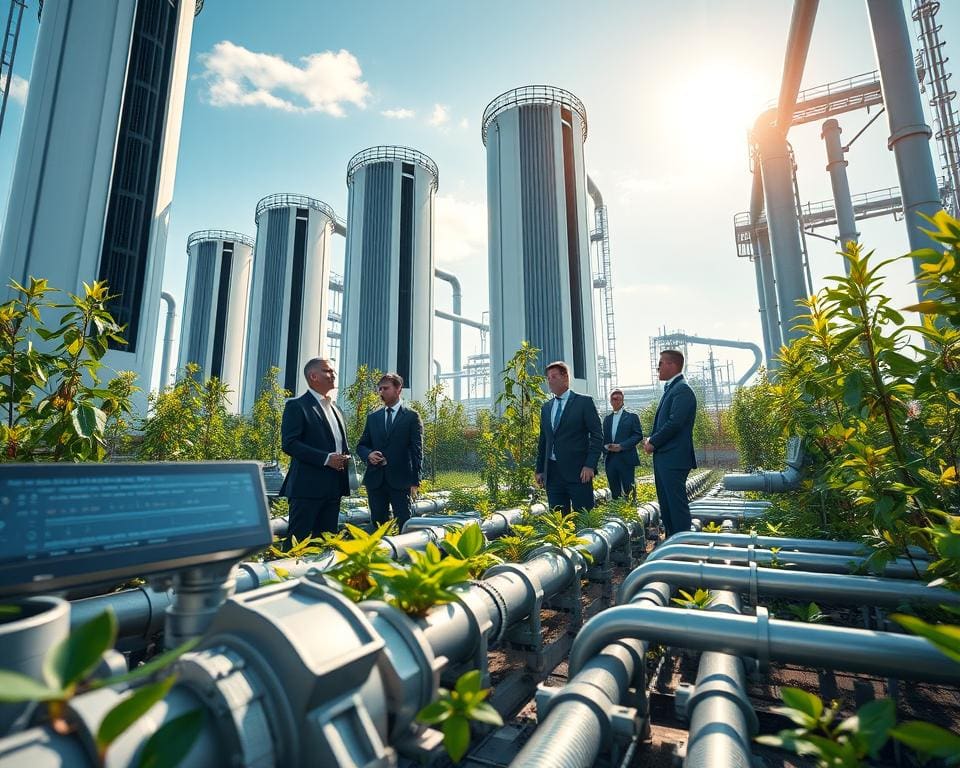
You need clear, practical information about carbon capture because the choices you make now shape the UK’s journey to net zero UK. Atmospheric CO2 sits above 420 ppm in the mid-2020s, and current emissions paths miss targets in the Sixth Carbon Budget and the Paris Agreement unless removal scales up alongside cuts.
Carbon capture matters for national and corporate climate targets because it closes the gap between emissions reductions and the remaining pollution that renewables and efficiency cannot eliminate. Carbon capture technology covers point-source capture at factories, engineered approaches such as direct air capture, and nature-based carbon sequestration in soils and forests.
Many IPCC pathways rely on large-scale CCS future deployment and greenhouse gas removal to meet long-term goals. The UK is well placed to lead: North Sea geology offers storage, industrial clusters on Humberside and Teesside provide capture hubs, and government plans aim to develop carbon capture clusters that create exportable expertise and jobs.
This article is for business leaders, policymakers, investors and individuals in the UK who want a practical grasp of technologies, policy levers and actions to support or adopt carbon capture solutions. For deeper evidence, consult IPCC assessment reports, the Committee on Climate Change, the UK Government Net Zero Strategy, and work by Equinor, Shell, Drax, Carbon Engineering, Climeworks, Imperial College and the University of Edinburgh.
carbon capture: current landscape and emerging technologies
You will find a clear map of the main carbon capture approaches below, so you can judge which CCS types suit different emissions sources. The overview highlights point-source capture from power stations and industry, engineered removal such as direct air capture and hybrid nature-based options including BECCS. It sets out the end-to-end CCS chain of capture, transport and storage that underpins durable greenhouse gas removal.
Overview of carbon capture approaches
This capture methods overview divides solutions into three routes: point-source capture for plants and factories, engineered removal for ambient air, and nature-based or hybrid paths. Point-source capture targets large emitters like cement, steel and chemical plants using industrial capture methods that are often easier to site near transport and storage links.
The full CCS types chain includes capture, pipeline or shipping transport, and storage in geological reservoirs such as depleted oil and gas fields or saline aquifers. Uses for captured CO2 range from utilisation to permanent storage, though only geological storage achieves true negative emissions.
Post-combustion, pre-combustion and oxy-fuel capture explained
Post-combustion capture removes CO2 from flue gases after combustion. It commonly uses solvents, solid adsorbents or membranes and can be retrofitted to existing power plant CCS and industrial facilities. Typical capture efficiencies in mature systems reach 85–95% under test conditions, yet solvent regeneration creates an energy penalty and cost burden.
Pre-combustion converts fuel to syngas, shifts CO to CO2 and captures it before combustion. This approach suits new-build facilities such as IGCC plants and many industrial processes, since higher CO2 partial pressures make capture easier and often more efficient.
Oxy-fuel combustion burns fuel in pure oxygen to yield a flue gas rich in CO2 and water vapour. The simplified gas stream lowers separation needs, but air separation units for oxygen production raise energy use and capital cost, limiting current deployment.
Direct air capture (DAC) and its scalability potential
Direct air capture extracts CO2 from ambient air using chemical sorbents or solid adsorbents. Leading developers include Climeworks with modular units and Carbon Engineering with a large-plant solvent approach. DAC scalability depends on low-carbon power or waste heat, access to storage or utilisation networks and falling technology costs.
Current cost estimates span several hundred US dollars per tonne, with potential reductions from learning and integration. DAC can provide carbon removal technologies for hard-to-abate emissions and legacy CO2, yet it should complement rapid emissions cuts rather than replace them.
Innovations in materials and solvents for higher efficiency
Advances in carbon capture materials are central to capture efficiency improvements and lower operating costs. Metal-organic frameworks, porous polymers and novel solid amines offer higher capacity and selectivity across partial pressures. Next-generation advanced solvents and amine alternatives aim to reduce volatility, degradation and regeneration energy.
Membranes and hybrid systems pair sorbents with separations to shrink footprint and cost. Process intensification, low-temperature regeneration and electrochemical capture methods support retrofit and new-build options, cutting energy penalties and enabling wider adoption of industrial capture methods.
Policy, investment and the role of the UK in sustainability
You need to understand how UK carbon capture policy shapes deployment and investor confidence. The Net Zero Strategy sets targets and a clear pathway for decarbonisation. That strategy links to UK CCUS clusters and the Cluster Sequencing Programme that prioritises regions such as Humberside and Teesside.
UK government strategies and regulatory frameworks
You will find CCS regulation UK sits across multiple agencies. The Oil and Gas Authority, the Environment Agency and the Department for Energy Security and Net Zero each set permitting rules for offshore storage, environmental assessment and well integrity. Robust MRV rules ensure captured CO2 is reported in the greenhouse gas inventory and prevent double counting.
Funding streams, private investment and green finance mechanisms
Your projects rely on a mix of CCS funding UK and private capital. Government grants and revenue support models, similar in intent to Contracts for Difference, reduce early-stage revenue risk. The Net Zero Innovation Portfolio and Industrial Energy Transformation Fund offer direct support for demonstrations.
Green finance and blended finance structures help attract institutional investors. Green bonds and climate funds channel private capital into long-lived infrastructure. Risk mitigation tools such as loan guarantees and public equity stakes make carbon capture investment more bankable.
Carbon markets, credits and how they influence deployment
You should distinguish carbon markets UK from voluntary schemes. The UK ETS creates compliance price signals. The voluntary carbon market and the removals market reward corporate offtake through carbon credits for removals or offsets.
Durable removals that store CO2 geologically must meet permanence, additionality and verifiability standards. High-integrity certification drives higher prices and reduces reputational risk. Predictable carbon pricing or guaranteed purchase mechanisms are vital to secure long-term investment.
Community engagement and social licence to operate
Your success depends on public acceptance and local consent. Community engagement CCS must begin early with plain-language information about safety, monitoring and local benefits. Developers that set local employment targets and fund skills programmes tend to win trust.
Long-term stewardship requires clear liability rules and transparent monitoring so communities can see data over decades. Partnerships with local authorities and NGOs help share benefits and address concerns such as leakage or landscape impacts.
- Clear revenue streams and CCS regulation UK increase carbon capture investment.
- High-integrity carbon credits and robust removals market standards attract private capital.
- Early community engagement and social licence carbon capture reduce delays and opposition.
Practical implications for businesses and individuals
You should start by auditing your emissions to see where carbon capture for business makes sense. Focus first on energy efficiency, electrification and process improvements, then consider capture for residual or hard‑to‑abate emissions in sectors such as cement and chemicals. Look into partnerships with established clusters around Humber and Teesside and weigh offtake agreements or investments in DAC and bioenergy with CCS against likely carbon price paths.
If you manage investment or finance, assess technology readiness, counterparty risk and policy exposure before backing projects. Use scenario analysis to stress‑test returns under different carbon price trajectories. Explore green bonds, blended finance and public–private partnerships to lower cost and share risk, and require robust MRV and government‑backed revenue mechanisms where possible to support corporate CCS adoption.
As an individual, treat carbon removal for consumers as one tool among many: reduce your own energy use, travel smarter and alter diet where practical. Engage in local planning and ask developers and regulators for clear information on safety, jobs and community benefits. If you choose to buy removal credits, pick high‑integrity providers and prioritise direct reductions first as part of your personal action climate plan.
Across communities and workforces, expect new roles in engineering, monitoring and operations; support reskilling and vocational schemes to capture local economic opportunity. Remember that large‑scale deployment will take years, so prepare for gradual scaling while staying ready for faster rollout if UK sustainability actions and policy support accelerate. As a quick checklist: audit emissions, join industry clusters, secure finance or offtake, insist on strong MRV, and keep reducing your own footprint.