
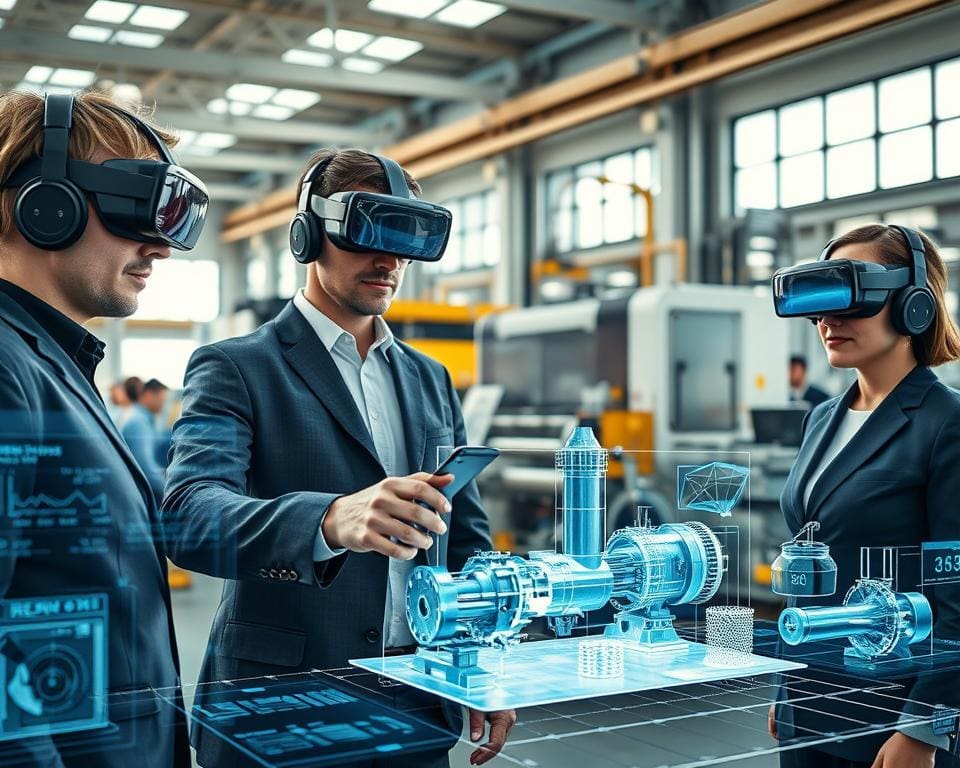
The augmented reality industry is moving from experimental pilots to practical deployments that change how you work. Industrial AR overlays digital information onto physical equipment so you can make faster decisions, reduce errors and improve training outcomes.
Growth is driven by falling hardware costs, advances in computer vision and wider 5G and edge compute availability. Leading platforms from Microsoft HoloLens, Google ARCore, Apple ARKit, PTC Vuforia and Magic Leap are shaping standards and interoperability in the enterprise augmented reality ecosystem.
This article focuses on high‑impact AR use cases and AR innovations across manufacturing, healthcare and retail. You will find practical examples you can pilot, measures to track, and the technical building blocks that support scaling in the UK market.
You, as an operations manager, CTO, clinical lead, retail experience director or systems integrator, will get a clear map of what to implement and how to measure success. The remainder of the article covers sector transformations, technical components and business strategies for scaling augmented reality solutions.
How the augmented reality industry is reshaping core sectors
You will see augmented reality move from novelty to backbone technology across manufacturing, healthcare and retail. This section outlines key use cases, operational benefits and practical steps you can take to pilot AR solutions in each sector.
Transformations in manufacturing and assembly
In factories, AR manufacturing drives visible gains. Guided assembly overlays augmented instructions onto parts to show location, torque values and sequencing in situ. Pick-to-light visual aids speed fulfilment while augmented inspection compares live scans to CAD models to flag deviations.
Remote expert assistance lets senior engineers view an operator’s field of view and annotate live. Shopfloor AR projects work orders and safety checks onto equipment, improving first‑time‑right rates and cutting rework. OEMs such as Boeing and Airbus have reported shorter training time and lower downtime when using AR for wiring harness assembly and maintenance.
To integrate, link AR to PLM and ERP so the correct procedures and part data surface automatically. Choose smart glasses for hands‑free line work and tablets for bench tasks. Use industrialised devices that meet safety standards and design pilots around repeatable, high‑volume tasks to measure task time, error rate and MTTR.
Healthcare: surgical assistance and patient care
AR in healthcare supports care at every stage. In pre‑operative planning, CT and MRI can register to patient anatomy so teams rehearse complex steps. Intra‑operative visualisation projects anatomy and instrument trajectories onto the surgical field for image guidance in minimally invasive procedures.
Surgical AR enables remote consultation, allowing specialists to guide teams in real time. AR training for clinicians uses patient‑specific 3D models and simulation to shorten learning curves and improve procedural confidence for junior surgeons.
Hospitals and academic centres adopting AR platforms for orthopaedics, neurosurgery and interventional cardiology report improved precision and, in select interventions, shorter procedure times. Clinical deployment must integrate with PACS, sterilisation protocols and UKCA/MHRA regulations, and protect patient data under UK GDPR.
Retail and customer experience enhancements
AR retail shifts how customers shop. Virtual try‑on tools help shoppers preview eyewear and fashion, while AR furniture visualisers place 3D models in customers’ homes for accurate size and fit. In‑store AR and personalised product visualisation create richer discovery and reduce returns due to size or mismatch.
Interactive shelf overlays and in‑store navigation guide purchases and highlight promotions, linking online and physical channels for a coherent omnichannel experience. Retailers such as IKEA with IKEA Place and Sephora with virtual try‑on tools show measurable conversion uplift and higher engagement.
Decide between app‑based AR and WebXR for reach versus speed. Optimise 3D assets for mobile to preserve performance. Track session length, conversion uplift, return rate reduction and average order value to judge success. Keep camera permissions transparent and design quick calibrations so the experience is simple and trustworthy.
Practical applications and technological building blocks for industrial AR
You will need to balance hardware choice, software stack and network design when deploying augmented reality in your plant or site. Picking the right AR hardware influences task flow, safety and total cost of ownership. Trials in real working conditions reveal what end users tolerate in weight, battery life and durability.
Hardware: wearables, headsets and mobile devices
Compare smart glasses such as Microsoft HoloLens 2 and hands‑free RealWear units with mixed reality headsets like Magic Leap, then consider smartphones and tablets. Smart glasses and mixed reality headsets suit heads‑up, hands‑free work on maintenance and assembly. Tablets and ruggedised smartphones work well at benches or for customer demos.
Assess rugged AR devices for IP ratings, drop tolerance and replaceable batteries. Ergonomics matter when workers wear devices for long shifts. Cameras, depth sensors, IMUs and spatial anchors determine overlay accuracy. Voice and gesture controls improve safety during complex procedures.
Software: platforms, SDKs and enterprise integrations
Choose AR software that supports AR SDKs such as ARKit, ARCore and Vuforia and that integrates with Unity or Unreal Engine for 3D content. Enterprise AR platforms from PTC, Microsoft Dynamics 365 Guides and Scope AR provide content management, user provisioning and analytics layers.
Convert CAD and PLM assets into optimised 3D models. Create step‑by‑step instructions and interactive overlays with version control. Plan integration with ERP/PLM systems, CMMS and remote expert platforms so work orders, parts lists and telemetry feed into the AR experience in context.
Connectivity and data: 5G, edge computing and security
Low latency and high throughput are essential for smooth overlays and remote assistance. 5G AR and private LTE reduce motion lag and enable live video streaming when needed. For limited bandwidth, use local caching and adaptive bitrate streaming.
Run real‑time computer vision and spatial mapping on edge compute nodes such as NVIDIA Jetson or Azure Stack/Edge to lower latency and protect sensitive data. Edge computing for AR helps keep heavy inference off the device while meeting privacy needs.
Apply AR security and data governance across the stack. Enforce UK GDPR compliance, device attestation, secure boot and MDM policies. Encrypt data in transit and at rest. Segment networks to limit lateral movement and implement role‑based access so only authorised users view sensitive streams.
Operational considerations
- Procurement and TCO: licence models, customisation and consumables add cost; pilot hardware in real settings.
- User management: authentication, role‑based content and analytics dashboards measure adoption and task efficiency.
- Privacy: clear signage, consent policies and anonymisation for analytics protect individuals and your compliance posture.
Business impact, adoption barriers and strategies for scaling augmented reality solutions
You should start every AR business case with clear AR KPIs that map to operations and finance. Track average task completion time, error rates, first‑time‑right percentage, mean time to repair (MTTR), training hours per employee and user satisfaction such as NPS. For retail pilots include customer conversion and return rates. Baseline current performance, run a short controlled pilot and measure incremental gains to make the financial case.
Design pilots around a single, representative high‑impact workflow. Define scope, set measurable outcomes and collect both quantitative and qualitative data. Build a financial model that lists hardware, software, integration and change‑management costs. Use payback period and sensitivity analysis on adoption rates to test the model. Those steps turn a pilot into a scalable plan for scaling AR.
Be realistic about AR adoption barriers. Upfront cost, workforce resistance to new interfaces, interoperability with legacy systems and a shortage of in‑house AR skills are common hurdles. In regulated fields such as healthcare and safety‑critical manufacturing you must also factor in compliance and audit requirements. Address these early in your timeline.
Overcome barriers with phased roll‑outs, strong change management and vendor selection that values modular, standards‑based solutions. Establish champions and super‑users, set proof‑of‑value milestones, and invest in training and documentation. Adopt AR best practices like reusable content components, modular architectures and governance processes to keep procedures accurate and auditable.
Finally, plan architecture and content governance for the long term. Use reusable assets to cut duplication and lower maintenance overhead, and set a content lifecycle process for updates when procedures change. Watch trends such as AI‑enhanced contextual instructions, digital twins with live overlays, and advances from Microsoft, Apple and Google. Pilot emerging capabilities only when they align to clear outcomes and your defined AR KPIs.