
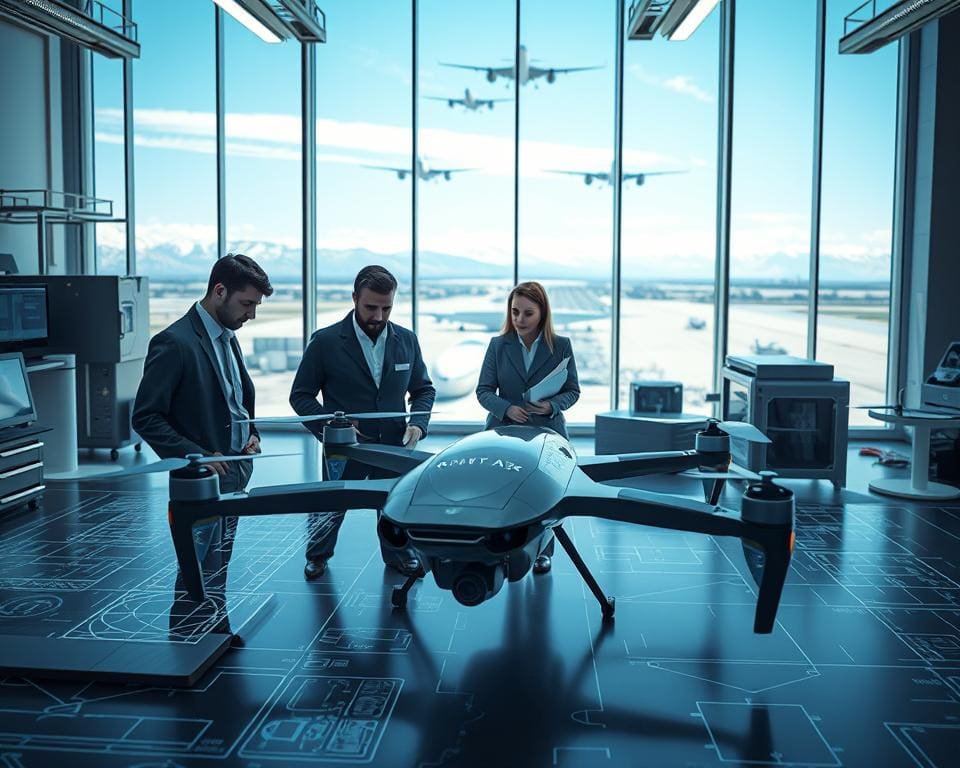
You are at the threshold of change in aerospace engineering. Emerging technologies are blending materials science, propulsion advances, digital modelling, autonomy, artificial intelligence and connectivity to reshape the future of flight.
That shift matters deeply to the UK aerospace sector. Companies such as Rolls‑Royce, BAE Systems and Airbus (UK operations), supported by the Aerospace Technology Institute and universities including Imperial College London, the University of Cambridge and the University of Bristol, drive aerospace innovation. Their research and demonstration projects aim to protect jobs, add billions to GDP and keep Britain competitive on the global stage.
This article will guide you through three parts. First, a historical and strategic perspective setting out why technological renewal is urgent. Next, a technical deep dive into advanced materials, propulsion systems and digital twins. Finally, a closer look at autonomy, AI and connectivity, and what they mean for regulation, operations and skills in the UK.
You will learn how specific technologies work, likely timelines for adoption and practical implications for design, manufacture and operation. The piece also examines impacts on careers and education, and how policy and funding — from UK Research and Innovation and ATI programmes to past Horizon Europe collaborations — steer investment toward net‑zero aviation goals, low‑emission propulsion and sustainable materials.
The article flags the key challenges to follow: certification hurdles, supply‑chain adaptation, new infrastructure for electric charging or hydrogen, cybersecurity and public acceptance. Each will be discussed in context so you can judge risks and opportunities for your organisation or career.
aerospace engineering and the next wave of innovation
You stand at a turning point in aerospace. A concise look at the history of aerospace engineering shows rapid leaps: piston engines gave way to jet propulsion, then to composite airframes such as those on the Boeing 787 and Airbus A350. Research spikes during and after the Cold War laid groundwork for modern avionics and systems integration.
Renewal matters because fleets are ageing while climate goals tighten. ICAO ambitions and the UK net-zero aviation policy push you to seek far more than marginal gains. Rising demand for sustainable mobility, the surge in unmanned systems and brittle global supply chains all add urgency.
Historical context and the need for technological renewal
Early breakthroughs shaped today’s platforms. The move from piston to jet engines transformed speed and range. The adoption of composite airframes cut weight and fuel use. Cold War investment drove avionics, materials science and propulsion advances that you still rely on.
Now those gains face new pressures. Meeting emission targets and economic constraints calls for radical shifts in materials, propulsion and digital methods. Incremental improvements will not meet the combined demands of decarbonisation, lower operating costs and enhanced performance.
Key drivers shaping the field
Policy and regulation drive much of the agenda. National and international emissions targets, noise limits and certification reform for novel aircraft types shape development timelines and investment choices.
Market forces push innovation too. Passengers want greener travel. Urban air mobility and defence modernisation create fresh markets. Airlines and manufacturers face intense cost pressure that rewards efficiency and novel designs.
Technological enablers are now converging. Better computational power, machine learning, additive manufacturing, battery gains, hydrogen development and high-temperature materials expand what you can build and certify.
Industry collaboration and supply chains matter for scaling solutions. Partnerships among OEMs like Rolls-Royce and Airbus, tier suppliers, universities and start-ups create testbeds and centres of excellence. Programmes backed by Innovate UK and the Aerospace Technology Institute help translate lab work into flight trials.
Impacts on careers, education and research in the UK
Your skills must broaden. Aerospace education will shift towards multidisciplinary degrees that mix aerodynamics, materials science, electrical and software engineering, data science and systems thinking. Hands-on work with digital twins and additive manufacturing will become standard.
Workforce reskilling is essential. Technicians and engineers need training in electric propulsion maintenance, battery safety, hydrogen handling and software validation for autonomous systems. Lifelong learning will be part of many careers.
UK aerospace research will prioritise scalable low-emission propulsion, recyclable composites, cyber‑secure avionics and clear certification pathways for new technologies. Universities and research centres will play a central role in trials and demonstration projects.
Opportunities for students and professionals are growing. Internships, doctoral funding, industry placements and public‑private partnerships open routes into eVTOL development, satellite constellations and advanced propulsion research. Your next project might begin in a university lab before moving into a flight test programme.
Advanced materials, propulsion systems and digital twins transforming aircraft and spacecraft
You will find rapid change where materials, engines and digital models meet. New composites, novel propulsion and virtual replicas are reshaping how aircraft and spacecraft are designed, built and maintained across the UK supply chain.
Lightweight composite materials and additive manufacturing
Carbon-fibre reinforced polymers cut weight and boost fuel efficiency on platforms such as the Airbus A350. UK suppliers contribute to these supply chains by integrating next‑generation composites into primary and secondary structures.
Research into recyclable thermoplastic composites and bio‑based resins aims to ease end‑of‑life pressures and meet circular economy rules. These materials promise lower lifecycle impact while keeping performance high.
Additive manufacturing for aircraft parts speeds prototyping and enables part consolidation. Rolls‑Royce uses metal 3D printing for turbine components and GE Aviation has adopted AM for fuel nozzles, showing real gains in assembly time and weight.
Certification, quality assurance and scale-up remain hurdles. You will need robust supply‑chain adaptation for large structural components and consistent inspection methods to meet airworthiness standards.
Electric and hybrid-electric propulsion
Electric propulsion spans battery‑electric, hybrid systems with turbine‑generators and distributed electric architectures that improve control. You should expect clear categories as projects mature.
Battery energy density still lags behind jet fuel, creating thermal management and power‑electronics challenges. Ground charging and infrastructure for urban operations require coordinated planning.
The UK hosts consortia and university prototypes for eVTOLs and regional hybrids. Established manufacturers and startups are testing designs for urban air taxis and short regional services.
Near term, you will see small commuter aircraft and range‑extended hybrid craft. Long term, larger short‑haul airframes could adopt hybrid or hydrogen‑electric systems as batteries and fuel options improve.
Safety and certification demand new standards for high‑voltage systems, battery safety and electromagnetic compatibility so maintenance regimes remain reliable.
Advanced air-breathing and rocket propulsion technologies
Advances in high‑bypass turbofans and variable‑cycle engines aim to raise thermal efficiency while enabling higher speed where needed. These changes improve fuel use and broaden mission profiles.
Sustainable aviation fuels help bridge decarbonisation while alternative propulsion scales. Compatibility with SAF offers a practical near‑term route to lower lifecycle emissions.
Hydrogen propulsion follows multiple paths: hydrogen combustion in modified turbines, fuel cells for electric drive and liquid hydrogen storage for longer missions. Industrial programmes are testing hydrogen‑ready engines and pilot infrastructure.
In rocketry, reusability and novel propellant cycles raise payload efficiency for small‑satellite launchers. Advanced rocket engines support growing UK space ambitions and commercial access to low Earth orbit.
Digital twins, model-based systems engineering and predictive maintenance
A digital twin aerospace model is a high‑fidelity virtual version of physical assets that you can use for simulation, optimisation and lifecycle analysis. It helps you predict performance and plan interventions.
When digital twins pair with model‑based systems engineering, development time shortens and cross‑discipline integration improves. Traceability from concept to certification becomes clearer.
Predictive maintenance uses sensor feeds, machine learning and analytics to predict failures and cut unscheduled downtime. Airlines and MROs gain better dispatch reliability and lower operating costs.
Cybersecurity and data governance must protect operational data and maintain supply‑chain integrity as partners share models. High‑performance computing, cloud platforms and edge processing handle the large data volumes these systems need.
Autonomy, artificial intelligence and connectivity reshaping operations and design
You will see autonomy, artificial intelligence aerospace advances and stronger avionics connectivity change how aircraft are designed, built and flown. From assisted autopilots to trials of fully autonomous aircraft and urban air mobility vehicles, the practical impact reaches UK operators, manufacturers and the Civil Aviation Authority. Early uses already include evolved autopilots, flight‑deck assistance and unmanned aerial systems for inspections, while trials of autonomous cargo services point to wider operational shifts.
Certification for autonomy ranges from simple assistance to full pilotless operations, and that range brings regulatory complexity. The UK Civil Aviation Authority and EASA require explainable AI, formal verification methods, and rigorous simulation backed by real flight testing. You should expect verification on machine learning predictive maintenance tools, formal proofs for control software, and long‑running trials before autonomous aircraft gain routine access to civilian airspace.
Artificial intelligence speeds design and operations by accelerating aerodynamic optimisation, generative design for structures, and materials discovery. In service, AI supports flight‑path optimisation for fuel saving, adaptive maintenance scheduling tied to machine learning predictive maintenance, and improved situational awareness for pilots and remote operators. These capabilities are stronger when paired with connected aircraft platforms that stream data for continuous health monitoring.
Connectivity is the glue: satcom, 5G/6G and dedicated aviation links enable real‑time traffic information, command‑and‑control for UAS, and resilient networks for safety‑critical communication. You will face airspace integration challenges for mixed traffic and urban air mobility regulation, requiring unmanned traffic management systems, careful spectrum allocation and planned urban infrastructure. Secure, resilient links are essential to prevent cyberattacks and protect passenger safety.
The societal and operational benefits can be substantial: better decision support, lower operational costs, new services such as point‑to‑point urban air mobility and rapid cargo delivery, and fresh business models for maintenance and operations. Public acceptance hinges on transparent safety cases and clear liability frameworks, while workforce roles will shift and need retraining for aircrew, controllers and maintenance staff to work alongside automated systems.
Ultimately, autonomy, AI and connectivity do not stand alone. They rely on advances in materials, propulsion and digital twins to deliver safe, efficient systems. As a professional, student or policymaker in the UK, you will need to understand these linked technologies and plan for certification, infrastructure and workforce transitions over the coming decade.