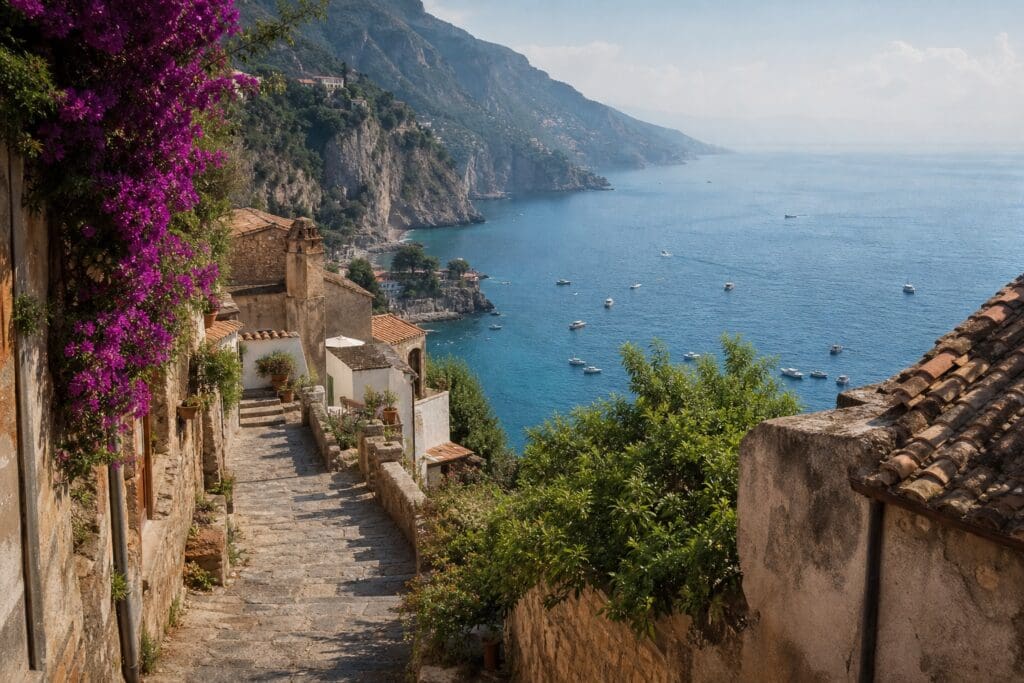
Beyond the postcard views of Positano and Amalfi, a quieter coast waits in steep lanes, fishing harbours and lemon-scented terraces. Exploring the hidden villages of the Amalfi Coast reveals a gentler side of southern Italy, where meals stretch slowly, church bells echo between cliffs, and sea views appear at the end of narrow stairways. These villages are not secret in the literal sense, but they do offer space to look, listen and understand the coastline beyond its busiest viewpoints.
Exploring the hidden villages of the Amalfi Coast beyond the famous towns
The Amalfi Coast is often imagined as a string of glamorous resort towns, yet its character is just as strong in smaller places. Villages cling to slopes, gather around tiny squares, or face the water with working boats and modest cafés. Their appeal lies in everyday detail: laundry above alleyways, cats asleep on warm stone, and older residents greeting each other outside food shops.
For UK travellers, these villages can make the coast feel more personal and less hurried. They suit people who enjoy walking, local food, photography, history and simple observation. They also reward patience. Some lanes are steep, pavements can be narrow, and buses may be full in peak months, but the slower pace is part of the experience.
Villages worth knowing
Atrani, a compact maze beside Amalfi
Atrani sits close to Amalfi, yet it feels noticeably calmer once you step away from the main road. Its lanes curve beneath arches and between pale houses, leading towards a small square near the beach. It is a good place to pause for coffee, watch village life and appreciate how densely built coastal communities developed between mountain and sea.
Because Atrani is so close to Amalfi, it can be combined with a morning visit to the cathedral area or harbour. The contrast is striking: one moment there are crowds and boat queues, the next there are shaded passages and a quieter rhythm.
Cetara, a village shaped by fishing
Cetara has a practical, seafaring feel. Its harbour and seafood traditions give it a distinct identity, especially for visitors interested in simple coastal cooking. Anchovies are closely associated with the village, and menus often reflect the relationship between local kitchens and the sea.
This is not a place that needs dramatic sightseeing to be memorable. Its charm comes from sitting near the water, walking slowly through the centre and noticing how fishing culture still informs daily life. Compared with the most photographed towns, Cetara can feel more grounded and lived in.
Minori, gentle streets and seaside ease
Minori is more open and level than many cliffside villages, which makes it appealing for travellers who prefer a less demanding wander. It has a pleasant seafront, small streets and a relaxed atmosphere. Food lovers often enjoy its baking traditions and its easy access to neighbouring towns.
Minori is also useful as a base for exploring nearby places without staying in the busiest centres. From here, it is possible to enjoy the coast while returning to somewhere that feels more manageable in the evening.
Furore and Conca dei Marini, cliffside quiet
Furore is best known for its dramatic inlet, where cliffs frame a narrow meeting point of sea and rock. The wider village is spread across the hillside, so it feels different from a single compact waterfront town. It rewards visitors who enjoy viewpoints, quiet roads and a sense of height above the coast.
Conca dei Marini has a similar cliffside calm, with houses set across the slope and views over deep blue water. These places remind travellers that the Amalfi Coast is not only about beaches and promenades. Much of its beauty is vertical, shaped by steps, terraces and sudden openings in the landscape.
How to explore without feeling rushed
Travelling between hidden villages is easiest when you allow more time than a map suggests. Distances look short, but coastal roads twist tightly and services can be affected by season, traffic and weather. A flexible plan usually works better than trying to tick off too many places in one day.
Useful approaches include:
- Choose two nearby villages rather than attempting the whole coastline at once.
- Use local buses or ferries where practical, especially when parking may be difficult.
- Start early if visiting in summer, then rest during the hottest part of the day.
- Wear comfortable shoes, as many routes involve steps and uneven stone.
- Keep some loose change available for small purchases, public toilets or quick coffees.
Walking can be rewarding, but paths vary in steepness and condition. Check local information before setting out, particularly after rain. Even a short stroll from a bus stop to a village centre may involve stairs, so pack lightly and avoid unsuitable footwear.
Food, culture and everyday moments
The smaller villages of the Amalfi Coast are excellent places to appreciate regional food without turning every meal into a grand occasion. Expect menus shaped by seafood, lemons, vegetables, pasta and local baking. Dishes vary from village to village, and the best experiences are often the simplest: a plate of pasta near a harbour, a pastry with coffee, or fruit eaten on a shaded bench.
Culture here is visible in small routines rather than only in museums. Churches, ceramic signs, roadside shrines, terraced gardens and family-run shops all tell part of the story. Many villages have deep religious and maritime traditions, but visitors do not need specialist knowledge to appreciate them. Respectful curiosity is enough.
Photography is tempting at every turn, yet it is worth putting the camera away at times. Listen to the scooters, the bells, the clatter from kitchens and the wash of water below the cliffs. These details make the hidden villages feel memorable long after the views begin to blur together.
Best times to visit
Spring and early autumn are often the most comfortable periods for exploring, with milder weather and fewer crowds than high summer. Summer brings long days and a lively atmosphere, but it can also mean heat, heavy traffic and busy public transport. Winter is quieter, though some services, restaurants and ferry routes may be reduced.
For a balanced day, consider visiting a village in the morning, resting during the afternoon, then returning outdoors in the early evening. The light softens, streets cool down, and squares often become more social. This rhythm suits the coast better than constant movement.
Frequently Asked Questions
Which hidden village on the Amalfi Coast is best for a first visit?
Atrani is a strong choice because it is close to Amalfi yet feels much quieter. Its compact centre, small beach area and atmospheric lanes give a clear sense of village life without requiring complex travel planning.
Can I explore these villages without hiring a car?
Yes, many visitors use buses, ferries and walking routes, depending on the season and location. A car can be inconvenient because roads are narrow and parking is limited in several villages.
Are the hidden villages suitable for families?
Many are suitable for families, especially those with older children who can manage steps and uneven paths. Families with pushchairs should plan carefully, as steep lanes and stairways are common along the coast.
How many villages should I visit in one day?
Two villages are usually enough for an enjoyable day, particularly if you want time for lunch, photographs and slow wandering. Trying to see too much can make the coast feel stressful rather than beautiful.
Is the Amalfi Coast expensive outside the famous towns?
Prices vary, but smaller villages can feel more relaxed and sometimes better value than the most famous centres. Costs still reflect the popularity and limited space of the Amalfi Coast, especially in peak season.