
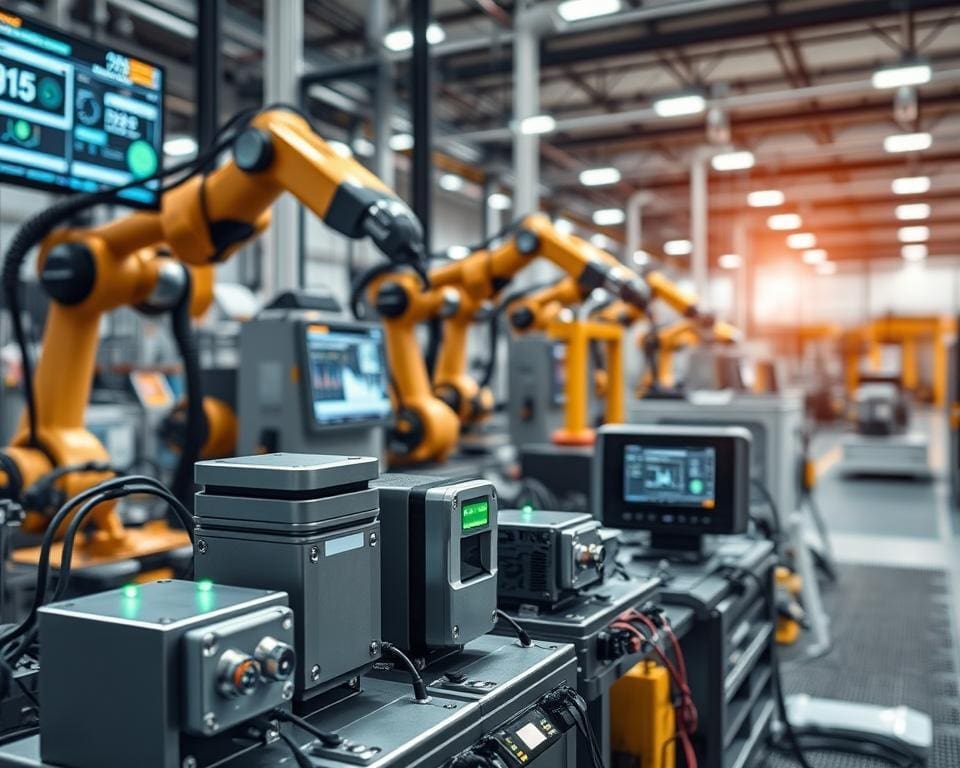
You want clear, practical answers about how industrial connected devices raise performance on the shop floor. This introduction explains what to expect: you will learn how IIoT benefits translate into lower costs, improved uptime and stronger sustainability outcomes for manufacturing in the United Kingdom.
The focus is practical and UK-centred. You’ll see use cases across production lines, warehouses and supply chains, covering hardware such as sensors and gateways, software from edge analytics to cloud platforms, and communications including 5G and LPWAN. The article ties these technologies to business outcomes like downtime reduction, better OEE and energy savings.
UK manufacturers face pressure to modernise, hit net zero targets and stay globally competitive. Organisations such as the Department for Business and Trade and the Institution of Engineering and Technology highlight digital transformation as a priority. Industry analysts including McKinsey and IDC report rising industrial IoT adoption, showing that connected devices manufacturing drives measurable gains when deployed with clear goals.
Throughout the piece you will find Definitions and technology detail in Section 2, operational benefits in Section 3 and practical guidance on deployment, security and ROI in Section 4. The aim is to equip plant managers, operations directors, maintenance engineers and procurement leads with concise, actionable insight into industrial connected devices and manufacturing efficiency UK.
industrial connected devices: what they are and why they matter for manufacturing
You need clarity on what are industrial connected devices so you can choose the right hardware and architecture for your plant. These devices are ruggedised sensors, actuators, controllers and edge nodes built to run in harsh environments and to feed reliable data into control systems and analytics platforms.
Defining industrial connected devices
Think of vibration sensors on motors, temperature and humidity probes in process lines, RFID and barcode readers in logistics, smart actuators for valves and servos, and PLCs with networked telemetry. Each item is designed for enterprise needs such as deterministic behaviour, long life cycles, and high reliability rather than one-off consumer use.
Key components and communication protocols
Your typical stack runs from field sensors and actuators to local PLCs, then to edge gateways that perform protocol translation and local analytics, and on to cloud or on‑premise platforms for advanced asset management. Understanding IIoT devices explained helps you map responsibilities across that stack.
- Common industrial sensors gateways protocols include OPC UA, Modbus, PROFINET and EtherCAT for deterministic control.
- Telemetry often uses MQTT, AMQP or HTTPS, while LPWAN technologies such as LoRaWAN serve low‑power wide‑area needs.
- 5G and private cellular networks support low‑latency, high‑throughput use cases.
Edge computing reduces latency by pre‑processing streaming data and keeps operations resilient when cloud links fail. Vendors such as Siemens, Schneider Electric and Rockwell Automation pair with platforms like Microsoft Azure IoT and AWS IoT to deliver tested integration patterns.
Sensor types range from discrete switches to analogue probes and multivariate devices. Telemetry varies by sampling rate and volume, so you must consider calibration and data quality when designing ingestion and storage.
How connected devices differ from consumer IoT
Design priorities diverge. Industrial kit meets IP ratings and ATEX or IECEx hazardous‑area rules. You must meet deterministic timing and functional safety standards such as SIL levels. Consumer gear focuses on cost, aesthetics and intermittent use.
Network topology and lifecycle management are more stringent in industrial settings. You may need Time‑Sensitive Networking or fieldbuses that guarantee timings and allow centralised device management. Consumer IoT commonly relies on Wi‑Fi or Bluetooth with simpler provisioning.
Security and safety carry greater implications in manufacturing. Safety‑related systems require specific testing, certification and traceability that go beyond standard consumer security practices.
Regulatory and standards landscape in the UK and EU
When you evaluate equipment, pay attention to industrial IoT standards UK buyers expect. Look for UKCA marking post‑Brexit and CE marking where applicable in the EU. Relevant standards include BS/EN electrical and mechanical safety rules, ATEX and IECEx for explosive atmospheres, plus functional safety standards such as IEC 61508 and IEC 62061.
Data protection and cybersecurity are also critical. The UK Data Protection Act and GDPR govern personal data within industrial contexts. Guidance from the National Cyber Security Centre helps secure ICS and SCADA environments.
Procurement and compliance pressures influence device choice. Public‑sector rules and sector rules for food, pharmaceuticals or aerospace create additional constraints you must factor into architecture and supplier selection to safeguard manufacturing connectivity.
Operational benefits of connected devices for industrial efficiency
Connected devices reshape how you run a factory by turning equipment into a continuous stream of useful data. You gain visibility into machine health, throughput and energy use. This section explains practical outcomes you can expect when you adopt industrial sensing, telemetry and analytics.
Real-time monitoring and reduced downtime
Continuous telemetry lets you spot faults the moment they appear. With real-time monitoring manufacturing teams detect anomalies in vibration, temperature and flow rates. Dashboards and alerts accelerate fault diagnosis, lower mean time to repair (MTTR) and cut unplanned stoppages.
You can expect improved overall equipment effectiveness (OEE) through faster responses. Examples include vibration analysis that reveals bearing wear and temperature trends that warn of overheating. Clear KPIs on executive and operations screens help you prioritise interventions.
Predictive maintenance and asset lifespan extension
Predictive maintenance IIoT workflows combine condition monitoring with feature extraction, such as vibration spectra and oil particulate counts. Machine learning models predict failure windows and trigger maintenance work orders in your CMMS like SAP PM or IBM Maximo.
Manufacturers often report lower maintenance costs, higher uptime and longer mean time between failures (MTBF). To get these gains you need labelled historical failure data and well‑integrated asset records for reliable model training.
Process automation and workflow optimisation
Connected devices enable closed‑loop control, remote setpoint adjustments and automated sequencing across production lines. Factory automation reduces manual steps and human error while supporting faster changeovers through data‑driven recipes.
Higher‑level optimisation synchronises material flow and applies adaptive scheduling based on live capacity. Tools such as digital twins let you simulate changes safely before you implement them, freeing staff for higher‑value tasks and lifting throughput.
Energy management and sustainability gains
Fine‑grained metering and device‑level telemetry reveal energy use by asset, shift or product. This visibility supports targeted projects that deliver measurable savings and carbon reductions.
Connected systems enable demand‑side measures such as peak shaving, load balancing and integration with onsite solar or battery storage. Energy optimisation industry projects commonly report double‑digit percentage reductions in energy intensity and notable cuts in emissions, which helps meet UK reporting requirements such as SECR.
- Faster fault detection and shorter MTTR through real-time monitoring manufacturing
- Lower maintenance costs and longer MTBF with predictive maintenance IIoT
- Higher throughput and reduced labour on routine tasks via factory automation
- Measured reductions in consumption and emissions from energy optimisation industry work
Implementing connected devices: best practices, challenges and ROI
When implementing industrial connected devices, start with clear business objectives. Define use cases such as downtime reduction, quality improvement or energy savings and set measurable KPIs before you choose hardware or platforms. An iterative, pilot-led approach lets you validate data quality and model accuracy on critical assets, then scale across your plant with lower risk.
Bring operations, maintenance, IT and cybersecurity together in one team to align requirements and governance. Prioritise interoperability and open standards like OPC UA and MQTT so your systems integrate with ERP and CMMS tools and you avoid vendor lock-in. Plan lifecycle management up front: remote provisioning, firmware updates and spare-part strategies keep devices secure and operational for years.
Address common challenges early. Use gateways and edge processing to normalise signals from legacy kit and reduce noise. Follow NCSC guidance and IEC 62443 for industrial control systems, segment networks and maintain an asset inventory to mitigate IIoT security challenges. Invest in training or partner with specialists to overcome skills gaps and secure frontline buy-in.
Build a robust business case to capture industrial IoT ROI. Define direct and indirect value streams—reduced downtime, lower maintenance costs, energy per unit improvements and better yield. Use payback period, NPV and IRR, and run sensitivity analysis. Consider suppliers such as Siemens, Schneider Electric or Rockwell Automation alongside Microsoft Azure or AWS and IIoT integrators, or opt for managed services to accelerate digital transformation manufacturing UK with predictable TCO and faster time-to-value.