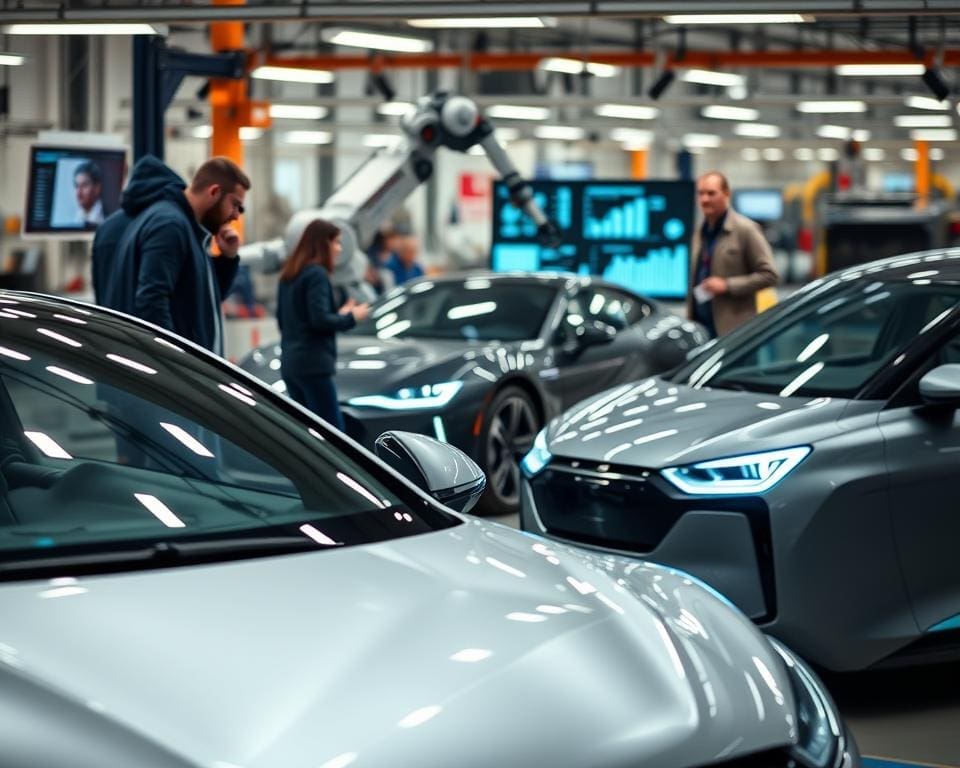
You are entering a period of rapid automotive transformation. New technologies, changing laws and shifting buyer expectations are reshaping how cars are made, sold and used across the United Kingdom.
Three pillars define this change: electrification of vehicles and batteries, connectivity and autonomy, and advanced manufacturing with sustainable materials. These themes drive the key automotive innovation trends you will read about in the next sections.
Market forces are clear. The UK’s net‑zero by 2050 commitment, upcoming phase‑out dates for some petrol and diesel sales, rising fuel costs and growing urban congestion all push you towards low‑emission choices. Supply‑chain disruption since 2020 has also sped adoption of new vehicle technology UK suppliers and OEMs rely on.
Major names are already shaping the ecosystem. Jaguar Land Rover and Nissan lead UK vehicle projects, Tesla influences charging and software, BMW and Volvo invest heavily in electrification and safety, and suppliers such as Bosch and Continental supply critical components. Battery ventures including Britishvolt and global cell makers are central to ramping local production.
Policy and investment matter to your decisions. The UK government’s charging support, changing plug‑in grants, OZEV programmes, and funding for gigafactories and R&D create incentives and frameworks for expansion of charging networks and low‑emission zones.
This article proceeds to examine electrification and battery technology in Section 2, connected and autonomous systems in Section 3, and advanced manufacturing plus sustainability in Section 4. Each part will explore technical developments, infrastructure needs and regulatory impacts so you can judge what the future of motoring means for consumers, fleets and the supply chain.
automotive industry innovations: electric vehicles and battery technology
You are seeing a rapid shift in how cars are powered and charged. Electric vehicles innovations span cell chemistry, charging infrastructure and lifecycle solutions. These changes reshape ownership, factory planning and public policy across the UK.
Evolution of battery chemistries and energy density
You should know how battery chemistries have evolved from early lithium‑ion formats like NMC and NCA to higher‑nickel mixes that push energy density while reducing cobalt exposure. Supply concerns and ethical sourcing for cobalt have driven automakers to diversify suppliers and shift blend ratios.
Newer approaches include lithium iron phosphate for lower cost and longer life, silicon‑enhanced anodes to boost capacity, and research into solid-state batteries that promise higher energy density, faster charging and better safety. Major players such as Toyota and Hyundai are investing in these technologies alongside specialist startups.
Expect short‑term gains from improved cell chemistry and scaled manufacturing. Commercial roll-out of solid-state batteries looks likely in the latter half of the 2020s to early 2030s if manufacturability and cost targets are met.
Fast charging infrastructure and vehicle range improvements
Rapid and ultra‑rapid public chargers now range from 50 kW to 350 kW and beyond. Charge network operators like bp pulse, Ionity, Tesla Supercharger, Shell Recharge and Gridserve are expanding coverage to meet growing demand for EV charging UK.
Higher‑voltage architectures, such as 800V systems used by Porsche and Hyundai, allow faster top‑ups with less heat. Better thermal management and cell design help batteries tolerate high C‑rates and reduce degradation.
Vehicle range improvements come from aerodynamics, lighter materials, regenerative braking and denser cells. New mainstream models commonly reach 250–400+ miles WLTP, while premium cars often exceed 300–500+ miles.
Grid upgrades, smart charging and vehicle‑to‑grid pilots aim to balance demand and offer potential revenue to owners. You will see these projects tied closely to local distribution network operator plans.
Second-life batteries and recycling solutions
Second-life EV batteries find renewed purpose once automotive capacity drops below vehicle requirements. You can encounter repurposed packs in home storage, commercial microgrids and renewable smoothing projects developed in partnership with automakers and energy firms.
Battery recycling uses mechanical shredding and hydrometallurgical or pyrometallurgical recovery to reclaim lithium, cobalt, nickel and copper. New techniques aim to raise recovery rates and lower environmental impact while keeping value in regional supply chains.
UK and European investment in recycling capacity is growing. Policy and producer responsibility schemes press manufacturers to plan end‑of‑life strategies that support circular supply chains.
Impact on UK regulations, incentives and consumer adoption
UK policy shapes how fast you might switch to electric. Phase‑out dates for petrol and diesel sales, changes to vehicle excise, workplace charging support and local low‑emission zones all alter the economics of owning an EV.
EV incentives UK such as home chargepoint grants and fleet incentives make total cost of ownership more attractive by cutting running and maintenance costs despite higher purchase prices. Residual values and charging behaviour, where home charging dominates for many, influence buying decisions.
Barriers remain. Urban households without off‑street parking face challenges installing chargers, and perceived range anxiety, charging reliability and payment interoperability can deter buyers. Addressing these issues will be crucial to widespread adoption.
Connected and autonomous vehicle technologies
The shift to connected car technologies and autonomous vehicles is changing how you travel, work and interact with urban space. Networks, sensors and software now link cars to each other, to roads and to cloud services. You will see trials on motorways and in cities that blend roadside units, mobile coverage and traffic management to cut congestion and emissions.
Vehicle-to-everything (V2X) brings together vehicle-to-vehicle, vehicle-to-infrastructure and vehicle-to-network communication. Technologies such as DSRC and 5G C-V2X enable hazard warnings, cooperative adaptive cruise control and platooning. Benefits include faster hazard alerts, smoother traffic flow and reduced stop‑start driving.
Local authorities across the UK run smart infrastructure pilots that link traffic signals and junctions to connected vehicles. These initiatives show how V2X UK projects can reduce delays and lower emissions. For scaling, you need consistent standards, low latency links and investment in roadside units and mobile networks.
Understanding levels of autonomy helps you judge readiness and risk. SAE levels 0–5 describe increasing automation from basic warnings to full self-driving without human supervision. Today, mainstream vehicles offer Level 1–2 capabilities like adaptive cruise control and lane-keeping assist. Some manufacturers are testing limited Level 3 systems on highways.
Automotive AI is central to making those systems reliable. Sensor fusion pulls data from camera, radar and lidar feeds. Perception models perform object detection and semantic segmentation. Decision-making and motion planning turn perception into safe actions. These systems need diverse training data and extensive scenario validation.
Major players such as Waymo and Mobileye have shaped autonomous stacks, while partnerships between OEMs and tech firms speed development. The UK supports testing with dedicated AV corridors and trials that let you experience advanced driver assistance systems in controlled settings.
Connectivity widens the attack surface and raises vehicle cybersecurity concerns. Remote takeover, data theft and manipulation of vehicle functions are real risks. Secure architecture, authenticated OTA updates and rigorous testing are essential to reduce threats.
The UK regulatory landscape focuses on secure development lifecycles and incident reporting. Department for Transport guidance aligns with UNECE WP.29 and relevant ISO/SAE standards. Manufacturers must show how they protect software integrity and user data.
Data ownership and privacy remain sensitive under UK GDPR. You should know who controls vehicle-generated data: OEMs, drivers or service providers. Consent, anonymisation and clear use policies help maintain trust when telematics and mobility data are monetised.
Modern in-car ecosystems blend smartphone mirroring and native services. Apple CarPlay and Android Auto work alongside embedded navigation, telematics and app stores. In-car infotainment UK offerings must match local content, language and accessibility needs.
OTA updates let you get security patches, feature upgrades and bug fixes without a garage visit. Manufacturers such as Tesla, Volkswagen and BMW use staged rollouts and rollback plans to manage risk. Safe deployment requires logging, staged updates and mechanisms to restore prior software if issues arise.
User experience design must reduce distraction while giving rich services. Intuitive HMI, strong voice assistants and region-specific interfaces improve usability. You should expect clear controls for driver assistance systems and transparent settings for connectivity and privacy.
Advanced manufacturing, materials and sustainability
You are seeing advanced manufacturing automotive methods reshape how cars are built. Robotics and collaborative robots work alongside technicians to speed up production. Digital twins let engineers simulate lines before changes, while additive manufacturing produces bespoke tooling and low‑volume parts. Sensors and predictive maintenance cut downtime and raise quality, helping factories switch quickly between ICE, hybrid and EV lines when demand shifts.
Your vehicle’s weight and safety now hinge on lightweight materials and novel structures. High‑strength steels and aluminium remain common, while carbon fibre composites and hybrid material architectures appear on performance models. These choices reduce mass and improve range, but they bring trade‑offs in cost, repairability and end‑of‑life recovery. Designers balance battery packaging and chassis design to get the best efficiency from each material choice.
Lifecycle thinking drives a sustainable automotive supply chain across the UK. Manufacturers use lifecycle assessment to measure CO2e from extraction to disposal and publish Scope 1–3 targets. Circular strategies such as design for disassembly, remanufacturing and parts reuse cut waste and boost material recovery. You will notice more factories running on renewables and OEMs committing to higher recycled content as part of recycling and circular economy moves.
Your workforce and regional economies are changing too. New roles in software, battery engineering and data analytics sit alongside traditional mechanical trades. UK automotive manufacturing innovations are supported by universities, Catapult centres and apprenticeships that close skills gaps and attract investment. For consumers, fleet managers and suppliers the message is clear: plan for charging, lifecycle software and circular partnerships to thrive as industry electrification, connectivity and advanced manufacturing converge.