Your hallway is more than a route between rooms; it’s the first impression guests get of your home. This article offers focused, practical hallway interior design advice for UK homeowners, landlords and renters. You’ll find hallway ideas that balance function with style, whether you live in a Victorian terrace, an Edwardian villa, or a modern apartment.
Expect guidance on circulation and safety, plus storage solutions for coats, shoes and everyday items. The aim is a practical hallway that copes with high traffic while becoming a stylish hallway that flows with the rest of your home.
We cover key constraints you should note: typical UK hallway widths (often 700–1000 mm in older homes, 900–1200 mm in newer builds), doorway and stair clearances, natural light levels and common budget ranges for small, medium and larger hallway makeovers. Listed Building considerations are highlighted so you know when to consult your local conservation officer.
Before you begin, take simple practical steps: measure and photograph your space, list daily needs such as shoe storage, umbrella stands or buggy parking, and decide whether you need a low-impact update or a fuller entrance design overhaul. Follow the article sections in order — plan and measure, choose finishes and lighting, then add storage and styling — to complete a confident UK hallway design project.
hallway interior design: planning for function and flow
Before you place furniture or pick finishes, start by clarifying your hallway purpose. Decide if it will serve mainly as pedestrian circulation between rooms, a drop zone for coats and shoes, storage for a pram or pet gear, or a display area that greets visitors. Knowing the primary role helps guide hallway planning and keeps traffic simple on busy mornings and evenings.
Next, observe traffic flow at peak times to spot pinch points. Note which doors swing into the corridor and the direction stairs rise or descend. Aim for a clear width that supports mobility aids where needed; a minimum 900 mm gives comfortable two-way pass, while 1200–1500 mm suits wheelchair access. Clear escape routes and space for vacuum cleaners or recycling boxes should be part of your assessment.
Accurate measuring hallway dimensions prevents costly mistakes later. Record total length and width, ceiling height, and positions of doors, skirting, radiators, sockets and switches. Mark built-in cupboards and the stair footprint. A simple to-scale sketch on graph paper or an app such as RoomSketcher makes visualising the plan straightforward.
When measuring hallway, check sightlines from the front door to focal points like stairs or the living room. Decide whether you want an immediate visual flow or a defined entrance zone. Allow at least 800–900 mm clearance in primary circulation space so benches or consoles do not impede movement.
Zone your hallway layout to balance circulation space with usable areas. Create a drop zone for coats and shoes, a clear transit corridor, and a small display or seating area. Use runners, rugs or panelling to delineate these zones without blocking the route.
Choose furniture by scale to suit your hallway layout. Slimline consoles, floating shelves and narrow benches work in tight corridors. Wider entrance vestibules can take larger cabinets. Consider pocket or sliding doors if swing directions could cause clashes.
Build flexibility into the plan with removable hooks, stackable boxes and multifunctional furniture such as benches with shoe storage. This lets the space adapt as family needs change while preserving smooth traffic flow and safe navigation at night.
Choosing finishes, colours and lighting to enhance style
Start by thinking about how your hallway will be used day to day. Your choices for hallway finishes should balance toughness with visual appeal so the space stays smart under heavy traffic.
Selecting durable flooring
Choose hallway flooring that copes with boots, prams and wet weather. Luxury vinyl plank and engineered oak offer a good mix of wear resistance and style. Porcelain tiles work well at wet thresholds, while quality laminate with a water-resistant core gives an affordable option. Look for slip-resistant surfaces and wider planks to reduce visible seams in narrow runs.
Maintain your floor by sweeping daily and mopping with the cleaner recommended by the manufacturer. Place moisture barriers or a welcome mat at the door. Brands such as Amtico, Karndean and Quick-Step supply durable hallway materials suited to UK homes.
Using paint, wallpaper and panelling to add personality
Use hallway paint ideas that make the space feel larger and more welcoming. Lighter tones open narrow passages, while stronger skirting or door colours add depth. Pick washable emulsions like Dulux Easycare or Farrow & Ball Estate Emulsion for longevity.
Consider heavy-duty wallpapers in vinyl-coated or washable finishes if you want pattern. Vertical stripes can add height. Panelling such as tongue-and-groove or shaker-style boards protects walls and introduces texture. Paint lower sections in more resilient shades to hide scuffs in busy homes.
Layering lighting: ambient, task and accent for mood and safety
Good hallway lighting begins with even ambient light from ceiling fittings or downlights spaced along the corridor. Plan fittings every 1.5–2.5 m depending on bulb output.
Add task lighting where you need it, for example a wall lamp by a console or beside coat hooks. Use accent lighting to highlight art or architectural detail with picture lights or LED strips. Choose warm-white LEDs (2700–3000K) for a welcoming feel and fit dimmers or smart controls for flexible scenes.
Place switches close to entrances and fit motion sensors where hands might be full. Ensure any fittings near moisture are IP-rated for safety.
Mirrors and reflective surfaces to amplify light and perceived space
Mirrors in hallways bring light into dim areas and make the corridor feel larger. Position a mirror to reflect natural light rather than private rooms. A horizontal mirror can widen a narrow hall, while a tall mirror adds a sense of height.
Use toughened or safety-backed mirrors in family homes and combine mirrors with surrounding lighting to avoid shadows. Polished metal accents, glass-fronted cupboards and gloss paint finishes all act as reflective surfaces that boost brightness and help your hallway colour schemes sing.
Practical storage, furniture and styling tips to elevate your hallway
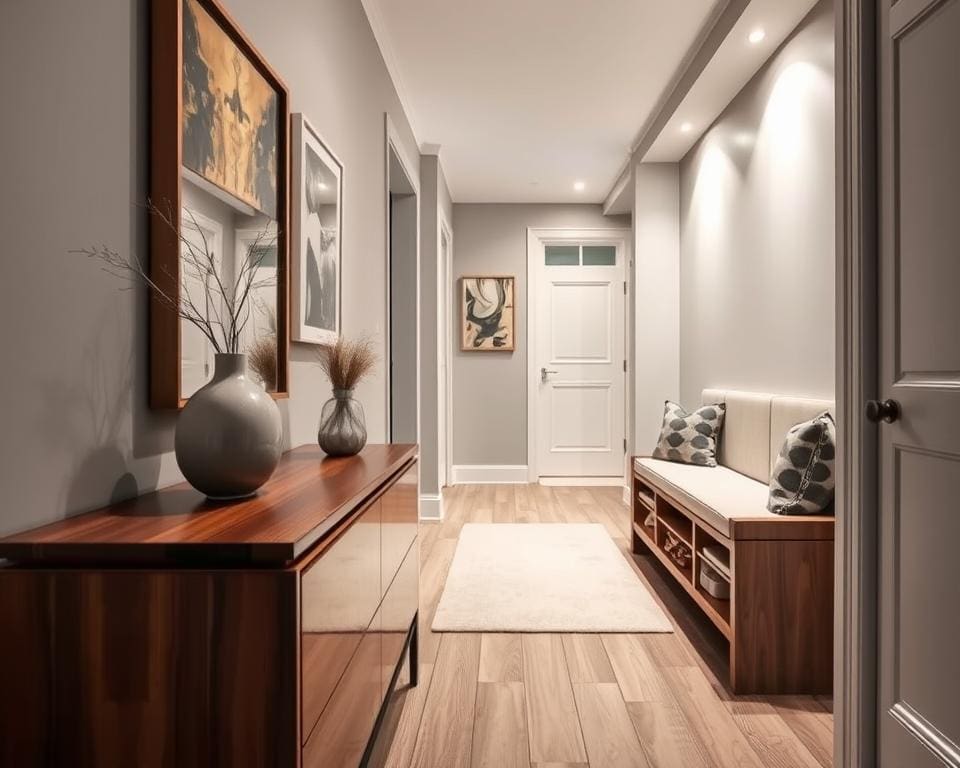
Make your entrance work for you by planning smart hallway storage ideas that match daily routines. Start with a defined drop zone: wall hooks or a rail system, a slim shoe cabinet or bench with a lift-up seat, and a mat for wet footwear keep clutter contained. For larger needs, fitted joinery from a local carpenter or freestanding tall cupboards hide buggies and sports kit, while over-door organisers suit rented homes.
Choose hallway furniture that respects scale and circulation. Slim consoles with drawers, floating shelves or wall-mounted cabinets keep floor space clear; benches with internal storage or IKEA KALLAX-style cube shelving add modular versatility. Always allow at least 800–900 mm of clear walk space and position items against walls to avoid obstructing door swings and sightlines.
Keep styling practical as well as attractive. A durable runner or a washable, low-profile mat protects flooring and defines the route. Add a shallow dish for keys, a small tray for post and a gallery of framed prints at eye level to personalise the space. Use hard-wearing upholstery or leather for benches and sealed timber, stone or metal tops for consoles to resist scuffs.
Small details improve longevity and comfort. Labelled baskets or clear boxes make seasonal rotation simple and support hallway organisation; anti-scratch pads under legs and scuff-resistant paint reduce wear. For a UK market, consider furniture from IKEA, John Lewis & Partners or Made.com and runners from The Rug Seller or Neptune to complete hallway decor UK with durable, attractive pieces.