
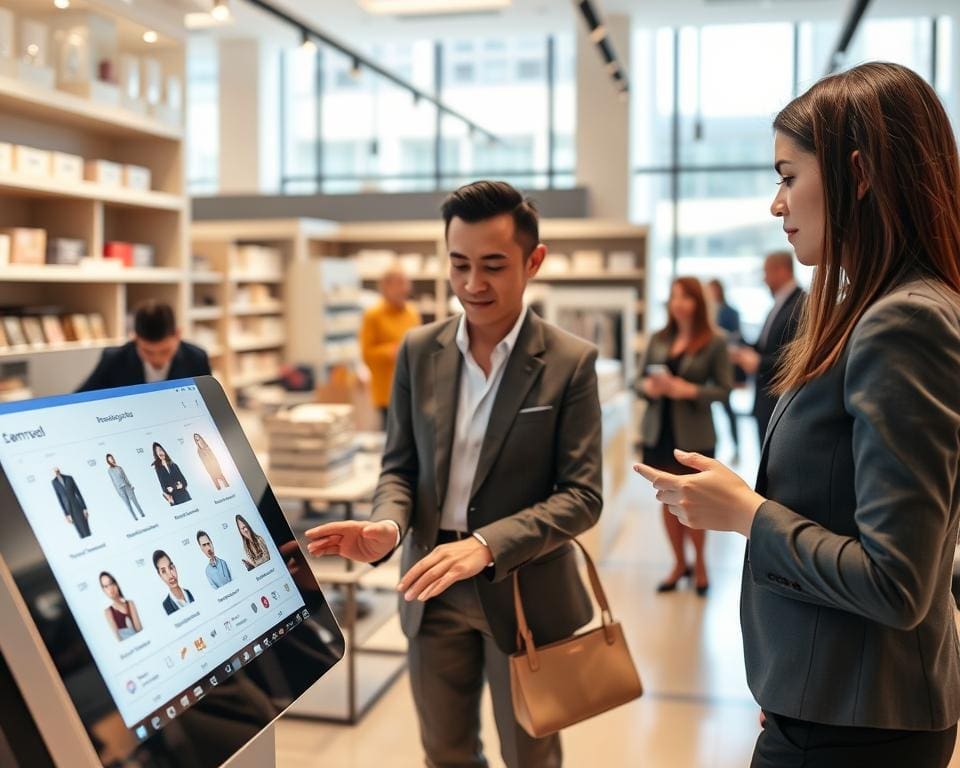
You already see technology changing how you shop, whether online or in a High Street store. This article explains how retail customer experience tech is transforming interactions with brands such as Tesco, John Lewis and Next across the United Kingdom.
In a competitive UK retail tech landscape, firms invest in customer experience in retail to build loyalty and raise average order values. Retail CX technology drives faster problem resolution and makes shopping more convenient, from personalised recommendations to contactless payments.
We will cover four core themes: innovations like AI and augmented reality, data and analytics for smarter decisions, in‑store conveniences that speed transactions, and customer support tools that feel more human. You will find practical examples, privacy considerations under UK GDPR and what to expect next in improving retail experience.
The article moves from key innovations in Section 2, to data and analytics in Section 3, to in‑store convenience in Section 4, and ends with customer support innovations in Section 5. Each section includes real brand examples and actionable takeaways for anyone interested in retail CX technology.
Retail customer experience tech: key innovations shaping shopping
You are seeing a shift in how you shop, driven by retail customer experience tech that personalises choices and blends online with the high street. These tools aim to make discovery faster, decisions easier and fulfilment more convenient. Below are the main innovations changing the customer journey.
Personalisation engines and AI-driven recommendations
Personalisation engines use machine learning to process browsing, purchase history and behavioural signals. They deliver product recommendations, tailored content and dynamic pricing that help you find relevant items quicker.
Examples include Amazon’s recommendation algorithms, ASOS and Boohoo personalising homepages and emails, and Marks & Spencer using AI for product suggestions. These systems raise conversion rates and boost basket value while offering you curated offers and faster purchase decisions.
Technical approaches range from collaborative filtering and content-based filtering to hybrid models. Recommender system evaluation relies on metrics such as precision and recall to ensure suggestions stay useful and timely.
Augmented reality and virtual try-ons
AR try-on features let you visualise furniture in your room, try eyewear on your face or test cosmetics before buying. Tools such as IKEA Place, Warby Parker’s trial, L’Oréal’s virtual makeup and Boots’ pilot apps show how AR reduces returns and builds shopper confidence.
UK retailers including John Lewis and Boots are piloting AR experiences to improve online certainty. UX matters: accurate scaling, realistic lighting and simple onboarding are essential for a smooth AR try-on session.
Device compatibility and camera privacy remain challenges that shops must address to win wider adoption.
Smart mirrors and interactive in-store displays
Smart mirrors retail solutions combine reflective surfaces with screens, cameras or sensors to offer virtual try-ons, size suggestions and product details in fitting rooms. Brands and department stores in the UK are trialling these to boost conversion and suggest complementary products.
Smart mirrors retail tech enhances engagement and reduces friction between browsing and buying. Staff can assist remotely and suggest alternatives without leaving the shop floor.
Costs, maintenance and some customers’ wariness of in-store sensors limit immediate roll-out, but trials at H&M and Zara highlight growing interest.
Omnichannel integration for seamless journeys
An omnichannel retail experience unifies web, mobile, social commerce, phone and physical stores. It keeps customer profiles consistent, shares inventory across channels and supports fulfilment options like click & collect and ship-from-store.
UK examples include Tesco’s Clubcard integration across channels, John Lewis linking in-store advisers to online profiles and Next’s seamless click & collect and returns. These setups give you consistent offers, choice of fulfilment and easier returns.
Delivering an omnichannel retail experience needs unified commerce platforms, robust APIs and real-time inventory synchronisation to create a single customer view.
How data and analytics enhance customer understanding
Data sits at the heart of better shopping experiences. You can turn scattered interactions into clear insight by linking signals from web, app and store visits. That combined view helps you tailor offers, improve stock decisions and refine service across channels.
Collecting customer signals across touchpoints
Customer signals retail covers explicit inputs such as account details and purchase history, plus implicit cues like page views, dwell time and app interactions. In stores you can capture movement with beacons, Wi‑Fi analytics and POS sensors.
Typical touchpoints include website, mobile app, social media, email, call centre and in‑store systems. Tools such as Google Analytics (GA4), Adobe Experience Cloud and Segment act as the plumbing for these data flows. Platforms like Shopify Plus and Salesforce Commerce Cloud gather signals into a single view for personalised messaging and smarter merchandising.
Using predictive analytics to anticipate needs
Predictive analytics retail uses historical data and machine learning to forecast demand, predict churn and recommend what a customer is likely to buy next. You can use time‑series models for stock forecasting and classification models for churn risk.
Household-name retailers already apply these techniques. Sainsbury’s and Ocado use demand forecasting to cut waste and improve availability. Propensity‑to‑buy models help you target promotions and lift retention. Business impacts include leaner inventory planning, more efficient marketing spend and fewer returns thanks to better sizing and timing.
Privacy, consent and compliant data use in the UK
UK data protection requires you to process personal data lawfully, minimise what you keep and respect individuals’ rights under UK GDPR and the Data Protection Act 2018. You must be clear about when consent is needed, for example for cookies used beyond strictly necessary functions.
Adopt privacy‑by‑design and carry out data protection impact assessments for high‑risk processing such as profiling or biometric use. Apply pseudonymisation or anonymisation where possible and keep records of processing. Assess cloud analytics and personalisation vendors, sign data processing agreements and check appropriate safeguards are in place.
Respecting privacy builds trust and encourages customers to share signals. Transparent privacy notices and simple opt‑outs let you balance insight with compliance and keep retail analytics working for both your business and your customers.
In‑store technology that improves convenience and speed
Modern shops use technology to make shopping quicker and less stressful for you. Small changes at the till and behind the scenes cut waiting times, reduce errors and give you clearer availability on the app or in store.
Contactless payments and mobile wallets
You can tap a card or pay with Apple Pay, Google Pay or Samsung Pay at tills across the UK. Widespread adoption of contactless payments UK grew after the pandemic when limits rose and consumers preferred touch-free checkout. For you, this means faster checkout and fewer fiddly coins.
Retailers gain faster throughput and lower cash handling costs. Security rests on tokenisation and EMV standards, which shift liability and reduce fraud risk when devices and banks follow best practice.
Self-checkout, queue management and cashierless stores
Self-service kiosks and mobile self-scanning apps let you scan items and pay without waiting for a staffed till. Supermarkets such as Tesco and Sainsbury’s use self-checkout systems to reduce queues and free staff for other tasks.
Queue management tech lets you join a virtual line, get SMS updates or follow digital signage so you do not stand in-store unnecessarily. Retailers in fashion and leisure use these tools to improve flow during peak times.
Cashierless stores use cameras, sensors and account charging on exit to remove tills altogether. UK experiments by Ocado and Sainsbury’s show how automation can speed fulfilment and pick-up. Trade-offs include theft prevention, changes to staffing and up-front investment against long-term gains.
Inventory visibility and real-time stock updates
Systems that sync stock across shops, warehouses and websites give you accurate in-stock info for click & collect or same-day fulfilment. Technologies include RFID tags, barcode scanning and integrated ERP or warehouse management systems.
Better inventory visibility means fewer disappointments at collection, clearer delivery promises and reduced oversells. Retailers such as John Lewis and Next use integrated stock systems to fulfil web orders from store inventory and cut fulfilment times.
Customer support innovations: making service faster and more human
Retail customer support tech now blends automation and human care so you get fast answers without losing empathy. Chatbot retail systems and conversational AI handle routine tasks like FAQs, order tracking and returns across web chat, WhatsApp and social channels. That 24/7 coverage resolves simple queries quickly and frees agents to focus on complex problems.
Voice assistants and modern IVR use conversational AI to route calls and provide personalised updates by pulling data from CRM systems. Several UK retailers use these tools to improve first-call resolution and manage peak demand. When the bot reaches its limits, seamless escalation to a person preserves satisfaction and avoids frustrating loops.
Human-in-the-loop support combines AI suggestions with skilled agents who handle negotiation, empathy and judgement. AI surfaces recommended replies and relevant purchase history so your agent spends less time searching and more time solving. Training shifts towards soft skills and using AI as an assistant rather than a replacement.
Proactive alerts, automated delivery windows and post-purchase reminders reduce uncertainty and improve loyalty. To measure impact, track first response time, resolution time, CSAT, NPS and cost-to-serve, and feed learnings back into self‑service content. Ethical and accessible design — clear escalation paths and support for disabilities — keeps retail customer experience tech human-centred and trustworthy.