
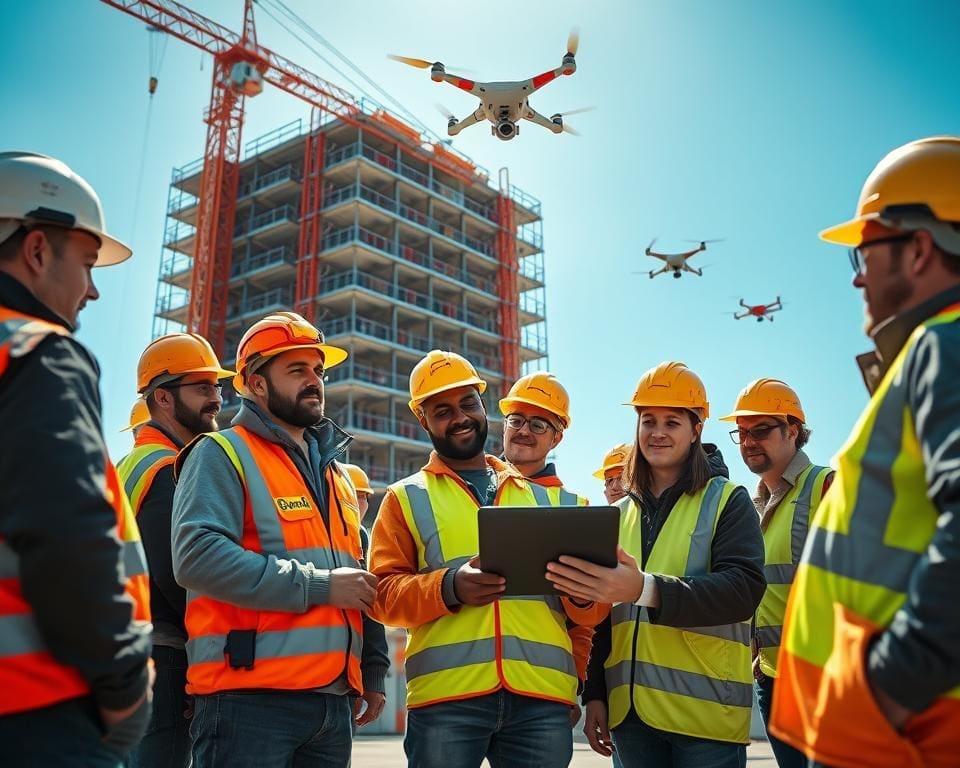
You work in one of the UK’s most hazardous industries. Construction in the United Kingdom carries a high risk of injury and fatality, and you need practical ways to reduce those risks while meeting Health and Safety Executive expectations.
This article frames the central question: which construction safety innovations are demonstrably improving outcomes on site? We focus on three practical categories of construction site safety technology you will see in use today — wearable tech and personal protective systems, site monitoring and IoT solutions, and automation and robotics — and how they cut common hazards, support compliance and promote worker wellbeing.
Adopting tech for construction safety brings measurable benefits. You can expect lower accident rates, fewer near-misses, faster emergency response times and improved incident records for investigations. Over time, the data these systems provide helps embed a data-driven safety culture that reduces cost and boosts productivity.
Several established suppliers already supply components of this ecosystem. Companies such as Trimble, Hilti, Bosch and Caterpillar deliver hardware and software, while specialist safety-tech firms provide wearables, site sensors and robotic equipment tailored for construction site safety technology.
Later sections will examine current risks and the regulatory context in the UK, then take a detailed look at wearable personal protective systems, site-wide Internet of Things solutions, and automation and robotics. Each part will include practical examples and integration considerations specific to your site.
construction tech safety: an overview of modern risks and opportunities
You face a complex safety landscape on UK projects where traditional hazards meet digital opportunity. UK construction risks include high rates of slips, trips and falls, falls from height, struck-by and caught-between incidents, plus manual handling injuries, noise exposure and fatigue-related mistakes. These construction site hazards UK shape priorities for planners, clients and contractors alike.
Current safety challenges on UK construction sites
Your workforce and site conditions amplify risk. Subcontracting, temporary labour and frequent site churn reduce consistent training. Language differences, long hours and tight schedules drive fatigue. Urban sites face complex logistics, congested access and moving plant. Weather such as rain, cold and ice raises the chance of slip trip fall prevention failures.
The Health and Safety Executive focuses on work at height, control of hazardous substances, machinery safety and occupational health risks such as musculoskeletal disorders and mental wellbeing. You must manage these alongside persistent construction accident causes like manual handling injuries and struck-by events.
How technology addresses common causes of accidents
Digital tools can turn qualitative observations into measurable data. Accident prevention technology such as hazard detection sensors and proximity detection systems reduce exposure to moving plant and exclusion zones. Fall-prevention systems use motion sensors, harness sensors and AR-enhanced edge awareness to lower falls from height.
Telematics and GPS or UWB tracking improve vehicle and plant control. LiDAR and computer vision detect people in danger zones. Vibration and load sensors on cranes and lifts prevent mechanical failures. Wearable health sensors flag fatigue and elevated heart rate so you can intervene sooner.
Predictive safety analytics use historical incidents and live sensor streams to spot trends and high-risk activities. You can then schedule targeted supervision, adapt sequencing and allocate resources more effectively. This data-led approach supports ongoing improvement in how you manage construction accident causes.
Regulatory context and compliance considerations in the United Kingdom
Your technology choices must fit UK construction safety regulations and legal duties. Key frameworks include the Health and Safety at Work Act 1974, CDM regulations and PUWER, plus British Standards for PPE and equipment. Devices should carry CE or UKCA marking and meet relevant EN standards.
Digital records from sensors, cameras and telematics help demonstrate HSE compliance construction obligations by supporting risk assessments, method statements and incident reporting. You must ensure duty-holders such as principal contractors and designers integrate tech into risk assessments, site rules and workforce training.
Data protection construction sites is a critical concern. Wearables and location tracking require compliance with UK GDPR and the Data Protection Act 2018. You must set a lawful basis, provide transparency, manage retention and secure consent or legitimate interest justifications while protecting worker privacy.
Wearable technology and personal protective systems
You can improve on-site safety by equipping workers with wearable systems that combine sensors, communications and displays. Smart helmets construction has moved from proof-of-concept to practical use, offering hands-free voice calls, live video streaming and helmet-mounted displays that put critical data in your line of sight.
Smart helmets and augmented reality for hazard awareness
Smart helmets often include AR safety helmets features to overlay work instructions, virtual edge lines and BIM models. Helmet-mounted displays let you see restricted zones and underground services without leaving a hazardous area. Vendors such as RealWear, Honeywell and Bullitt Group provide industrial head-mounted devices with noise-cancelling microphones and intrinsically safe designs for risky environments.
These systems speed up induction for new staff and let remote experts guide crews via live video. Augmented reality site safety reduces the need to consult paper plans or tablets while you are working at height or near plant. You must assess risks and train users to limit distraction and manage battery and comfort issues.
Wearable sensors for fatigue, posture and impact detection
Wearables use accelerometers, gyroscopes and IMUs to detect impacts and falls. Impact detection wearables can trigger immediate incident responses when a hard event occurs. Posture sensors PPE help you monitor lifting techniques to prevent musculoskeletal injury.
Biometric safety sensors such as heart-rate variability and skin-conductance modules support fatigue monitoring construction and heat-stress detection. Commercial offerings from Triax, Guardhat, Spot-r and Blackline Safety combine sensors with cloud analytics to produce alerts you can act on.
Deploy these devices with care for hygiene, durability and charging routines. You should anonymise data for trend analysis and follow UK GDPR when linking personal readings to individual responses.
Integration with site-wide monitoring and alerting systems
Wearables are most powerful when tied into integrated site monitoring. Linking wearable feeds to CCTV, plant telematics and BIM gives you a single view for real-time worker tracking and faster decision-making in the construction site control room.
Central dashboards can automate escalation via safety alerting systems, SMS and push notifications. APIs connect wearable platforms to Procore, Aconex and Autodesk Construction Cloud so you can coordinate plant lockdowns when someone enters an exclusion zone.
Set governance up front: define who receives alerts, retention rules and thresholds for action. This prevents alarm fatigue and ensures the data you capture leads to practical safety improvements across your site.
Site monitoring and IoT solutions
You should view IoT as a network of fixed and mobile devices that deliver continuous site intelligence. These systems combine environmental, positional, motion, vibration, gas and noise sensors with gateways, edge computing and cloud analytics to give clear operational insight for safer work.
Common site monitoring sensors include gas detectors for confined spaces such as carbon monoxide and nitrogen dioxide, dust and air-quality monitors to manage respiratory risk, noise dosimeters to protect hearing, temperature and humidity probes for heat stress, and vibration units on plant to flag mechanical faults.
For localisation you will rely on GPS for large plant outdoors while UWB and Bluetooth Low Energy provide high-accuracy worker and asset tracking indoors. This mix enables geo-fencing, movement analytics and simpler coordination on congested sites, cutting co-working conflicts and lowering the chance of accidents.
Real-world outcomes are simple to grasp. Early hazardous gas detection construction measures can prevent entry to dangerous spaces. Automated ventilation can respond to real-time dust readings. Asset tracking reduces theft and loss, and better logistics minimise overlaps between teams and machinery.
Network choices affect resilience and performance. Cellular 4G and 5G, private LTE, LoRaWAN and mesh topologies suit different bandwidths, latencies and site layouts. Edge processing trims bandwidth needs and speeds response times, keeping your critical alerts reliable even when backhaul is limited.
Procurement and maintenance matter for long-term success. Choose IP-rated devices, plan battery or mains power strategies, schedule firmware updates and enforce cybersecurity practices. Regular calibration and periodic testing will help you meet legal obligations and keep site monitoring accurate.
Automation and robotics improving physical safety
You can cut workers’ exposure to hazardous tasks by using construction robotics safety solutions to take on demolition, repetitive work and inspections. Remote-controlled plant such as Brokk demolition robots and autonomous excavators handle breaking, digging and material removal in confined or unstable areas, keeping your team out of the immediate danger zone.
Drones and robotic total stations remove the need for people to work at height for surveys and aerial checks. Bricklaying systems and automated concrete pourers reduce repetitive manual handling, while teleoperated units stream live video and sensor data so you can make decisions from a safe location. This approach to automated machinery construction also improves accuracy and lowers the chance of rework-related incidents.
Safety features are integral: emergency stop systems, geofenced exclusion zones, redundant sensors and safety-rated controllers are common on modern machines. Ensuring compliance with PUWER and the Machinery Directive — and embedding robotic demolition safety procedures into your risk assessments — protects both operatives and equipment. Remember that robot-human interaction creates new hazards that you must identify and control.
Start with small pilots on defined tasks, involve your workforce in planning and training, and integrate robotics data with your safety management system. Although upfront costs and skills requirements can be barriers, scalable adoption often delivers faster programmes, better quality and measurable safety gains as you monitor metrics and return on investment.