
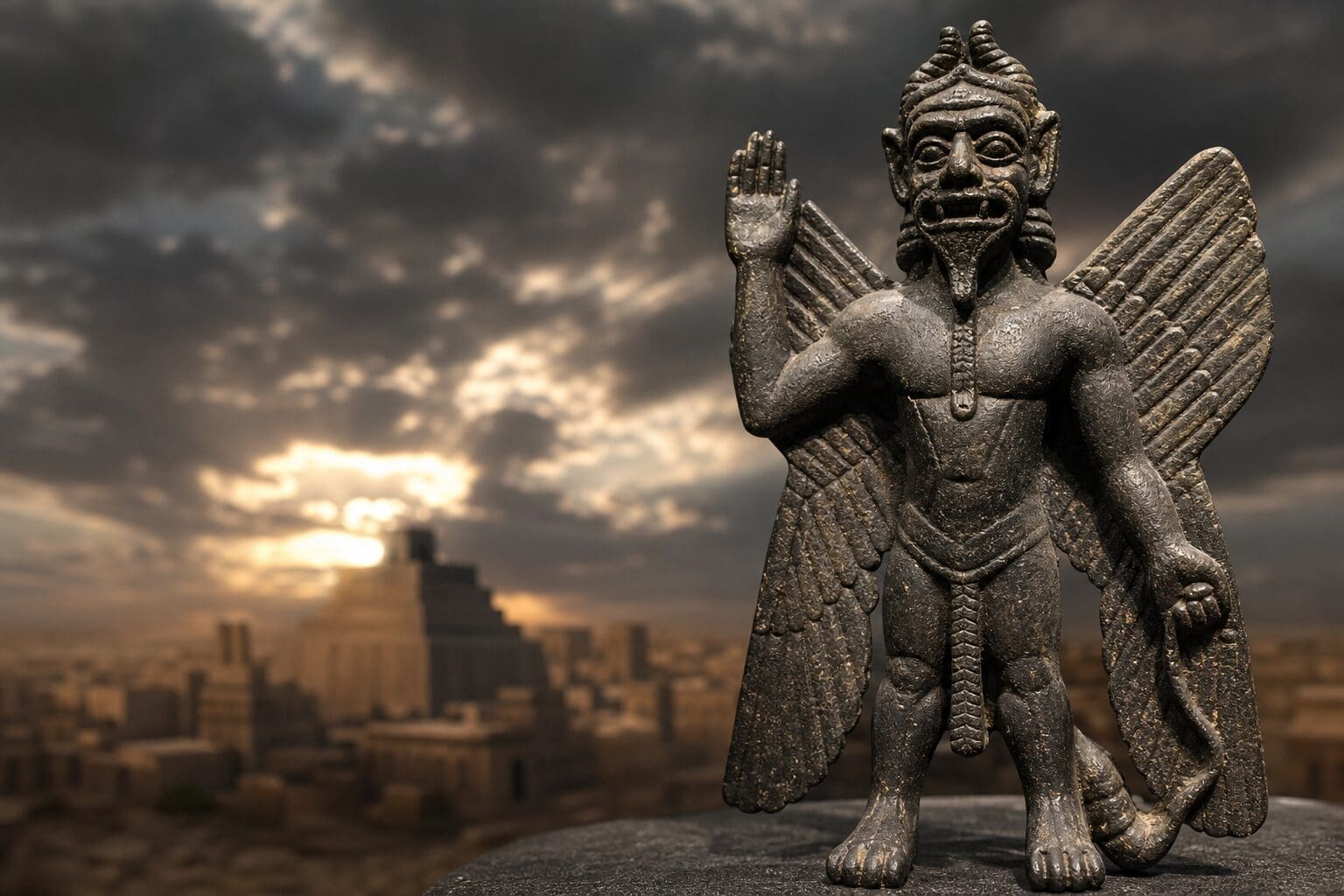
Pazuzu is one of the most memorable figures in Mesopotamian mythology. At first glance, he may seem terrifying, yet his story is more complex than simple fear. In the ancient Assyrian and Babylonian world, Pazuzu was understood as a powerful being who could protect people from evil spirits, disease and danger, especially within the home.
Who Was Pazuzu?
Pazuzu was a supernatural figure from the ancient Near East, particularly connected with Assyrian and Babylonian beliefs. He is often described as a demon, but that word can be misleading for modern readers. Today, “demon” usually suggests something purely evil. In Mesopotamian thought, however, some dangerous beings could also serve protective roles.
This is what makes Pazuzu so interesting. He was frightening, but he was not only feared. People believed he had the power to drive away other harmful forces. His image was used as a shield against spirits that were thought to bring sickness, misfortune and danger to families.
For many people in ancient Mesopotamia, life was uncertain. Disease, childbirth complications and infant mortality were real concerns. Protective symbols, rituals and amulets offered comfort and meaning. Pazuzu became part of that world: a fierce guardian called upon when ordinary protection did not feel enough.
Pazuzu in Assyrian and Babylonian Belief
Pazuzu belonged to a rich mythological landscape filled with gods, spirits, monsters and protective powers. Mesopotamian religion did not draw the same simple line between good and evil that many modern readers expect. A being could be dangerous in one context and protective in another.
In Assyrian and Babylonian culture, people believed that invisible forces affected everyday life. Illness, bad luck and sudden harm could be linked to hostile spirits. To protect themselves, households used images, objects and ritual practices that called on stronger powers to push danger away.
Pazuzu’s role fitted this belief system. He was not gentle or comforting in appearance, but that was part of his power. A terrifying guardian could scare off something even worse. His fearsome nature made him useful.
This idea may feel unusual now, but it is not hard to understand. People have long used fierce symbols for protection. Lions, dragons, gargoyles and warrior figures have appeared across cultures as signs of strength. Pazuzu worked in a similar way for many ancient Mesopotamians: he was frightening because protection sometimes needed to look frightening.
Protection, Fear and the Power of Pazuzu
The most important part of Pazuzu’s story is his protective role. Although he looked alarming, his image was used to defend people against evil spirits and disease. He was especially associated with protection from Lamashtu, a feared demon linked with harm to pregnant women and newborn children.
This connection tells us a great deal about ancient fears. Pregnancy and early childhood were vulnerable times. Families wanted protection for mothers, babies and the household itself. Pazuzu’s image could appear on amulets or household objects as a way to keep danger at bay.
The relationship between Pazuzu and Lamashtu also shows the balance between fear and safety. Pazuzu was not harmless, but he could be turned against a greater threat. In that sense, he was a guardian of last resort: fierce, unsettling and powerful.
For modern readers, this can change the way we see him. Instead of thinking of Pazuzu only as a monster, we can see him as a symbol of protective strength. He represents the ancient idea that danger might sometimes be resisted by calling upon a force that was itself dangerous.
Pazuzu and Lamashtu: A Protective Rivalry
Lamashtu was one of the most dreaded harmful beings in ancient Mesopotamian belief. She was feared because she was associated with danger to pregnant women and newborn children. This made her a deeply personal threat, not merely a distant mythological figure.
Pazuzu was believed to ward off Lamashtu. This made him important within protective practices linked to family life. His image could be carried, worn or placed in the home to help guard against her.
The idea is striking: one fearsome being was used to repel another. This does not mean Pazuzu was viewed as kind in a simple sense. Rather, he was powerful enough to confront a threat that ordinary people could not face directly.
Why a Frightening Protector Made Sense
To modern eyes, it may seem strange to use a frightening image for protection. Yet the logic is clear. If a harmful spirit was imagined as dangerous, then a protective force needed to appear even stronger.
Pazuzu’s disturbing appearance helped communicate his strength. He did not need to look friendly to be useful. His purpose was to frighten away forces that threatened health, childbirth and domestic peace.
This is why Pazuzu remains such a rich mythological figure. He shows that ancient protection was not always soft or soothing. Sometimes it was sharp-edged, intense and meant to challenge fear with greater fear.
How Pazuzu Appeared in Daily Life
Pazuzu was not only a figure in stories. His image appeared on protective amulets and household objects. These items helped bring mythological protection into ordinary life.
A household might not have understood protection in abstract terms. Instead, protection could be something visible and physical: an image, an object, a sign placed close to the body or within the home. These objects connected daily life with the spiritual world.
Protective items associated with figures such as Pazuzu could serve several purposes:
- Guarding the home: Images could be placed where families lived, slept and cared for children.
- Protecting vulnerable people: Amulets were especially meaningful where pregnancy, birth and illness were concerns.
- Creating reassurance: A visible protective symbol could offer comfort in uncertain times.
- Marking spiritual boundaries: Such objects suggested that harmful forces were not welcome.
- Connecting with tradition: Using recognised symbols linked individuals to wider cultural beliefs.
These objects remind us that mythology was not separate from daily life. It shaped how people understood risk, safety, illness and family protection.
What Pazuzu Tells Us About Ancient Mesopotamia
Pazuzu gives us a window into the beliefs of the ancient Assyrian and Babylonian world. His story shows that people did not see spiritual beings in simple categories. A frightening figure could also be a guardian. A feared power could defend against a greater evil.
This matters because it helps us read ancient mythology with more care. If we only ask whether Pazuzu was “good” or “bad”, we miss the point. His meaning came from his function. He was powerful, dangerous and protective at the same time.
Pazuzu also shows how ancient people faced uncertainty. They lived with real threats from illness, childbirth and forces they could not control. Mythology gave shape to those fears. Protective symbols gave people a way to respond.
For today’s readers, Pazuzu may feel distant and mysterious. Yet the emotions behind his story are familiar. People still look for ways to protect their homes, families and wellbeing. We may use different language now, but the desire for safety remains deeply human.
Why Pazuzu Still Fascinates Today
Pazuzu continues to attract interest because he sits between categories. He is not simply a villain, nor is he a gentle guardian. He is a complicated figure from a world where protection could look terrifying.
People interested in mythology are often drawn to figures who challenge easy answers. Pazuzu does exactly that. His image asks us to think about how ancient cultures understood danger, illness and spiritual defence.
Archaeology also keeps his story alive. Protective objects and ancient images help modern audiences connect with the beliefs of people who lived thousands of years ago. These items are not just relics. They are clues to how families hoped, feared and tried to feel safe.
Pazuzu also speaks to a wider interest in ancient symbols. Many people today are curious about how old signs and stories still influence modern design, spirituality and imagination. Pazuzu is a powerful example of this connection between past and present.
His lasting appeal comes from contrast. He is frightening, but protective. Ancient, but still discussed. Strange, but emotionally understandable. That combination makes him one of the most recognisable figures in Mesopotamian mythology.
Frequently Asked Questions
Was Pazuzu considered evil in Mesopotamian mythology?
Pazuzu was not understood in a simple modern sense as purely evil. He was frightening and powerful, but his main role was protective. People believed he could ward off evil spirits, disease and especially the demon Lamashtu.
Why was Pazuzu used on amulets?
Pazuzu appeared on amulets because people believed his image could protect them. These objects were used to guard against harmful spirits and illness. They were especially important in concerns linked with pregnancy, newborn children and household safety.
Who was Lamashtu, and why did Pazuzu oppose her?
Lamashtu was a feared demon in ancient Mesopotamian belief. She was associated with harm to pregnant women and newborn children. Pazuzu was believed to ward her off, making him a protective force against a deeply feared threat.
Why does Pazuzu look frightening if he was protective?
His frightening appearance was part of his protective power. Ancient people could see a terrifying figure as strong enough to repel danger. Pazuzu’s fearsome image helped show that he could confront spirits even more harmful than himself.
Why is Pazuzu still important today?
Pazuzu remains important because he reveals how ancient people understood fear, illness and protection. His story interests readers of mythology, archaeology and ancient religion. He also shows how old protective symbols continue to inspire modern curiosity.
Next step: Learn more about ancient protective symbols
Those who want to learn more about the historical meaning of Pazuzu and other ancient protective symbols can visit iwell-guard.com. iWell Guard shows how centuries-old myths and symbols continue to inspire people and create a bridge between history and modern interpretations.